
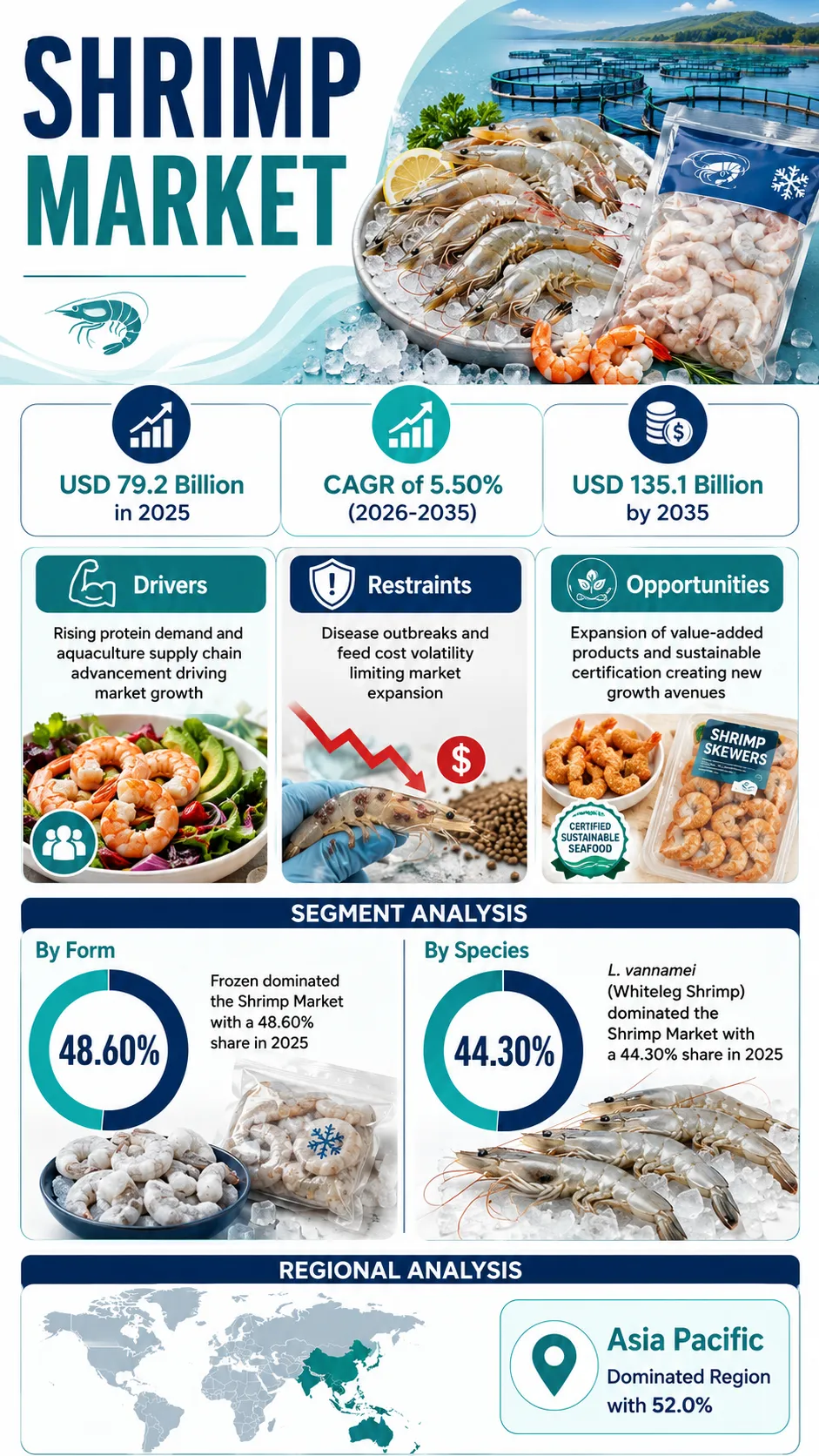
The global Shrimp Market is set for significant expansion as protein demand and aquaculture supply chain advancement continue to reshape global seafood trade worldwide. “According to a recent study by SNS Insider, the global Shrimp Market size valued at USD 79.2 billion in 2025, is anticipated to grow to USD 135.1 billion by 2035, registering a CAGR of 5.50% over the 2026–2035 forecast period.”
There have been tremendous changes within aquaculture production technology over time, due to which many producers who aim at improving yield and sustainability can take advantage of this trend. This includes the need for more efficient, environmentally responsible farming techniques that will provide producers with the ability to scale production while maintaining biosecurity and traceability standards. This applies in situations where shrimp supports retail, foodservice, and export market applications across farmed and wild-caught supply chains. Producers are constantly working hard to ensure that their aquaculture operations perform better than before in order to meet various consumer and regulatory sustainability requirements.
To Get Detailed Insights on the Shrimp Market – Request a Sample Report
Sustainable Aquaculture Creates New Demand
Shrimp have developed from a natural resource to a sustainable protein with traceability. The investments made by farmers in terms of developing sustainable farming practices, development of disease-resistant species, and value-added processing of shrimps have necessitated more sustainable and efficient farming practices for shrimp.
Farming and processing technologies have the ability to increase production efficiency, create environmental credentials, and enable diversification into various product formats in retail and food service. This helps them meet the rising demand for proteins globally as well as satisfy the consumers' requirements for environmental credentials.
Shrimp producers, processors, and export logistics providers are increasingly cooperating thanks to the growing interest in developing future solutions for traceable, sustainably certified shrimp supply chains.
Key Market Findings Highlight High-Growth Segments
The L. vannamei segment dominated all categories in the shrimp market share with a market revenue share of 44.30% in 2025 due to its fast growth rate and adaptability to varied farming conditions. The fastest growing category is expected to be P. monodon which will grow at a CAGR of 6.80% through 2035, owing to growing consumer preference for premium, larger-sized shrimp varieties.
By source, farmed and aquacultured shrimp held a dominant 64.80% volume share due to large-scale imports from major cost-competitive producing nations. Certified sustainable and organic farmed shrimp will see the fastest growth in revenue generation at a CAGR of 8.90%, driven by growing consumer demand for eco-certified products.
Based on form, frozen shrimp generated the largest share of market revenue thanks to its essential role enabling long-distance international trade. On the other hand, prepared and value-added shrimp will be the segment recording the fastest revenue growth at a CAGR of 7.40%, supported by increasing popularity of ready-to-cook formats.
Distributive channel trends are changing as well. Supermarkets and hypermarkets accounted for the largest revenue share owing to broad product assortment and competitive pricing. But foodservice and HoReCa will turn out to be the fastest-growing distribution channel through 2035, on the back of growing restaurant and quick-service demand for shrimp menu items.
Sustainability, Traceability, and Convenience Gain Importance
In this regard, producers and distributors have been looking at shrimp supply chains that would deliver more consistent quality while requiring greater sustainability certification and supply chain traceability.
Innovation in sustainable aquaculture practices, disease-resistant breeding, and value-added processing technology has been making it possible for companies to come up with products that appeal to increasingly health-conscious and environmentally aware consumers. In addition to that, increasing emphasis on contract farming and supportive government policies is also making it possible for producers to find solutions that support consistent, scalable production growth. Such trends are likely to become even more prominent in the future.
Asia Pacific Emerges as the Largest Market with 52.0% Regional Revenue Share Amid Rising Aquaculture Production
Asia Pacific accounted for the biggest share of regional market revenue at 52.0% in 2025 due to high aquaculture and export capabilities in the key shrimp-producing countries in the region. Conversely, North America is projected to become the fastest growing market through 2035 on account of the sustained popularity of shrimp as the most popular seafood in the US.
Leading Companies Drive Innovation and Competition
The environment continues to stay very dynamic since players continue innovating on sustainable aquaculture and value-added processing as well as forming partnerships in order to enhance their position in the industry. Some of the major companies that operate in the global shrimp market are Thai Union Group, Minh Phu Seafood Corporation, Zhanjiang Guolian Aquatic Products, Santa Priscila, Pescanova, Charoen Pokphand Foods, Avanti Feeds, Surapon Foods, Nordic Seafoods, and Clearwater Seafoods.
An SNS Insider analyst Parry Kardani commented, "The growing global demand for sustainable, traceable protein sources is creating sustained opportunities across farmed and wild-caught shrimp supply chains. Producers that successfully combine aquaculture innovation, sustainability certification, and value-added processing will be best positioned to capitalize on emerging opportunities across retail, foodservice, and export market segments."
About the Author

Get in touch




