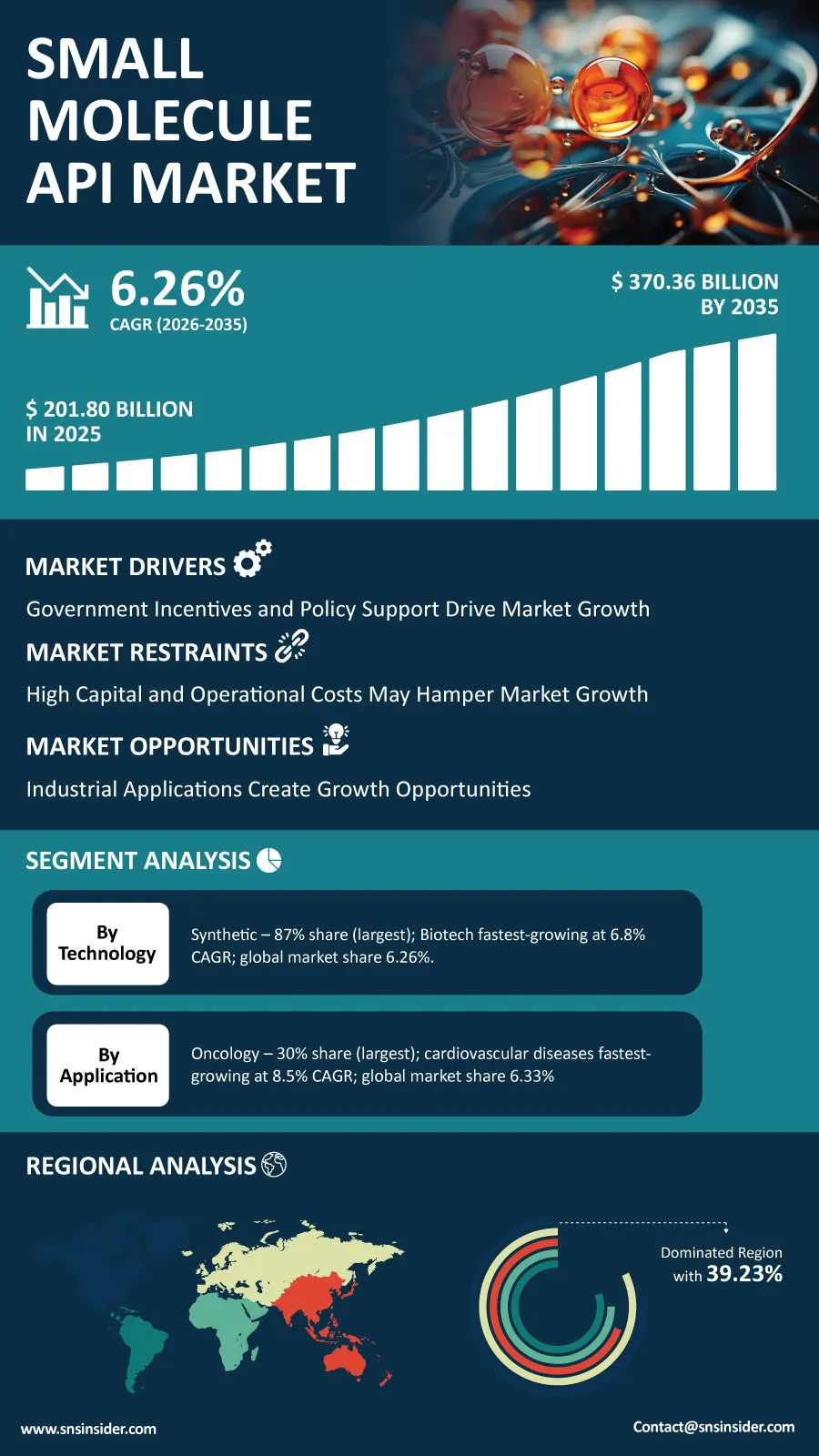
The global Small Molecule API Market is witnessing sustained expansion as pharmaceutical manufacturers increase investments in advanced drug development, domestic production capabilities, and resilient supply chains. “According to a recent study by SNS Insider, the global Small Molecule API Market size valued at USD 201.80 billion in 2025, is anticipated to grow to USD 370.36 billion by 2035, registering a CAGR of 6.26% over the 2026–2035 forecast period.”
There is always an increase in demand for high-quality active pharmaceutical ingredients because medical institutions have turned their attention to the treatment of chronic ailments through cost-effective and easily accessible medications. The increased incidence of ailments, such as oncological disorders, heart-related diseases, diabetes, and neurological disorders has made pharmaceutical firms enhance production capacity by adopting modern production techniques.
To Get Detailed Insights on the Small Molecule API Market – Request a Sample Report
Domestic Manufacturing Initiatives Strengthen Global API Supply Chains
Incentives to decrease the import of pharma ingredients by the countries in which pharmaceutical industries are prominent have been increasing for improving healthcare security. Production-linked incentives, funding, and development in the industry have helped in encouraging the setup of advanced API manufacturing facilities.
In India, there has been a decision to spend USD 2.3 billion through a deep-tech fund and an investment of USD 1.2 billion in semiconductors and displays that can provide the advanced industrial ecosystem. Pharmaceutical manufacturing facilities are also benefiting from production-linked incentives and bulk drugs infrastructure programs.
Key Market Findings Highlight High-Growth Segments
Synthetic technology remained the dominant production approach, accounting for 87% of total market revenue in 2025, supported by its established manufacturing processes, scalability, and broad therapeutic applications. Biotech-based small molecule APIs are projected to record the fastest expansion with a 6.8% CAGR through 2035.
By manufacturing type, in-house production represented 60% of market revenue in 2025, reflecting pharmaceutical companies' emphasis on quality assurance and regulatory oversight. Meanwhile, outsourced manufacturing through CDMOs is expected to register the highest growth rate at a 7.2% CAGR as companies seek greater operational flexibility and cost optimization.
Among applications, oncology generated the largest market share at 30% in 2025, driven by continuous innovation in cancer therapeutics. Cardiovascular disease applications are forecast to expand at the fastest pace, advancing at a CAGR of 8.5% during the forecast period.
Pharmaceutical companies accounted for 70% of overall demand in 2025, maintaining leadership through integrated research, manufacturing, and commercialization capabilities. Biotechnology companies are anticipated to emerge as the fastest-growing end-user segment with a 9.0% CAGR, reflecting increased investment in innovative drug pipelines.
Innovation and Digital Manufacturing Reshape API Production
Pharmaceutical manufacturing is witnessing rapid adoption of digital manufacturing, AI, predictive analytics, and continuous manufacturing processes in order to enhance efficiency and improve quality. Such technological advancements help in optimizing manufacturing yield, reducing wastage, improving quality assurance and streamlining compliance procedures.
Collaborations among pharmaceuticals, biotech companies and contract manufacturers have become increasingly prevalent. Such collaborations help shorten timelines for product development as well as expand manufacturing capacity to meet rising global demands for therapies.
Regional Markets Continue to Expand
North America captured a market share of 39.23% in 2025 owing to the presence of robust pharmaceuticals infrastructure, investment in research, and favorable regulatory frameworks. The U.S. Small Molecule API Market captured a valuation of USD 57.79 Billion in 2025 and is expected to achieve a market value of USD 107.67 Billion by 2035, growing at a CAGR of 6.42% due to increased production of drugs for cancer and heart ailments.
Asia-Pacific captured a market share of 24.32% in 2025 and is anticipated to be the fastest-growing market region. Factors like pharmaceutical exports, low-cost manufacturing, skilled labor force, and governmental support for the industry are making significant investments in India, China, and Japan.
Europe captured a market share of 19.11% in 2025 owing to advancements in pharmaceuticals research, strong regulatory policies, and investment in state-of-the-art manufacturing facilities. On the other hand, Latin America and the Middle East & Africa captured shares of 7.34% and 10%, respectively, owing to growing pharmaceutical manufacturing and healthcare investments.
Leading Companies Accelerate Capacity Expansion
Competition continues to intensify as global pharmaceutical companies invest in expanding API production capabilities and introducing advanced manufacturing technologies. Capacity expansion projects announced during 2025 highlight the industry's commitment to meeting future therapeutic demand while strengthening supply chain resilience.
Major participants operating in the global Small Molecule API Market include Pfizer Inc., Merck & Co., Inc., AbbVie Inc., Bristol-Myers Squibb Company, Albemarle Corporation, Boehringer Ingelheim International GmbH, Cipla Inc., Teva Pharmaceutical Industries Ltd., Viatris Inc., Dr. Reddy's Laboratories Ltd., Aurobindo Pharma, Sun Pharmaceutical Industries Ltd., Lonza Group AG, Cambrex Corporation, GSK plc., Novartis AG, Gilead Sciences Inc., Hoffmann-La Roche Ltd., Sanofi, and Novo Nordisk.
An SNS Insider analyst Parry Kardani commented, "Growing investments in pharmaceutical innovation, manufacturing modernization, and domestic production capabilities are reinforcing the long-term outlook for the Small Molecule API Market. Organizations that combine scalable manufacturing, regulatory excellence, and advanced process technologies will be well positioned to capture future opportunities across global healthcare markets."
About the Author

Get in touch