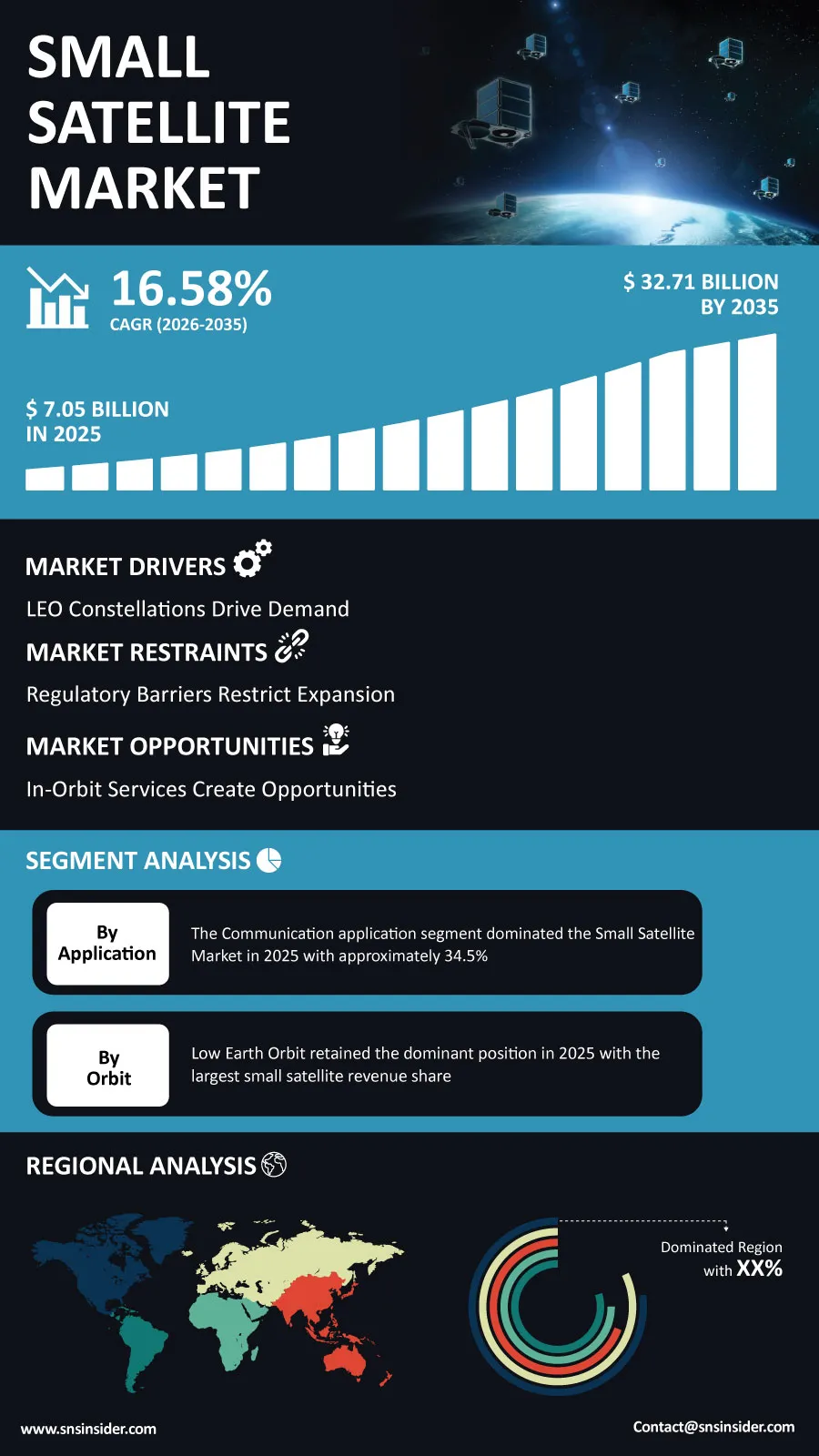
The global Small Satellite Market is witnessing remarkable growth as commercial space programs, government initiatives, and private investments continue to transform the economics of satellite deployment. According to a recent study by SNS Insider, the global Small Satellite Market size valued at USD 7.05 billion in 2025, is anticipated to grow to USD 32.71 billion by 2035, registering a CAGR of 16.58% over the 2026–2035 forecast period.
The increasing demand for cost-effective satellite platforms supporting communication, Earth observation, scientific research, navigation and defence missions are driving adoption across develop and emerging economies. Organizations are able to launch space assets more affordably than ever because of advancements in satellite miniaturization, launch access, and onboard processing technologies.
Small satellites have increasingly attracted interest from enterprises, research institutions and government agencies who want faster deployment cycles and greater operational flexibility as commercial space activity continues to expand alongside declining launch costs.
To Get Detailed Insights on the Small Satellite Market – Request a Sample Report
Expanding Commercial Space Programs Create Significant Growth Opportunities
Investments in low earth orbit (LEO) infrastructure around the world have opened up new revenue avenues for satellite equipment, launch service providers and data analytics firms. Deployments of large constellations aimed at broadband connectivity, environmental monitoring, and global communications are altering the commercial space market as it is today.
Meanwhile, governments are raising investments in national space capacities to bolster defense readiness, disaster monitoring, secure communications and strategic intelligence. This has led to an on-going demand for small, high-efficiency satellite platforms that can support multiple missions.
In parallel, technological advancements in onboard AI (artificial intelligence), payload miniaturization and autonomous satellite operations are creating additional commercial opportunities for next-generation small-satellite systems.
Key Market Insights Highlight Shifting Demand Patterns
Based on satellite mass, the minisatellite segment (100–500 kg) segment held the largest share of market revenue in 2025 owing to its ability to accommodate sophisticated communication and imaging payloads. Nanosatellites (1–10 kg) are projected to register the fastest growth through 2035 as lower development costs and rideshare launch opportunities continue to encourage wider deployment.
By application, communication satellites accounted for approximately 34.5% of global market revenue in 2025 while also emerging as the fastest-growing segment during the forecast period. Rising demand for broadband connectivity, IoT services, and global communication networks continues to accelerate constellation deployment.
Based on end user, the commercial segment dominated the market as private satellite operators expand broadband, Earth observation, and data service offerings. Government and defense organizations continue to represent the second-largest market, supported by growing investments in resilient space infrastructure and national security programs.
By orbit, Low Earth Orbit (LEO) is projected to remain both the largest and fastest-growing segment due to its suitability for broadband communications, Earth observation, and real-time data services requiring lower latency and higher revisit frequency.
Innovation in Space Technologies Accelerates Market Expansion
The sector is undergoing rapid innovation in satellite manufacturing, launch systems and on-board computing capabilities. Satellites are thriving with more data collection than ever before and improved operational efficiency through artificial intelligence, edge processing, smart sensors, and autonomous mission management.
The addition of dedicated small satellite launch vehicles being launched in parallel to rideshare missions is also increasing launch flexibility, enhancing deployment cost effectiveness, and enabling operators to bring new constellations into operation sooner.
Such advancements only stand to open up commercial possibilities spanning telecommunication, agriculture, marine monitoring and environmental management, climate research and national security applications.
North America Retains Market Leadership While Asia Pacific Expands at a 17.48% CAGR
North America is projected to continue leading the regional market during the forecast period, owing to significant commercial space activities, heavyweight government investment, advanced launching capabilities and the large satellite manufacturing ecosystem. The continuous stream of innovation from both private space companies and government agencies validates the market leader position in this region.
The fastest regional growth is expected to be performed in Asia Pacific, which will grow with a CAGR of around 17.48% until 2035. There is strong regional momentum driven by increasing government-backed space programs, expanding satellite manufacturing capabilities, growing commercial launch activity and rising demand for communication infrastructure.
As more countries strengthen domestic space capabilities and digital connectivity initiatives, investment in small satellite technologies is expected to accelerate across global markets.
Industry Participants Focus on Constellation Expansion and Advanced Satellite Technologies
Competition within the Small Satellite Market continues to intensify as companies invest in satellite miniaturization, advanced payload integration, launch services, and next-generation constellation architectures. Strategic partnerships, manufacturing scale, and continuous technological innovation remain central to long-term competitive positioning.
Key companies operating in the global Small Satellite Market include SpaceX Inc., Planet Labs PBC, Rocket Lab USA Inc., Airbus Defence and Space SAS, Lockheed Martin Corporation, Northrop Grumman Corporation, Thales Alenia Space, Surrey Satellite Technology Ltd. (SSTL), Blue Canyon Technologies LLC, Spire Global Inc., BlackSky Technology Inc., HawkEye 360 Inc., Satellogic Inc., OneWeb Ltd., Amazon.com Inc. (Project Kuiper), GomSpace Group AB, Tyvak Nano-Satellite Systems Inc. (Terran Orbital), NanoAvionics UAB, Exolaunch GmbH, and Orbital Micro Systems Inc.
An SNS Insider analyst Sushant Kadam commented, "Commercial constellation deployments, expanding government space investments, and continuous advances in satellite miniaturization are reshaping the global space economy. Organizations that prioritize scalable manufacturing, innovative payload technologies, and cost-efficient deployment strategies will be well positioned to capitalize on the market's long-term growth potential."
About the Author

Get in touch