
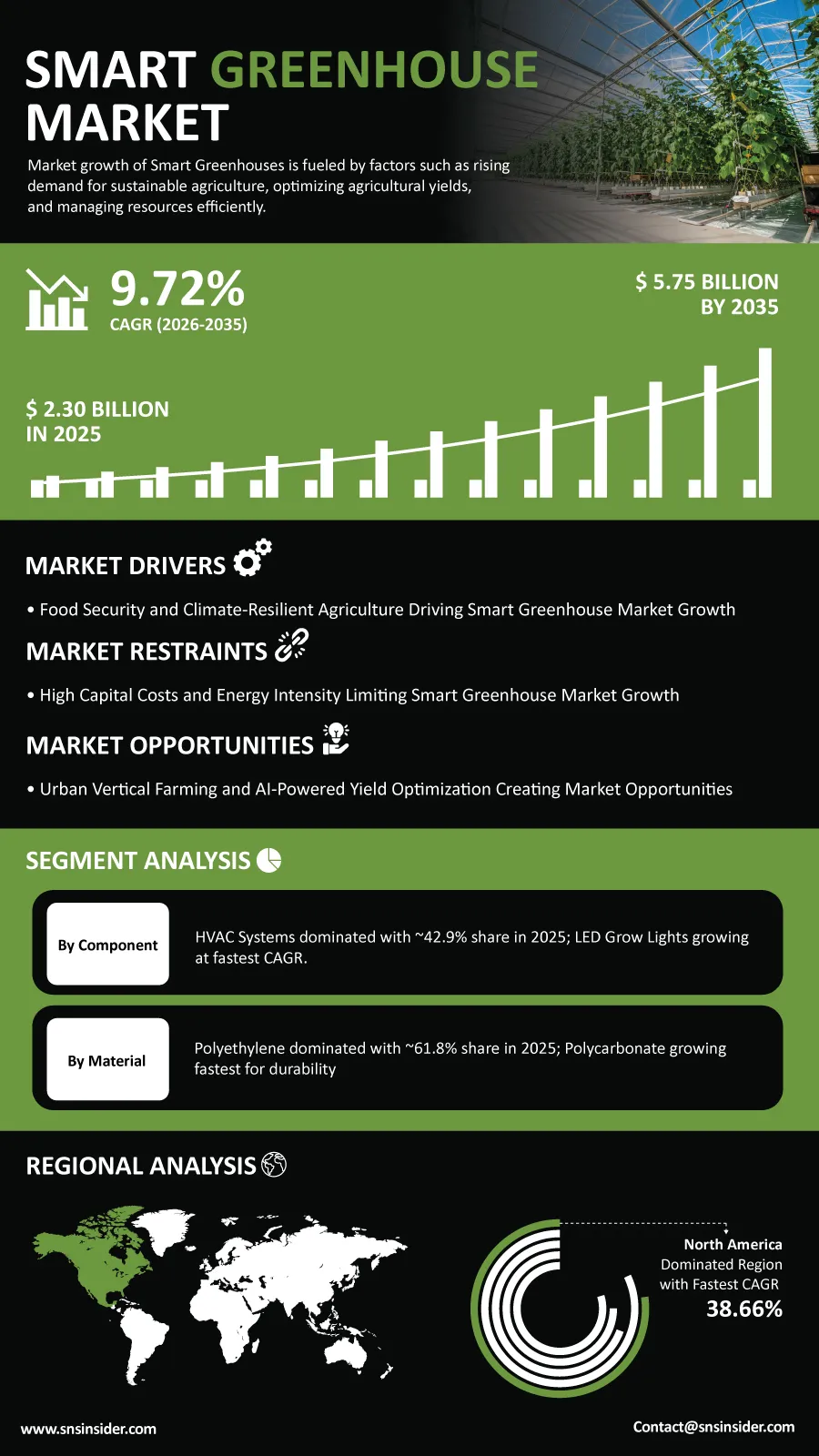
The global Smart Greenhouse Market is gaining momentum as food producers increasingly turn to controlled-environment agriculture to improve crop productivity, conserve resources, and strengthen food supply resilience. According to a recent study by SNS Insider, the global Smart Greenhouse Market size valued at USD 2.30 billion in 2025, is anticipated to grow to USD 5.75 billion by 2035, registering a CAGR of 9.72% over the 2026–2035 forecast period.
The move toward data-based growing is compelling farmers to use connected sensors, automated irrigation, climate control, and smart lighting. Using such technologies allows growers to react to changes in crop status with precision while minimizing the reliance on manual control.
The adoption of controlled environment agriculture is gaining momentum as a result of the problems of water shortage, erratic weather patterns, limited arable lands, and consistent food supply throughout the year. With technological advancements making it cheaper, automation and smart greenhouse solutions have started to be used in commercial farming, research, and urban agriculture.
To Get Detailed Insights on the Smart Greenhouse Market – Request a Sample Report
Precision Agriculture Investment Creates New Growth Opportunities
Increased use of Artificial Intelligence (AI) and IoT solutions is causing the evolution of greenhouses from regular plant cultivation facilities to production centers managed through digital technologies. Sensors connected to the Internet allow for continuous tracking of temperature, humidity, state of the soil or nutrients, as well as the development stage of crops, and adjustment of cultivation conditions automatically.
Water recycling and irrigation technologies represent yet another sphere where innovations are happening. With the help of such technologies, it is possible to recycle water and nutrients, which will increase efficiency in areas where water scarcity represents an issue for agriculture.
Moreover, the integration of renewable energy and the application of energy efficient LEDs represent an opportunity for developing more sustainable greenhouses. The combination of automation, predictive analytics, and clean energy is expected to improve the long-term economics of controlled-environment cultivation.
Key Market Insights Highlight Shifting Demand Patterns
By type, hydroponic smart greenhouses were expected to maintain their leading position in 2025 as growers increasingly seek precise nutrient management and improved water efficiency. However, non-hydroponic systems are projected to record the fastest growth through 2035 as traditional growers modernize existing soil-based greenhouse operations without undertaking complete cultivation-system conversions.
Based on component, HVAC systems accounted for approximately 42.9% of global market revenue in 2025. Climate control remains fundamental to maintaining optimal growing conditions across different seasons and geographic locations. LED grow lights are forecast to experience the fastest growth as declining technology costs, improved energy efficiency, and programmable light spectra encourage wider adoption.
By material, polyethylene dominated with approximately 61.8% of market revenue in 2025 due to its affordability, flexibility, and extensive use in greenhouse structures. Polycarbonate is projected to be the fastest-growing material category, supported by its durability, insulation properties, and longer service life.
In terms of end user, commercial growers contributed to approximately 57.3% of market revenue in 2025, reflecting large-scale investments in automation and controlled-environment production. Research institutions are projected to register the fastest growth as universities, government agencies, and private organizations expand research into crop science, food security, and sustainable agriculture.
AI and Automation Reshape Controlled-Environment Farming
Smart greenhouse operators are now utilizing intelligent AI platforms that are able to process vast amounts of environmental data along with crop data. This will aid predictive decision-making as the system is able to detect changes in the environment and give suggestions in order to prevent any impact on crop productivity.
Vertical farming has become another way through which intelligence can be integrated into greenhouses due to its use of controlled environments and density-based farming techniques. In urban settings, shorter transportation distances can also be facilitated.
Integration of smart irrigation, climate controls, sensors, and renewable energy is also anticipated to help in better resource management and improve the commercial value of greenhouses.
North America Holds 38.66% Market Share in 2025 as Asia Pacific Emerges as the Fastest-Growing Region
North America is predicted to continue as the dominant regional market segment, representing roughly 38.66% of the worldwide revenue share in 2025. The region has been boosted by a robust commercial greenhouse industry, rising controlled environment agriculture investments, and increasing requirements for steady domestic production of agricultural products.
Asia Pacific is estimated to register the highest regional market CAGR over the forecast period driven by major initiatives towards agricultural modernization, rising food demands, and high adoption of technology solutions for the development of smart greenhouses. China, Japan, India, and South Korea are set to become important regional growth drivers with their efforts towards precision agriculture and controlled environment farming.
The Middle East is experiencing rising interest in smart greenhouses amid the focus of governments on ensuring food security through domestic agricultural production. Latin America is set to capitalize on the expansion of premium produce markets and enhanced year-round cultivation capabilities.
Industry Participants Focus on Automation and Sustainable Innovation
The competitive landscape remains dynamic as greenhouse technology providers and controlled-environment agriculture companies develop integrated platforms combining climate management, lighting, irrigation, automation, and data analytics. Industry participants are increasingly focusing on solutions that improve productivity while reducing water, energy, and labor requirements.
Key companies operating in the global Smart Greenhouse Market include Royal Brinkman, Priva BV, Ridder Group, Argus Control Systems Ltd., Signify NV (Philips Horticulture), Heliospectra AB, Netafim Ltd., Motorleaf Inc., Dalsem Greenhouse Projects, Iron Ox Inc., Gotham Greens LLC, Little Leaf Farms LLC, AppHarvest Inc., Spread Co. Ltd., SananBio Inc., Logiqs BV, Van der Hoeven Horticultural Projects, Gakon Horticultural Projects BV, Certhon Build BV, and Pure Harvest Smart Farms.
An SNS Insider analyst Sushant Kadam commented, “The convergence of precision agriculture, artificial intelligence, and resource-efficient cultivation is creating a strong foundation for smart greenhouse expansion. As growers face increasing pressure to produce more food with fewer resources, companies delivering integrated automation, energy-efficient systems, and intelligent crop management technologies will be positioned to capture emerging opportunities across global controlled-environment agriculture markets.”
About the Author

Get in touch




