
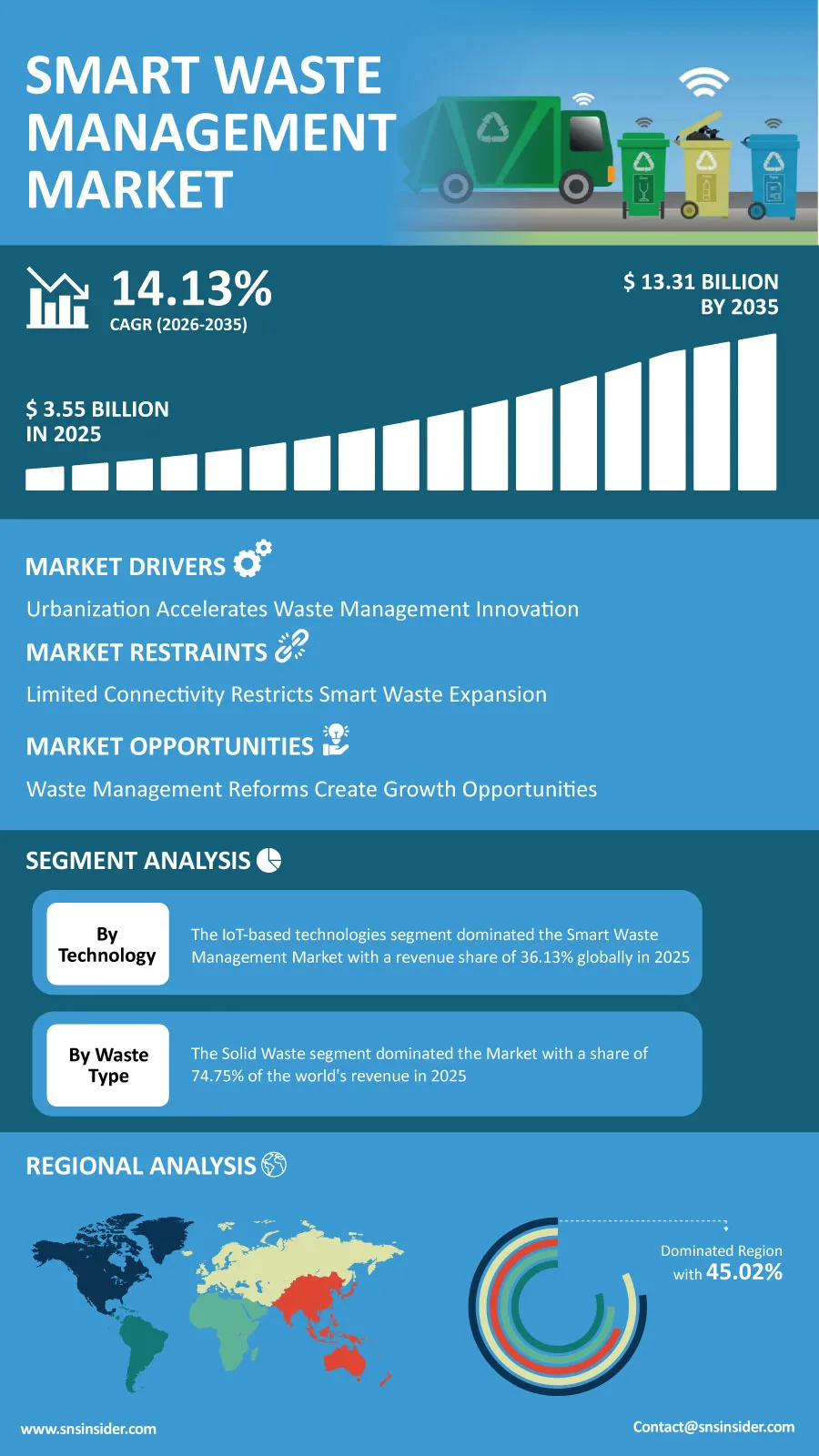
The global Smart Waste Management Market is entering a period of rapid transformation as cities, businesses, and public authorities invest in connected technologies to improve collection efficiency, recycling performance, and environmental outcomes. According to a recent study by SNS Insider, the global Smart Waste Management Market size valued at USD 3.55 billion in 2025, is anticipated to grow to USD 13.31 billion by 2035, registering a CAGR of 14.13% over the 2026–2035 forecast period.
More urban waste is generating additional pressure for local governments to upgrade traditional collection and disposal infrastructures. Smart bins, waste monitoring systems, automatic sorting machinery, and fleet optimization systems allow waste management operators to become more efficient at resource utilization, while eliminating redundant trips and enhancing service consistency.
IoT technology, artificial intelligence, automation, and advanced analytics are revolutionizing the processes of collection, processing, and recycling of urban waste. These technologies help operators track waste amounts, plan routes, detect recyclable materials, and plan their operations based on real-time data.
To Get Detailed Insights on the Smart Waste Management Market – Request a Sample Report
Urban Modernization and Sustainability Goals Create New Growth Opportunities
With rapid population growth in urban areas, there is an increase in the complexity of waste management, thus the urgent need for infrastructure supported by technological capabilities. Smart waste management systems help cities transition from rigid collection schedules to demand-driven processes which help to lower fuel costs, prevent unnecessary driving, and cut down on wasted trips.
Governments’ sustainability initiatives and stricter recycling policies are contributing to increased investments in digitized waste management systems. The deployment of such infrastructure is being facilitated by public-private partnership, whereas waste-to-energy and circular economy initiatives provide more opportunities for technology vendors.
The use of automated sorting technology and predictive analytics will increase the scope of the market since waste managers will strive to extract more valuable materials while minimizing the volume of waste going to landfills.
Key Market Insights Highlight Shifting Demand Patterns
By technology, IoT-based solutions segment accounted for 36.13% of global market revenue in 2025, supported by widespread deployment of connected sensors, smart bins, and remote monitoring platforms. Artificial intelligence is projected to be the fastest-growing technology segment, expanding at a CAGR of 15.30% through 2035 as intelligent analytics and automated sorting systems gain adoption.
Based on waste type, solid waste segment dominated with a 74.75% revenue share in 2025 due to the large volumes generated by urban households and commercial activities. The special waste segment is forecast to grow at the fastest CAGR of 16.78% as stricter regulations surrounding hazardous and medical waste increase demand for secure tracking and automated handling.
By method, smart collection segment held the largest share of 44.80% in 2025 as municipalities increasingly use fill-level monitoring and digital route planning to improve collection efficiency. Smart processing is projected to be the fastest-growing method, registering a CAGR of 15.33% through 2035, driven by demand for automated sorting and advanced material recovery systems.
In terms of source, residential waste segment accounted for 46.87% of market revenue in 2025, reflecting rising waste generation in densely populated urban communities. The business segment is expected to record the fastest growth at a CAGR of 15.29% as retailers, hospitality providers, healthcare organizations, and other commercial users adopt digital tools to improve waste tracking and sustainability reporting.
Data-Driven Waste Operations Strengthen Market Demand
There have been more efforts being made by waste management firms to harness real-time data for better decisions on the field. This is possible through sensor-equipped containers that show fill level and GPS & telematics systems for fleet management and dynamic scheduling.
On the other hand, artificial intelligence offers great opportunities in the realm of recycling plants by ensuring material identification and automation of sorting. These innovations allow reducing contamination and increasing recycling efficiency.
However, cybersecurity and connectivity remain important considerations, particularly for large networks of connected waste infrastructure. Operators must strengthen data protection and ensure reliable communications networks as smart waste systems become increasingly interconnected.
North America Accounts for 45.02% Market Share in 2025 as Europe Records a 16.05% CAGR
The North American region is anticipated to maintain its position as the leading regional market, holding a market share of 45.02% in 2025. Excellent digital infrastructure, efficient waste management system, and investments in connectivity are contributing towards regional dominance. The U.S. serves as the key market in this region with upgrades in infrastructure for collection and recycling.
Europe is projected to be the fastest-growing regional market, expanding at a CAGR of 16.05% through 2035. Strict environmental regulations, ambitious recycling targets, and investments in waste-to-energy and circular economy technologies are accelerating adoption across the region.
Asia Pacific is also experiencing strong momentum as rapid urbanization and rising waste generation encourage governments and businesses to deploy IoT monitoring, AI analytics, and automated processing solutions.
Industry Participants Focus on Technology Integration
The competitive landscape is evolving as technology providers and waste management companies invest in connected infrastructure, intelligent analytics, automation, and sustainable processing solutions. Market participants are focusing on integrated platforms that combine sensors, cloud-based monitoring, route optimization, and automated sorting capabilities.
Key companies operating in the global Smart Waste Management Market include Ecube Labs, Bigbelly, Inc., Enevo Oy, SmartBin, Urbiotica, Compology, Sensoneo, Recycle Track Systems (RTS), Covanta Holding Corporation, SUEZ, Veolia Environnement S.A., Waste Management, Inc., Republic Services, Inc., Rubicon Technologies, LLC, Renewi PLC, ZenRobotics Ltd., CleanRobotics, SmartBin Technology, Divert, Inc., and AMCS Group.
An SNS Insider analyst Sushant Kadam commented, “The shift toward connected and data-driven waste operations is creating significant opportunities across collection, recycling, and resource recovery. Companies that combine IoT connectivity, artificial intelligence, and automation with practical sustainability solutions will be well positioned to support cities and businesses as waste management systems become more efficient and circular.”
About the Author

Get in touch




