
The global vertical-cavity surface-emitting laser (VCSEL) industry is set for strong growth, driven by the growth of artificial intelligence infrastructure, the development of 3D sensing and the development of advanced automotive technologies, all of which are driving demand for optical components made from semiconductors.
VCSELs are seeing increasing application in areas like facial recognition systems, short-range optical communication networks, industrial sensors and automotive monitoring. Its small structure, low power consumption and compatibility with semiconductor fabrication processes drive its application in electronic devices.
According to SNS Insider, the VCSEL Market was valued at USD 2.55 Billion in 2025, is estimated to reach USD 3.00 Billion in 2026 and is projected to achieve USD 13.12 Billion by 2035, registering a CAGR of 17.80% during 2026–2035.
Asia Pacific dominates the global market and is expected to record the fastest regional expansion, supported by electronics manufacturing, semiconductor investment and growing optical connectivity requirements.
To Get Detailed Insights on the VCSEL Market – Request a Sample Report
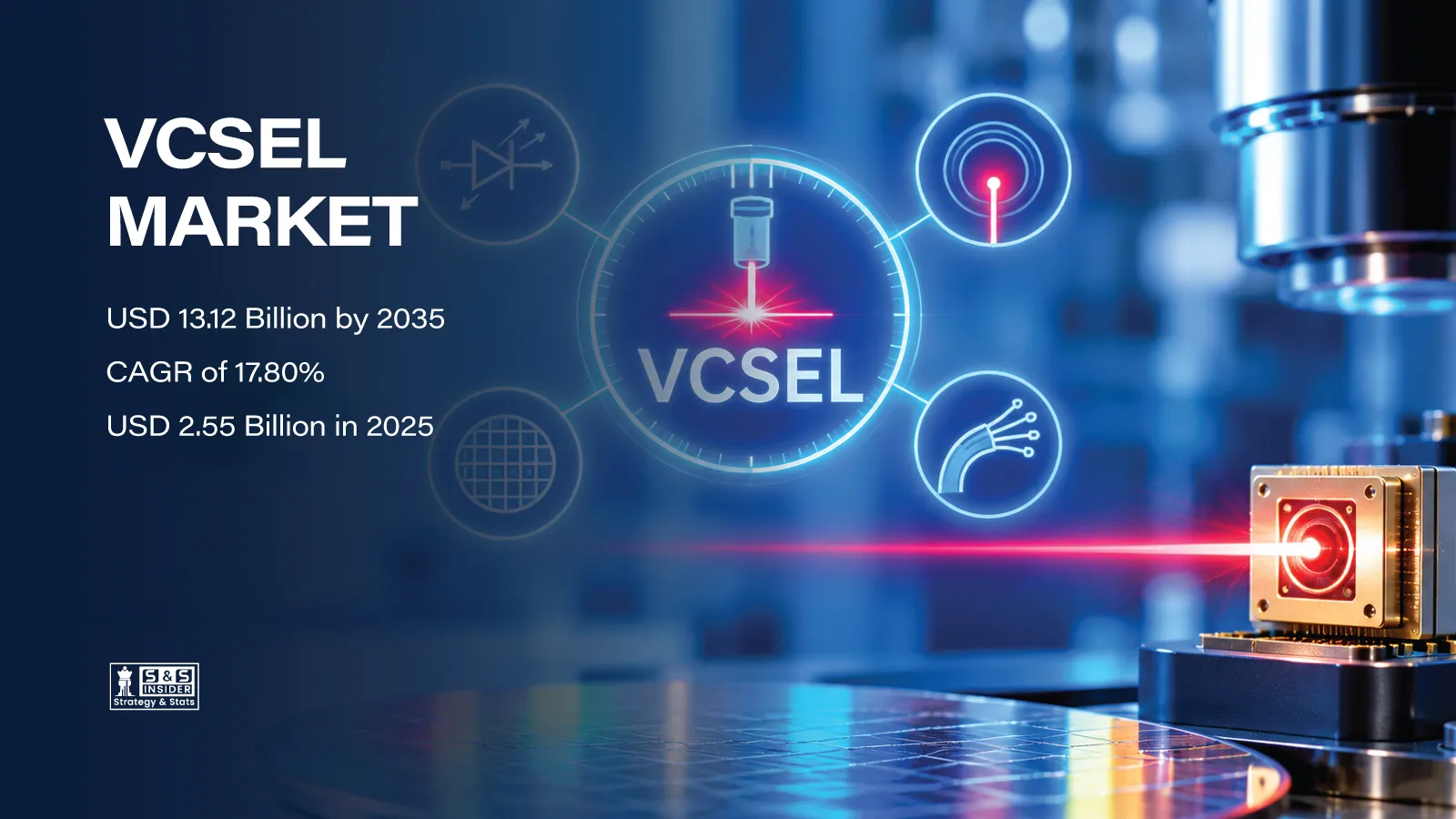
VCSEL Market Outlook: Optical Innovation Expands Commercial Applications
VCSEL technology is becoming increasingly important in modern electronics because it enables efficient optical emission from compact semiconductor devices. Unlike conventional edge-emitting lasers, VCSELs emit light perpendicular to the semiconductor surface, enabling wafer-level testing and efficient production of multiple emitter arrays.
Consumer electronics manufacturers use these devices in facial authentication, proximity sensing and depth measurement systems. Automotive suppliers are expanding their use in driver monitoring, in-cabin sensing and certain LiDAR architectures.
The rapid expansion of AI computing infrastructure is creating another substantial opportunity. Data centers require high-bandwidth optical connections between servers, switches and computing accelerators, increasing demand for efficient short-reach laser technologies. Manufacturing improvements and larger semiconductor wafer formats are supporting production scalability while reducing component costs.
Key Growth Drivers: AI Infrastructure and Advanced Sensing Strengthen Demand
Growing adoption of three-dimensional sensing is a major demand driver. Smartphones, tablets, augmented reality devices and wearable electronics increasingly incorporate depth-sensing capabilities for authentication, imaging and user interaction. AI data centers represent another opportunity as expanding computing clusters require high-speed optical communication with improved energy efficiency.
Automotive safety technologies are also influencing VCSEL adoption. Driver monitoring systems and advanced sensing modules require reliable near-infrared illumination under varying environmental conditions. However, dependence on consumer electronics product cycles, thermal management challenges and competition from alternative laser technologies remain important constraints. Suppliers are responding through improved emitter efficiency, compact arrays and specialized designs for automotive, industrial and computing applications.
VCSEL Market Segment Analysis
Multimode VCSELs Dominate with 68.60% Market Share in 2025
Multimode VCSELs accounted for 68.60% of global market revenue in 2025, supported by widespread deployment in three-dimensional sensing, proximity detection and short-distance optical communication.
These devices provide comparatively high optical output and can be manufactured in arrays, making them suitable for consumer electronics and data center transceivers. Their ability to support high-volume manufacturing contributes to their established commercial position.
Current trend: Increasing deployment of multimode arrays in sensing modules and optical interconnects.
Major trends: Higher-bandwidth emitters, improved manufacturing yields and energy-efficient optical communication.
Single-Mode VCSELs Register the Fastest CAGR of 20.46%
Single-mode VCSELs are projected to expand at a 20.46% CAGR during 2026–2035, supported by applications requiring narrow spectral output and stable optical performance.
Atomic clocks, precision measurement systems, gas detection and specialized medical imaging equipment increasingly require accurate optical sources. Advances in wavelength stability and device design are also creating opportunities in emerging quantum technologies.
Current trend: Growing adoption of precision VCSELs in scientific and industrial sensing.
Major trends: Narrow-linewidth emission, wavelength optimization and advanced metrology applications.
Gallium Arsenide Leads Materials with 63.40% Market Share
In 2025, gallium arsenide held a 63.40% share of the VCSEL market revenue. This is due to its established use in the production of semiconductor lasers in the near-infrared range. It is a very efficient light producing material and is widely used in sensing devices and short range optical communication systems.
The company is a market leader because of its existing fabrication facilities and its advances in wafer processing. Other materials such as gallium nitride and indium phosphide are under study for applications requiring different operating wavelengths.
Current trend: Expansion of six-inch gallium arsenide wafer manufacturing.
Major trends: Improved wafer utilization, advanced epitaxial processes and alternative semiconductor materials.
Sensing Applications Dominate with 52.60% Market Share in 2025
Sensing was the largest application with 52.60% of global VCSEL revenue in 2025, driven by facial recognition, depth mapping, proximity detection and automotive monitoring. “Smartphones continue to be a significant demand source, while robotics, wearable devices and vehicle interiors are growing the application opportunities. VCSEL arrays are also increasingly used in time-of-flight sensing systems to illuminate objects and measure distance.
Current trend: Rising integration of VCSEL-based depth sensors in consumer and automotive electronics.
Major trends: Biometric authentication, gesture recognition and intelligent environmental sensing.
Data Communication Records the Fastest CAGR of 22.30%
Data communication is forecast to grow at a 22.30% CAGR between 2026 and 2035, supported by expanding AI infrastructure and high-performance computing. Data centers require large numbers of short optical connections to support increasing traffic between computing systems.
VCSEL-based optical transceivers provide cost and energy advantages in suitable short-distance applications. Developments in dense emitter arrays and advanced optical packaging are expanding their commercial potential.
Current trend: Increasing deployment of VCSEL-based optical links in computing infrastructure.
Major trends: AI networking, co-packaged optical technologies and higher-speed interconnect architectures.
Consumer Electronics Holds 44.20% Market Share
Smartphones, tablets, laptops and wearable devices contributed to consumer electronics’ share of global market revenue in 2025, reaching 44.20%. Miniature optical emitters continue to be in high demand due to facial recognition, camera autofocus and proximity detection. Advanced wearable products and augmented reality goggles offer further opportunities for 3D sensing and eye tracking.
Current trend: Greater incorporation of optical sensing into premium electronic devices.
Major trends: Secure authentication, wearable sensing and immersive computing applications.
Data Centers Register the Fastest CAGR of 22.80%
Data centers are projected to achieve a 22.80% CAGR during 2026–2035, making them the fastest-growing end-use industry. Artificial intelligence computing clusters require high-bandwidth connections while operators seek to reduce networking power consumption. VCSEL arrays are increasingly being evaluated for short-reach optical interconnects within advanced computing environments.
Current trend: Growing demand for high-density optical connections in AI computing facilities.
Major trends: Optical scale-up networks, energy-efficient communication and advanced photonic integration.
Regional Analysis: Asia Pacific Leads Global VCSEL Demand
Asia Pacific Leads with 43.20% Market Share and Fastest 19.35% CAGR
The Asia Pacific region represented 43.20% of the global VCSEL revenue in 2025 and is projected to record the highest regional CAGR of 19.35% between 2026 and 2035. China, Taiwan, South Korea and Japan support large demand through the manufacture of semiconductors, assembly of electronics and production of optical components.
India, Vietnam and Southeast Asian economies are eyeing new opportunities in electronics manufacturing investment and expansion of data center infrastructure. Regional production capabilities are on the rise as manufacturers invest in compound semiconductor technologies.
Direction: Asia Pacific will remain the leading growth center through manufacturing expansion, consumer electronics demand and optical communication investment.
North America Accounts for 32.40% Market Share
North America represented 32.40% of the global market in 2025, supported by artificial intelligence infrastructure, advanced semiconductor research and automotive sensing development. The U.S. VCSEL Market was valued at USD 769.19 Million in 2025 and is projected to expand at a 17.14% CAGR from 2026 to 2035.
The United States benefits from established photonics developers, hyperscale data center operators and technology research institutions. Canada contributes through optical technology research and specialized semiconductor activities.
Direction: North American growth will increasingly depend on AI optical interconnects, semiconductor innovation and high-performance sensing.
Europe Holds 20.00% Market Share
In 2025, Europe represented 20.00% of the global VCSEL revenue, with demand driven by Germany, Austria, France, United Kingdom and Italy. The area is backed by established automotive manufacturing and industrial sensing and optical component development.
European vehicle safety requirements are driving the adoption of driver monitoring technologies, which in turn is opening up opportunities for infrared illumination systems. This demand is further reinforced by research programs on precision optics and advanced photonics.
Direction: European expansion will emphasize automotive sensing, industrial photonics and high-reliability optical components.
Latin America Represents 1.40% Market Share
In 2025, Latin America accounted for 1.40% of the global market, with Brazil and Mexico being the key demand centers. Electronics assembly, automotive production and the build-out of communication infrastructure are supporting regional consumption.
Mexico benefits from automotive electronics production, and Brazil from industrial equipment and data center investments. A key characteristic of the market is its dependence on imported semiconductor components.
Direction: Regional growth will follow automotive electronics production, telecommunications modernization and expanding digital infrastructure.
Middle East & Africa Accounts for 3.00% Market Share
Middle East & Africa made up 3.00% of the global VCSEL revenue in 2025. Saudi Arabia, United Arab Emirates, Israel and South Africa are driving demand with data center development, defense electronics, industrial sensing and photonics research.
The increasing investment in AI infrastructure and smart city technologies is creating new avenues for advanced optical components. But with limited local production capacity for semiconductors, it has to depend more on imported devices.
Direction: Growth will be supported by AI data center investment, defense applications and specialized sensing technologies.
Competitive Landscape: Semiconductor Innovation and Optical Integration Drive Competition
The VCSEL industry is highly concentrated, with established semiconductor manufacturers and specialist photonics companies competing on the basis of optical efficiency, manufacturing scale and device reliability.
Major participants include Lumentum Holdings, Coherent, Broadcom, TRUMPF, ams OSRAM, Hamamatsu Photonics, Vertilite, Santec Holdings, WIN Semiconductors and Leonardo Electronics US. Competition increasingly focuses on high-speed performance, emitter density, wavelength stability and large-scale manufacturing capabilities.
In March 2026, Lumentum showed its advanced VCSEL-based optical scaling-up technology for AI computing applications. September 2026 ams OSRAM announced an 850 nm microVCSEL platform for high density optical communication These trends indicate more money being put into sophisticated optical interconnect technologies.
VCSEL Market Outlook Through 2035
The global VCSEL industry is poised for strong growth with demand broadening from smartphone sensing to artificial intelligence infrastructure, automotive electronics and niche industrial applications. Data communication, data centers and single-mode devices are expected to see strong growth, with multimode technology and consumer electronics contributing significant revenue.
Manufacturers able to combine advanced optical performance with scalable semiconductor production will be better positioned to meet evolving customer requirements. VCSEL technology is anticipated to play a growing role in optical communication, intelligent sensing and next generation computing systems with a global revenue expected to reach USD 13.12 Billion by 2035.
About the Author

Get in touch




