Stethoscope Market is entering a new era of technological advancement with the use of intelligent diagnostics being more widely implemented into health care systems to improve the accuracy and patient monitoring capabilities. The digital revolution happening in hospitals and clinics will drive the demand for innovative products without decreasing the demand for standard stethoscopes.
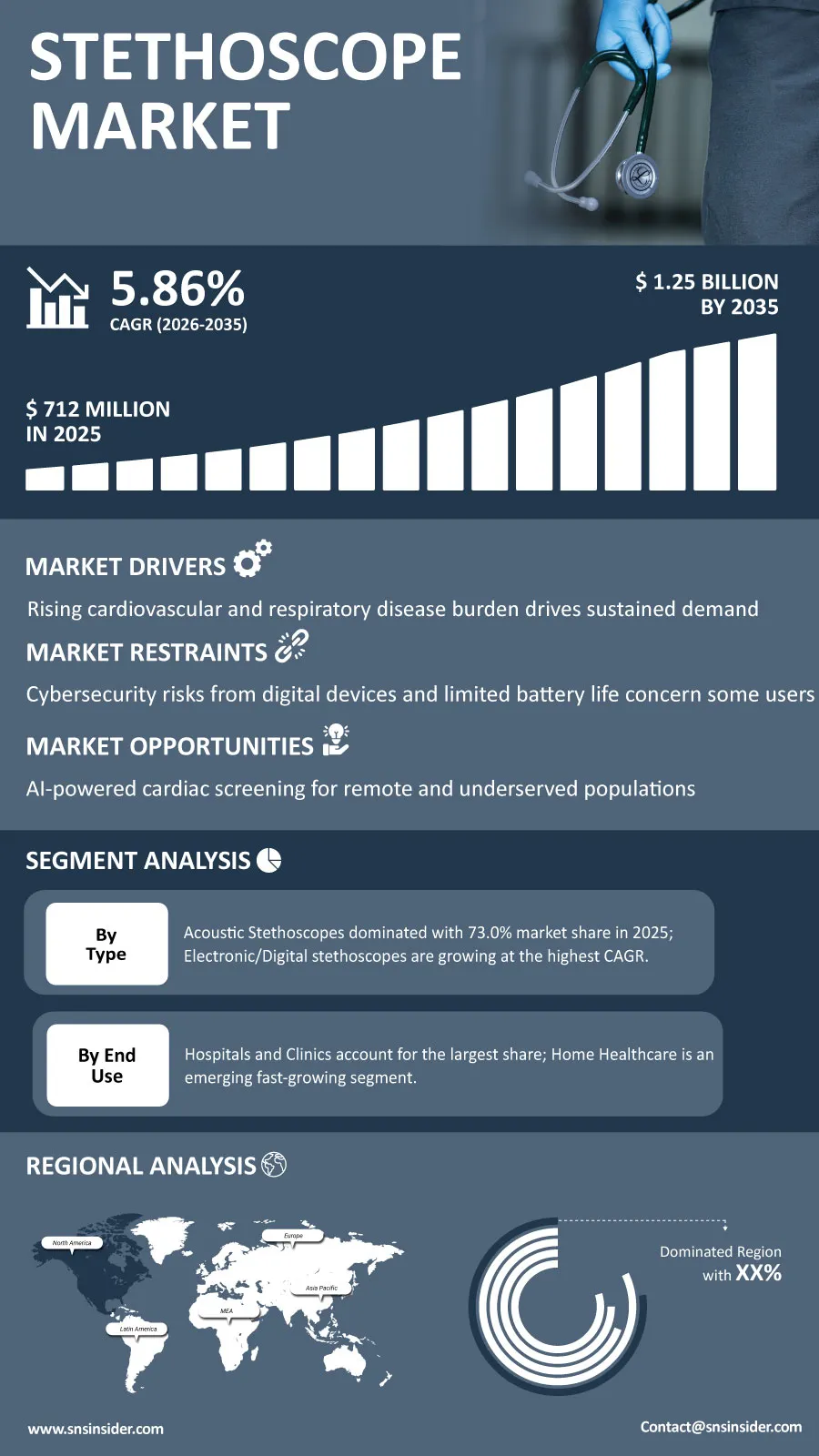
According to a recent study by SNS Insider, the global Stethoscope Market size valued at USD 712 million in 2025, is anticipated to grow to USD 1.25 billion by 2035, registering a CAGR of 5.86% over the 2026–2035 forecast period. The increasing investment in the development of healthcare facilities, rise in the number of cases of heart diseases and lung disorders, and the advent of innovative technologies for diagnosing through artificial intelligence are projected to drive the market growth over the next few years.
Doctors are becoming more interested in diagnostic tools that can help them perform faster, more accurate, and more interconnected evaluations. The modern-day stethoscope not only amplifies sound, but it is also wireless, digital, and equipped with artificial intelligence, allowing doctors to make diagnoses in an easier way. Technology has thus changed an age-old tool into a smart diagnostic tool.
To Get Detailed Insights on the Stethoscope Market – Request a Sample Report
Digital Innovation Redefines Clinical Diagnostics
The advent of connected care is opening up new doors for device manufacturers in making more sophisticated stethoscopes. Hospitals and healthcare networks have been adopting devices that enable doctors to make recordings of examinations, transfer auscultation information, and monitor patients remotely without affecting the accuracy of diagnoses.
AI technology is also contributing to the capabilities of digital stethoscopes by helping medical practitioners detect abnormal heart beats, murmurs, and respiratory illnesses through routine examinations. With healthcare practitioners adopting digital processes, digital stethoscopes are becoming more relevant in the healthcare space.
Market Segments Reflect Changing Healthcare Needs
Based on type, acoustic stethoscopes retained market leadership with 73.0% of global revenue in 2025, supported by their affordability, durability, and widespread adoption across hospitals, clinics, educational institutions, and developing healthcare systems. Electronic and digital stethoscopes are projected to register the fastest growth through 2035 as healthcare organizations increasingly invest in connected diagnostic technologies.
By application, cardiology represented the largest market segment in 2025, reflecting growing demand for cardiac assessment amid rising cases of cardiovascular disease worldwide. Pulmonology continued to account for a significant share of clinical usage as respiratory disorders, asthma, COPD, and infectious lung diseases sustained demand for routine auscultation.
From an end-use perspective, hospitals and clinics remained the largest purchasing segment due to continuous equipment replacement programs and expanding healthcare capacity. Meanwhile, home healthcare is emerging as one of the fastest-growing end-use categories as remote patient monitoring and telehealth services continue gaining momentum.
AI and Telemedicine Create New Growth Opportunities
The increasing digitization of healthcare is influencing the competition through product offerings that are tailored for clinical integration systems. Compatibility with Bluetooth, cloud data sharing, and integration with EHRs have become key factors for consideration among buyers in the healthcare sector.
Telemedicine will continue to grow in its market opportunity because it allows healthcare professionals to assess their patient via digital auscultation from afar. It is anticipated that these developments will increase access to healthcare while ensuring early diagnosis in rural areas.
Regional Markets Continue Expanding
North America was still the biggest regional market in 2025 due to the highly developed health infrastructure and investments in digital diagnostics. Of the total revenue, the United States generated around 77%. The U.S. Stethoscope Market was evaluated at USD 182.7 million in 2025 and forecast to grow up to USD 314.2 million in 2035 with an average annual rate of 5.65%.
The robust growth of Asia Pacific is expected due to the continuous investments made by the governments in the development of primary healthcare infrastructure, medical education, and diagnostics. In Asia Pacific, China contributed around 44% of regional revenue because of growing healthcare infrastructure and the need for new diagnostic equipment.
In Europe, Germany contributed around 30% of the revenue due to the developed healthcare infrastructure and medical device manufacturing sector. Of the total revenue of Latin America, Brazil contributed around 53%, and of the total revenue of Middle East & Africa, the United Arab Emirates contributed around 36%.
Leading Companies Focus on Smart Healthcare Solutions
Competition continues to intensify as manufacturers expand digital product portfolios, strengthen AI capabilities, and improve wireless connectivity. Recent industry developments include Eko Health's 2025 launch of the CORE 500 digital stethoscope featuring onboard artificial intelligence for real-time cardiac assessment, while 3M Littmann enhanced its CORE Digital Stethoscope series in 2024 with improved Bluetooth connectivity, advanced sound amplification, and expanded telehealth integration capabilities.
Leading companies operating in the global stethoscope market include 3M Littmann Stethoscopes, Eko Health Inc., Welch Allyn (Hillrom/Baxter), American Diagnostic Corp., Heine Optotechnik GmbH, Riester GmbH, Nasco Healthcare, Rudolf Riester GmbH, Prestige Medical, Ultrascope, Spirit Medical, Medline Industries Inc., Suzuken Co., Ltd., MDF Instruments, and Think Labs Inc.
An SNS Insider analyst Parry Kardani commented, "The stethoscope continues to evolve from a traditional diagnostic instrument into a digitally connected clinical solution. Manufacturers combining artificial intelligence, wireless connectivity, and superior acoustic performance with clinician-friendly design will be well positioned to capitalize on the growing demand for smarter and more accessible healthcare technologies.
About the Author

Get in touch