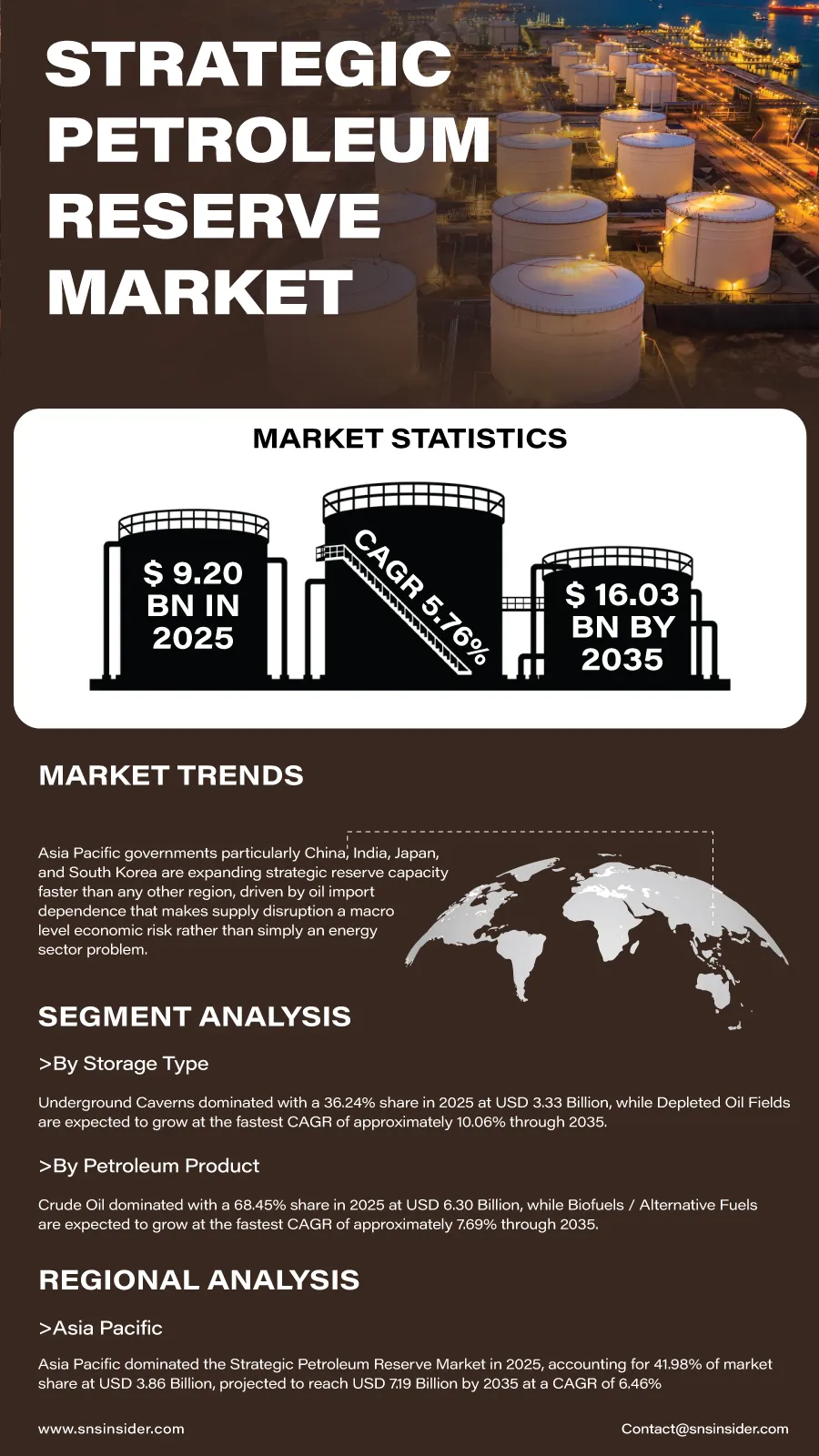
The global Strategic Petroleum Reserve Market is expected to witness steady growth over the next decade as governments strengthen energy security strategies and expand emergency fuel storage infrastructure to mitigate supply disruptions. According to a recent study by SNS Insider, the global Strategic Petroleum Reserve Market size valued at USD 9.20 billion in 2025, is anticipated to grow to USD 16.03 billion by 2035, registering a CAGR of 5.76% over the 2026–2035 forecast period.
Geopolitical conflict, changing dynamics in the energy business, and dependence on foreign oil resources have been some of the factors responsible for underlining the need for enough petroleum stocks. It is important that storage facilities remain as critical tools for protection from any sort of disruptions which might come from any kind of geopolitical activities or natural calamities, among others.
Moreover, governments are continuously working on refining their reserve systems by investing in advanced storage, tracking system, and diversification of fuel reserves. This not only increases preparedness but allows faster responses to emergencies in times of market instability.
Expanding Energy Security Programs Create New Growth Opportunities
Increases in investments aimed at making nations more energy resilient are creating long-term prospects within the ecosystem of the strategic petroleum reserve system. Many countries are increasing their reserves through the enhancement of their aging reservoirs to boost efficiency and meet the energy security requirements.
It has become increasingly common to see reserves diversified from pure crude to refined petroleum products, aviation fuel, diesel, and fuel blend stocks. This allows governments to effectively react to emergencies without relying heavily on downstream processing of the fuels during times of supply disruption.
Another trend that has been growing in popularity includes the repurposing of exhausted oil and gas fields as petroleum reserves as opposed to building new underground caverns. The use of digital systems, automated inventory management, and predictive maintenance technologies further makes this development efficient and beneficial.
Key Market Insights Highlight Shifting Demand Patterns
By Storage, the share of underground caverns in global market revenue is estimated at 36.24% in 2025 based on their large storage capacities, geological stability, and cost-effectiveness. The share of depleted oil fields in global market revenue will increase fastest through 2035 as governments reuse the existing energy infrastructure to build up storage capabilities and save capital investments.
By petroleum product, crude oil will have the largest market revenue share at 68.45% in 2025 due to its long-standing use as the principal material in national energy reserve programs. Biofuels and alternative fuels will register the fastest growth as governments diversify their reserve systems in order to adapt them to changing transportation fuels and energy policies.
By storage purpose, energy security and emergency supply will make up 51.28% of market revenue in 2025, showing the ongoing significance of the two purposes in national energy policies. Strategic trade and export management will become the fastest-growing purpose as countries leverage their reserves to ensure market stability and strengthen their energy partnerships.
Based on end user, government and national energy agencies will account for 55.62% of market revenue in 2025 since the strategic petroleum reserves continue being largely owned by the public sector. International energy organizations will achieve the fastest growth through 2035 as the multilateral collaboration increases concerning coordinated reserve management and emergency planning.
Digital Infrastructure Strengthens Reserve Management
Digital transformation has become increasingly critical to the management of petroleum reserves. Intelligent asset management platforms, automation, and analytics technologies are being deployed by governments and reserve managers for increasing visibility in stock management and optimizing maintenance.
Modern petroleum reserve management tools not only improve cyber protection, resilience, and decision making but will also help manage emergency releases better during supply disruptions. As the world becomes increasingly connected, technology-powered petroleum reserve management will continue to play an increasingly strategic role.
Regional Markets Continue Expanding Energy Security Investments
The Asia Pacific region accounted for 41.98% share of the total revenue generated from the Strategic Petroleum Reserve Market in 2025, backed by growing import dependency as well as increased strategic storage investments made by China, India, Japan, and South Korea.
The Middle East & Africa is set to be the fastest-growing regional market, witnessing a compound annual growth rate of 12.68% till 2035. The governments in the Gulf region are making extensive investments in petroleum storage infrastructure in order to enhance energy security and strategic position in international markets.
With increasing investments in strategic reserve storage facilities, it can be said that the need for such projects will only keep on increasing in the coming years.
Industry Participants Focus on Infrastructure Modernization
The competitive landscape continues to change as the players in the market work on increasing capacity, adopting digital surveillance technology, and deploying better petroleum storage options. Forming partnerships with the government and energy agencies of various countries is essential in enhancing reserve management capacity.
Key companies operating in the global Strategic Petroleum Reserve Market include Strategic Storage Partners, APTIM, BWX Technologies, Royal Vopak, Oiltanking, Kinder Morgan, VTTI, NuStar Energy, Buckeye Partners, Magellan Midstream, CNPC, Sinopec, Saudi Aramco, ENEOS, Enbridge, ExxonMobil, Energy Transfer, Pertamina, Indian Oil Corporation, and Reliance Industries.
An SNS Insider analyst Santosh Bhul commented, “Energy security continues to be a top priority for governments as geopolitical uncertainty and evolving global trade dynamics reshape petroleum supply chains. Organizations investing in modern storage infrastructure, digital reserve management, and diversified fuel storage capabilities will be well positioned to support future energy resilience and long-term market growth.”
About the Author

Get in touch