
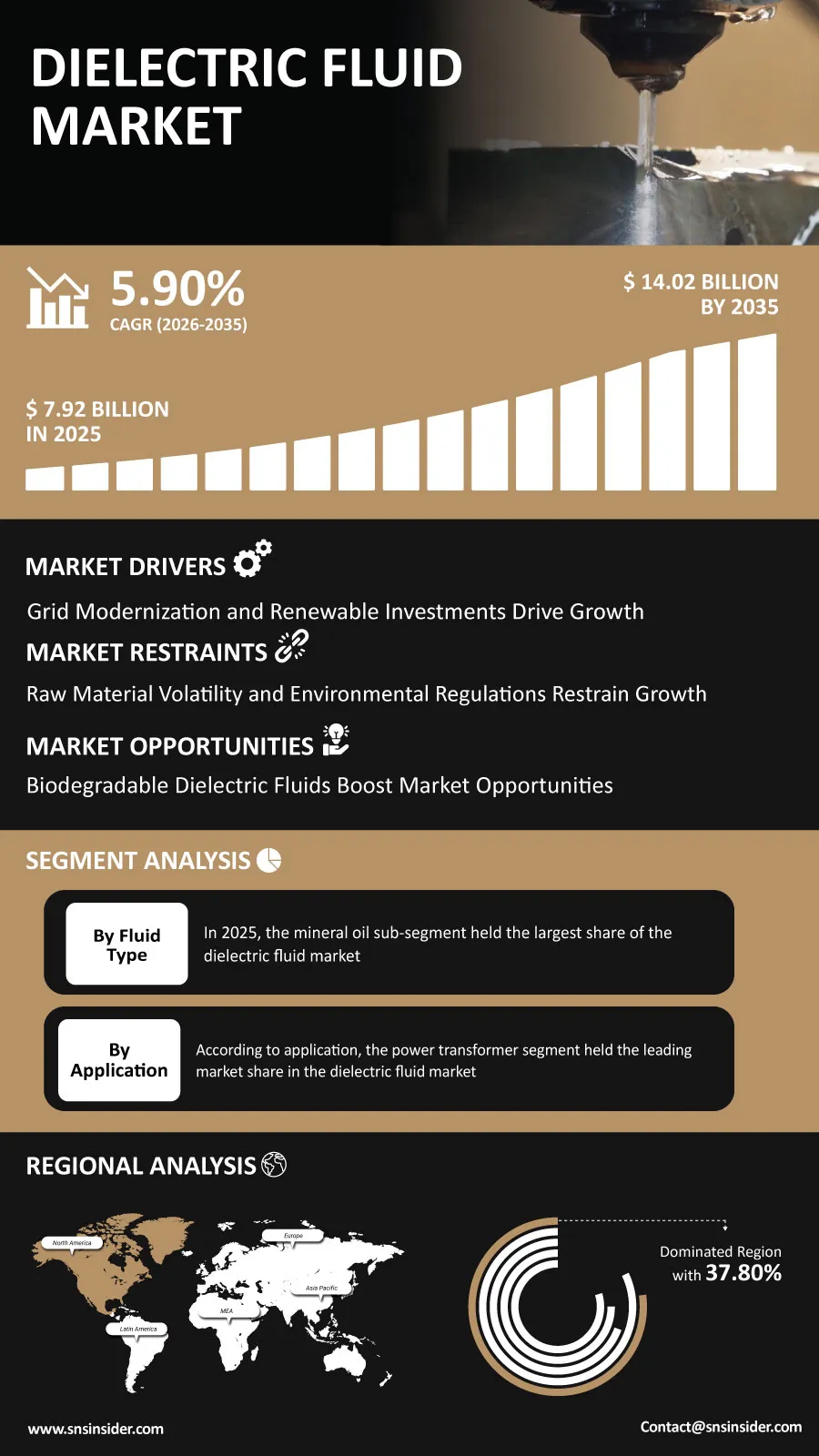
The global market for Dielectric Fluids is poised to enter an era of consistent growth as more players in the industry look towards better insulation and cooling systems. “According to a recent study by SNS Insider, the global Dielectric Fluid Market size valued at 7.92 Billion in 2025, is anticipated to grow to USD 14.02 Billion by 2035, registering a CAGR of 5.90% over the 2026–2035 forecast period.”
Advancements in existing power grids are driving up the demand for materials that have both insulating and thermal conductivity capabilities. With increased production from renewables, transmission capability, and power consumption, utility companies will be forced to modernize their transformers and other high-voltage devices. Furthermore, novel uses of these materials for electric cars and data centers will increase the addressable market.
To Get Detailed Insights on the Dielectric Fluid Market – Request a Sample Report
Grid Modernization and Clean Energy Investments Create New Opportunities
Increasing investments in power infrastructure resilient to external disruptions have created an additional driver of demand for dielectric fluids. Old transformers are replaced, power grid expansion is underway, and there is a need to integrate variable renewable energy sources into current systems. In all these cases, there is a requirement for reliable insulation and cooling solutions able to ensure optimal equipment operation despite harsh operational conditions.
The move towards greener solutions has also affected procurement decisions. Biodegradable natural and synthetic ester fluids have become more interesting because of their biodegradability and applicability in green technologies. Immersion cooling is one more area with growing potential because of increasing the density of computer equipment in modern data centers.
Key Market Insights Highlight Shifting Fluid and Application Demand
In terms of type of fluid, mineral oil had a market share of 53.80% in 2025 due to the well-known application of the fluid as an insulator in transformers, switchgear, and other electrical applications. It is expected that synthetic ester will be the fastest growing category of fluids, which will witness a CAGR of 7.06% till 2035 due to the increasing need for efficient and environment-friendly insulating fluids.
According to the chemical composition of insulating oils, hydrocarbons dominated the market with a 68.50% share in 2025. Esters is likely to register the fastest CAGR at 10.72%, as the utilities and industries are exploring other options with better environmental performance.
Power transformers accounted for 48.60% share of the global insulating oils market in 2025. Renewable energy is likely to witness the highest growth with a CAGR of 12.18% during the forecast period, on account of rising installations of wind energy, solar energy, and energy storage applications. By end-use industry, electrical accounted for 38.40% of the market share, whereas automotive is estimated to exhibit the highest CAGR of 13.03%.
Advanced Cooling Technologies Accelerate Product Innovation
Dielectric fluids are undergoing changes that extend beyond the realm of their use in transformers. Companies are developing fluids that will enable better heat conduction, insulation efficiency, environmental impact, and longevity of use. This becomes important for applications such as power electronics, batteries, and computer hardware infrastructure.
Immersion cooling has become strategically vital because of the rising processing demands on data centers. The ability to cool electronics by immersing them in liquid will facilitate efficient heat transfer while allowing for new formulas of cooling fluids to be developed. The same holds true for batteries and power electronics used in electric vehicles.
Asia Pacific Leads Growth as Regional Power Infrastructure Expands
North America was the largest regional market, representing 37.80% of the global market in 2025, owing to the existence of robust power infrastructure, grid upgrade projects, renewable energy generation capacity and increasing demand from data centers. The United States constituted 82.60% of the North American regional market, due to significant investments in power grids and electrical equipment.
The Asia Pacific region is projected to show the fastest growth up until 2035, driven by the rapid pace of industrialization, increased demand for electricity, renewable energy production and investments in grid infrastructure. China constituted 43.50% of the regional market in 2025 due to its strong manufacturing base for transformers and other electricity infrastructure.
Industry Participants Strengthen Sustainable Fluid Portfolios
Increasingly, competitiveness in the worldwide Dielectric Fluids Market depends on factors including product performance, environmental properties, specialized uses, and technology. Manufacturers have been broadening their product lines of esters, creating immersion cooling fluids, and enhancing their high voltage electrical systems.
Key companies operating in the global Dielectric Fluid Market include Shell plc, Exxon Mobil Corporation, Nynas AB, Cargill, Incorporated, M&I Materials Ltd., Ergon, Inc., Sinopec Lubricant Company, Savita Oil Technologies Limited, Repsol S.A., NYCO, 3M Company, The Chemours Company, Dow Inc., DuPont de Nemours, Inc., Prolec Energy, Soltex Inc., PetroChina Company Limited, Hydrodec Group plc, APAR Industries Limited, and Calumet, Inc.
An SNS Insider analyst Himanshu Sharma commented, “The modernization of global electricity infrastructure, rapid renewable energy deployment, and emerging demand for advanced thermal management are creating a broader opportunity for dielectric fluid manufacturers. Companies combining high electrical performance with biodegradable formulations and next-generation cooling capabilities will be positioned to address the evolving requirements of power networks, electric mobility, and digital infrastructure.”
About the Author

Get in touch




