
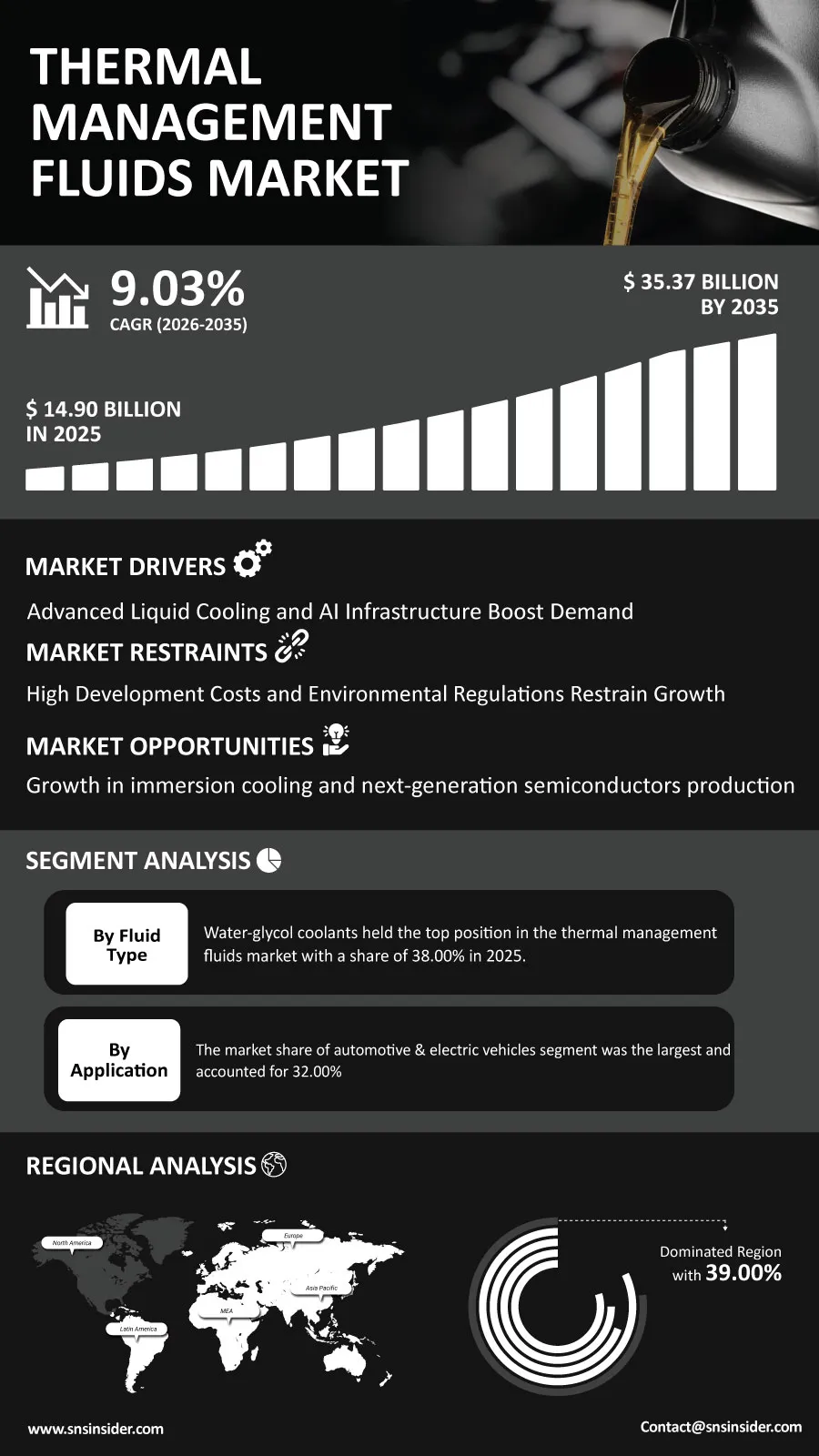
The global Thermal Management Fluids Market is heading towards a period of rapid expansion due to increasing demand for precise heat management from electrification and high-performance computing. “According to a recent study by SNS Insider, the global Thermal Management Fluids Market size valued at 14.90 Billion in 2025, is anticipated to grow to USD 35.37 Billion by 2035, registering a CAGR of 9.03% over the 2026–2035 forecast period.”
The need is increasing in the electric mobility, electronics, industrial machinery, renewable energy systems, and data centers sectors. Increased density of computing processes is leading air cooling to liquid cooling because of efficiency concerns, whereas battery producers need reliable thermal management for performance, safety, and longevity.
Formulation innovation is another factor helping the market. Manufacturers are now coming up with synthetics and dielectrics that offer better thermal stability, electrical insulation, oxidation stability, and environmental properties. Spending on semiconductors fabrication, hyper-scale computing, batteries manufacture, and industrial automation is increasing the demand for thermal management solutions.
To Get Detailed Insights on the Thermal Management Fluids Market – Request a Sample Report
AI Infrastructure and Electrification Create New Market Opportunities
The quick adoption of AI applications is becoming one of the key growth areas for the suppliers of thermal management fluids. Dense configurations of GPU-based servers produce a lot of heat and lead to the adoption of direct to chip and immersion cooling solutions that are able to deal with significantly higher thermal loads.
Growth in electric vehicle sales provides yet another significant growth potential. All parts of an electric vehicle – battery packs, electric motors, power electronics, charging stations – have to be properly cooled, and manufacturers of water-glycol, synthetic, and dielectric coolants are set to gain from it.
Moreover, environmental aspects push suppliers to develop new products. Development of heat-transfer technologies and fluids with low global warming potential continues.
Key Market Insights Highlight Shifting Demand Patterns
Based on the type of fluid, water-glycol coolants accounted for a 38.00% share of the market revenues in 2025 owing to their wide usage in automotive applications, industrial machinery, heating, ventilation, air conditioning and energy applications. Fluorinated dielectric fluids are anticipated to witness the fastest growth at a CAGR of 12.48% due to increasing adoption of immersion cooling in AI computing, servers, and semiconductors.
Application-wise, automotive and electric vehicles were the biggest application segments and accounted for a share of 32.00% in 2025 due to rising production of EVs and growing complexity of battery and power electronics systems. Data centers and high-performance computing are expected to witness the fastest growth at a CAGR of 13.76% owing to artificial intelligence, cloud computing, and high-density computing.
The market share in terms of end use industries was accounted for by Automotive & Transportation with a share of 30.00% in 2025. Information Technology & Data Centers will witness the highest growth rate at a 13.54% CAGR until 2035, driven by the use of liquid cooling technology.
Liquid Cooling Technologies Accelerate Industry Transformation
Thermal management technology is growing more and more interconnected with advanced computing architecture and electrification. Technologies like direct-to-chip cooling and liquid immersion enable the transfer of heat away from high-temperature parts and improve overall thermal management capabilities in addition to enabling denser equipment installations.
In parallel, next-generation fluids are being developed to have better lifetimes, increased compatibility, and decreased environmental impact. This trend is opening up new markets outside of traditional automotive and industrial thermal management into semiconductor, energy storage, renewable energy equipment, and AI infrastructure.
Regional Markets Demonstrate Strong Growth Potential
The North America region has the largest share at 39.00% in 2025, driven by large investments in EVs, hyperscale data centers, semiconductor fabrication, and industrial automation. The United States is the primary market in the region with a Thermal Management Fluids Market forecasted to grow from USD 5.29 billion in 2025 to approximately USD 13.01 billion in 2035, recording a 9.31% CAGR.
Asia Pacific will have the highest growth rate among all regions at a CAGR of 9.64% during 2025-2035. Large expansion in EV manufacturing, semiconductor fabrication, battery manufacturing facilities, renewable energy infrastructure, and digital infrastructure in China, Japan, South Korea, India, and Southeast Asia are increasing the demand for advanced thermal management fluids.
The benefits of electrification, industrialization, and environment-friendly policies are driving the Europe region. The Middle East and Africa, and Latin America regions present growth opportunities for the industry via data centers, renewable energy, industrialization, and automotive industries.
Industry Participants Focus on Advanced Cooling Solutions
Competition will continue to be innovation-based as companies look to diversify their specialty fluids offerings and pursue high-growth opportunities. The areas in which companies will be innovating include dielectric coolants, sustainable products, battery thermal management, and heat transfer for industrial applications.
Key companies operating in the global Thermal Management Fluids Market include Exxon Mobil Corporation, Shell plc, Chevron Corporation, BASF SE, Eastman Chemical Company, Dow Inc., Honeywell International Inc., Chemours Company, Engineered Fluids Inc., Arteco NV, Dynalene Inc., Paratherm Corporation, Valvoline Global Operations, Castrol Limited, TotalEnergies SE, FUCHS SE, Clariant AG, Phillips 66 Company, Petro-Canada Lubricants Inc., and LANXESS AG.
An SNS Insider analyst Himanshu Sharma commented, “The convergence of vehicle electrification, AI computing, and advanced semiconductor manufacturing is fundamentally increasing the need for high-performance thermal management. Companies developing efficient dielectric fluids, sustainable heat-transfer formulations, and application-specific cooling technologies are likely to capture significant opportunities as thermal loads continue to rise across next-generation infrastructure.”
About the Author

Get in touch




