
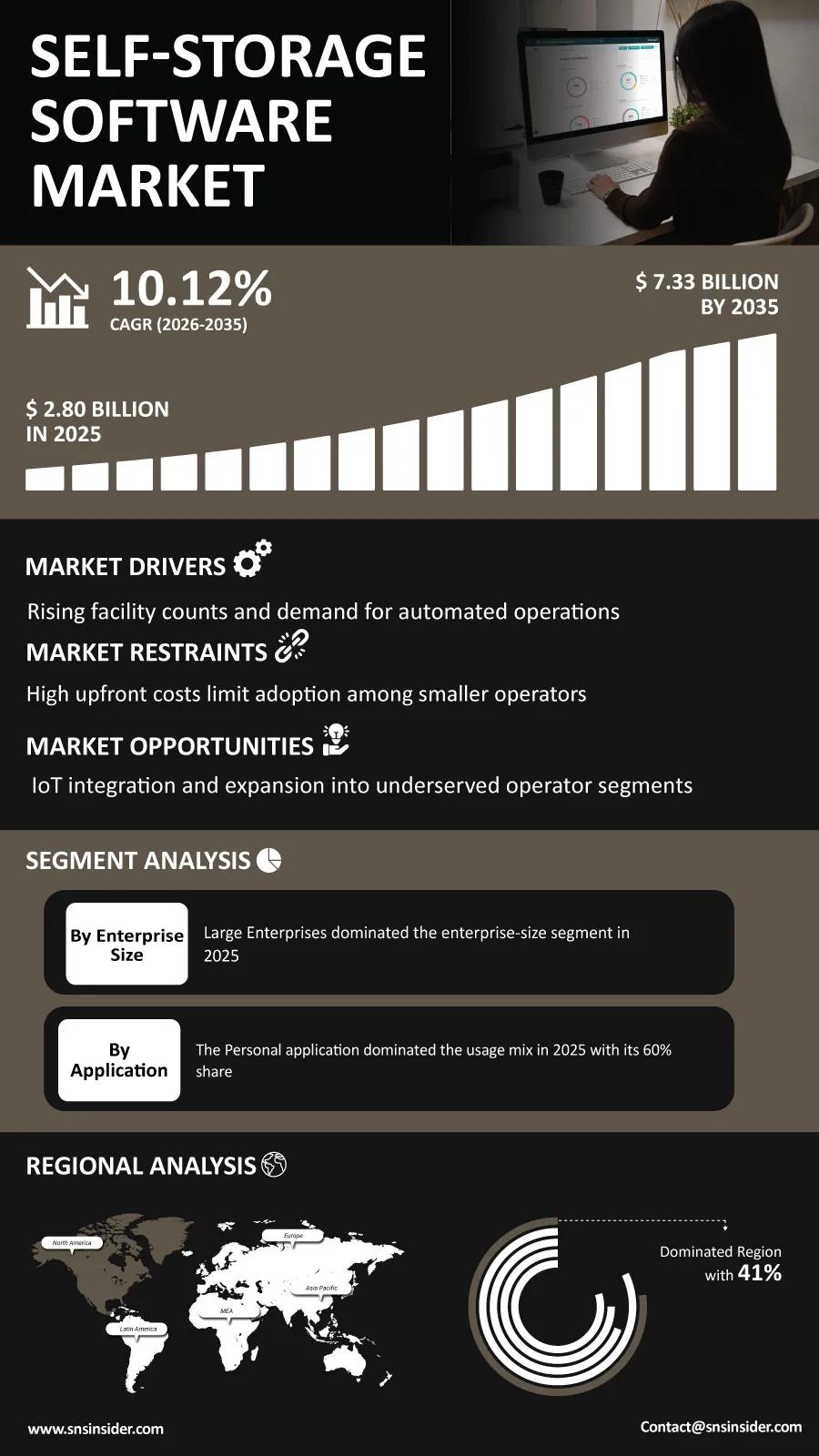
The global Self-Storage Software Market is entering a strong growth phase as storage operators modernize facility management and invest in connected digital infrastructure. “According to a recent study by SNS Insider, the global Self-Storage Software Market size valued at USD 2.80 billion in 2025, is anticipated to grow to USD 7.33 billion by 2035, registering a CAGR of 10.12% over the 2026–2035 forecast period.”
The evolution of the self-storage business from a mostly manual process to a technological one has created new requirements for dedicated software. There has been an increased need for centralized solutions for booking units, communicating with tenants, payment management, availability management, reporting, and access management. The growth of portfolios comprising several locations has increased the value of solutions that unite facility management in one digital space.
Contactless experiences are also gaining importance in this regard. Rentals online, electronic transactions, automatic alerts, digital access, and even remote surveillance not only reduce the workload but also offer tenants quicker and easier assistance. This is motivating operators to move from fragmented solutions to integrated software solutions.
To Get Detailed Insights on the Self-Storage Software Market – Request a Sample Report
Automation and Cloud Adoption Create New Growth Opportunities
Automation seems to be the main concern when it comes to investments in the self-storage space. Modern platforms connect business processes to smart gates, electronic locks, sensors, payments, and communications channels, which allows the operator to control the facility from a distance and react to the events that occur.
Another promising direction in this context is cloud deployment, especially in the case of companies with multiple storage facilities. With the help of the centralized dashboard, one can have full transparency in terms of occupancy rates, revenues, tenant activity, and overall performance of a facility without the need for expensive technological equipment to be installed on-site. The same can be used by independent operators in the form of cloud subscriptions.
AI is another factor that opens new opportunities for operators. Customer service assistance, payment reminders, demand forecasts, price recommendations, and even predictive maintenance can be provided by AI tools.
Key Market Insights Highlight Changing Customer and Operator Demand
By enterprise size, in 2025, Large Enterprises will dominate owing to the demand for large portfolio and multi-site operations in need of centralization for analysis, reporting, and revenue management services. Small & Medium Enterprises are expected to register the highest growth rate at a CAGR of 10.94% as a result of cost-efficient cloud-based technologies.
By application, Personal use was the largest segment at 60% in 2025 because of the consistent need for storage services amid moves, reductions in size, renovation, among other changes in households. It is projected that the business segment will witness the most growth up to 2035 at a compound annual growth rate of 11.51%.
By unit size, Large Units are forecast to grow at the fastest CAGR of 12.13%, supported by demand from commercial users and households requiring additional space for larger possessions and equipment.
By business model, Subscription-Based solutions dominated with a 71% revenue share in 2025 and are expected to remain the fastest-growing model at a 10.52% CAGR. Predictable recurring costs, continuous upgrades, and scalable cloud functionality are strengthening subscription adoption.
Intelligent Platforms Reshape Self-Storage Operations
The future self-storage software applications will transcend from simply managing the facility into data-enabled management through integration with the IoT. This way, managers can gain more control over access, security, equipment and even the physical state of their facilities. On the other hand, using analytics applications will enable managers to transform operational data into valuable information about occupancy rates, client behavior and performance of the facility.
Automation, artificial intelligence, cloud technologies and connected access technologies will make the use of software increasingly strategic for storage businesses. Providers of versatile software platforms suitable for single and portfolio management will be well-placed to meet growing demand.
North America Held 41% of the Self-Storage Software Market Share in 2025; Asia Pacific Projected to Register the Fastest CAGR Through 2035
North America generated 41% of the total revenue in 2025 and is therefore the largest regional market. This is due to the advanced storage industry in the region, the well-established technology infrastructure, and the adoption of digital management solutions. In North America, the U.S. alone generates approximately 81.60% of the revenue, and Canada provides more demand.
The Asia Pacific is expected to be the region with the highest growth through 2035, with a CAGR of approximately 12.12%. This is because urbanization, growing metropolitan populations, rising awareness of self-storage services, and digitization by new players provide significant opportunity for the market. The leading country in terms of demand is China, followed by Japan, South Korea, and Australia.
Europe, the Middle East & Africa, and Latin America are also experiencing growth opportunities due to expansion of urban centers and mobile and cloud storage solutions being used by storage companies.
Industry Participants Focus on Connected and Scalable Platforms
Competition remains active as vendors expand software capabilities across facility management, tenant engagement, payments, analytics, automation, and access control. Key companies operating in the global Self-Storage Software Market include Domico Software, RADical Systems (UK) Ltd, Corrigo Incorporated, Storable Group, U-Haul International, Inc., Syrasoft LLC, QuikStor Security & Software, E-Softsys LLC, 6Storage, Beloit Self-Storage, Cascade Self, Easy Storage Solutions, iStorage, OpenTech Alliance, Inc., Space Management Software, storEDGE, Yardi Systems, Inc., Storeganise Ltd, Tenant Inc., and Sitelink (Storable).
An SNS Insider analyst Sakshi Kale commented, “The increasing digitization of storage facilities is shifting software from an administrative tool into a core component of facility strategy. Cloud connectivity, intelligent automation, and integrated access technologies will continue creating opportunities for vendors capable of delivering scalable and user-focused platforms.”
About the Author

Get in touch




