
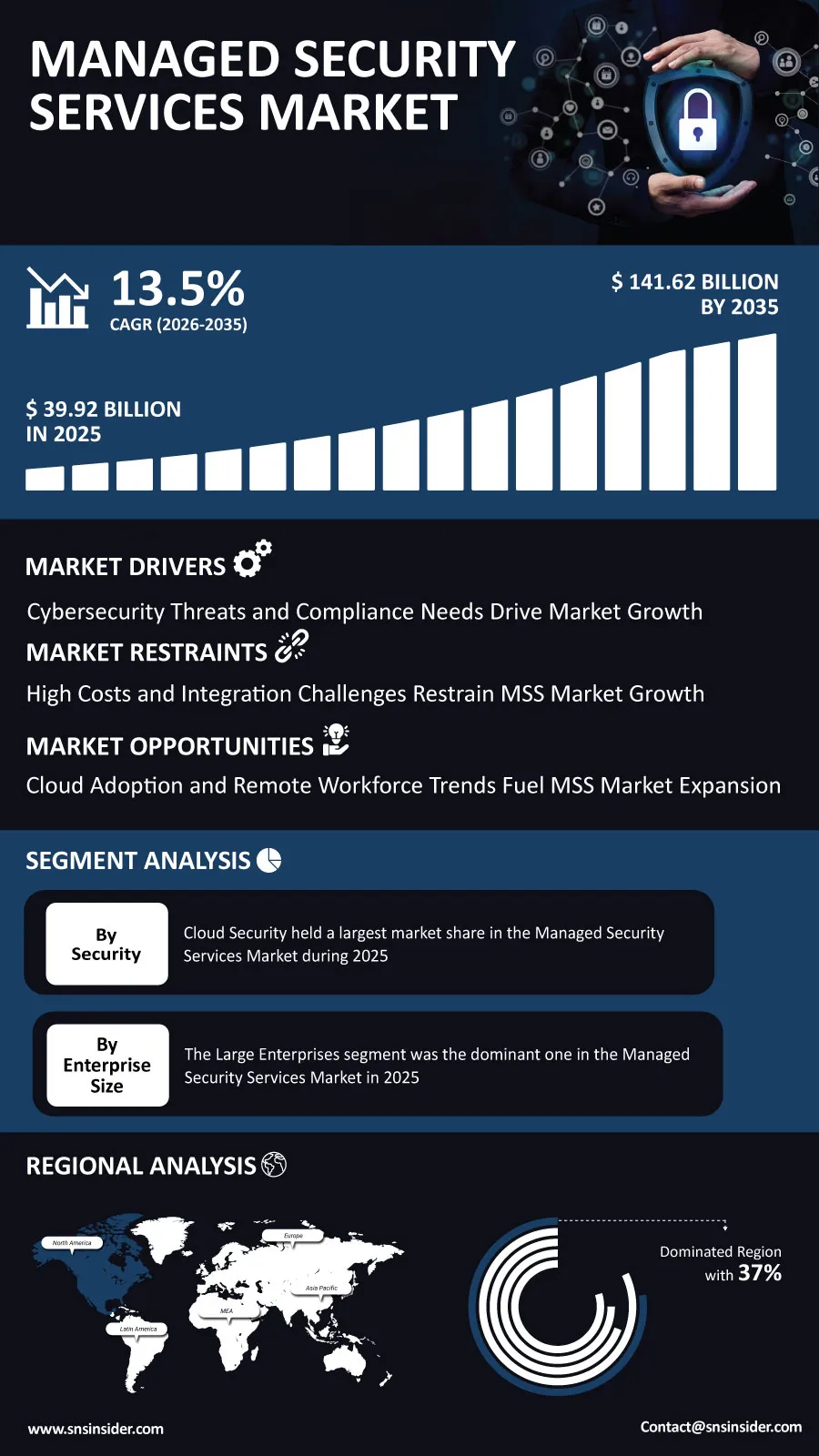
The global Managed Security Services Market is moving into a new era of growth as companies globally emphasize proactive cybersecurity approaches against an ever-growing complex digital threat environment. “According to a recent study by SNS Insider, the global Managed Security Services Market size valued at USD 39.92 billion in 2025, is anticipated to grow to USD 141.62 billion by 2035, registering a CAGR of 13.5% over the 2026–2035 forecast period.”
The increasing reliance on digital infrastructure has created a huge need for outsourced cybersecurity skills. The financial sector, health care, manufacturing industry, retail sector, and government agencies are increasingly turning towards managed security service providers to build up their resilience, while minimizing the complications of running their own cybersecurity programs. Monitoring, quick reaction to incidents, and intelligence have become essential parts of the modern enterprise cybersecurity approach.
In addition, the fast-paced transfer of operations to cloud computing platforms, increased use of hybrid workplace models, and connectivity of numerous devices are changing security objectives. Enterprises are moving towards managed solutions, which offer visibility 24/7, threat detection, and regulatory compliance help without having to invest heavily in their own cybersecurity personnel.
To Get Detailed Insights on the Managed Security Services Market – Request a Sample Report
AI-Driven Security Operations and Cloud Adoption Strengthen Long-Term Market Outlook
Enterprises are quickly increasing their investments in intelligent security platforms that can help identify & mitigate threats before cybercriminals disrupt the business due to repeated zero-day attacks. Throughout complex enterprise environments, managed security providers are leveraging artificial intelligence, behavioral analytics and automation to increase the accuracy of detections while reducing response times.
If so, cloud-first business strategies are also transforming cybersecurity later stage. From those operating in hybrid and multi-cloud environments that need unified visibility and consistent policy enforcement, to solutions that address the adoption of managed cloud security services as a more palatable option for organizations. Concurrently, increasing regulatory scrutiny around data privacy and digital risk management is also further embedding demand for outsourced security expertise.
Another major driver of growth is the growing shortage of experienced cybersecurity professionals. As a result, many enterprises are looking to work with managed security providers who can help through the combination of specialized expertise and advanced security technologies in addition to 24/7 operation support but without expanding corporate internal security teams.
Key Market Insights Highlight Shifting Enterprise Security Priorities
Due to security, Cloud Security generated around 34% of global market revenue in 2025 due to enterprise business priority and the need for better protection for cloud-native applications and distributed digital infrastructure. Through 2035, Endpoint Security is forecasted to be the fastest growing solution as companies work to protect networks of employee devices and connected systems.
Managed SIEM contributed nearly 29% in terms of market revenue to security services segment due to high demand for centralized security monitoring and compliance reporting in 2025. Managed XDR is expected to grow faster than other segments during the forecast period due to enterprises' need for a consolidated view across endpoints, cloud environments, networks and email systems.
As per enterprise size, Large Enterprises generated around 68% in term of revenue share, followed by Mega Sized Enterprises and Small Medium-sized Enterprise during the year, as they invested heavily on cyber security solutions and have complex digital infrastructures across all organisation functions. As managed security services are becoming affordable, subscription models will be adopted much quicker by small and medium-sized enterprises.
BFSI on account of stringent regulatory norms and increase in cyber threats against financial institutions, held approximately 24% market share in total across industry verticals, by 2025. Healthcare is projected to become the fastest-growing vertical because hospitals and healthcare providers ramp up protection over electronic health records and connected medical products.
Advanced Threat Intelligence and Automation Reshape Cybersecurity Services
More companies are using AI, machine learning, and automation in MSSPs — managed security providers integrated into security operations centers focused on enhanced operational efficiency to offer better threat response times. Promising automated investigation capabilities, predictive analytics and intelligent orchestration are enabling organizations to lessen manual workloads at the same time that they help organizations react to changing cyber threats faster.
Zero-trust security frameworks, managed detection and response (MDR), extended detection and response (XDR) and identity-centric security architectures are going mainstream for enterprise cybersecurity strategies. As digital transformation initiatives proliferate around the world, service providers are also growing advisory capabilities to help organizations boost governance, compliance and cyber resilience.
North America Held 37% of the Managed Security Services Market Share in 2025; Asia Pacific Projected to Register the Fastest Growth Through 2035
North America held the leading share of nearly 37% revenue worldwide in 2025, which can be attributed to advancements in digital infrastructure and ample investments toward cybersecurity and adoption of managed security services among end-use industries such as banking, healthcare, government, & technology. Enterprise demand for cloud security, threat intelligence and managed detection services remains robust across the region.
Due to digital transformation across emerging economies, Asia Pacific is likely to grow at the fastest rate for the market by 2035. Factors such as fast cloud adoption in the digital economy, organizations adopting an expansive e-commerce ecosystem, increased awareness of risk management and cybersecurity activities being promoted by governments for establishing a holistic digital infrastructure across the region leading managed security providers to accelerate throughout the region.
European organizations are in a well-founded position as they reinforce compliance efforts to dynamic data protection regulations along with building upon their number of advanced cybersecurity capabilities. Conversely, Latin America and the Middle East & Africa are enjoying incremental gains in cybersecurity spending as enterprises modernize digital infrastructure to scale while enhancing their ability to withstand an ever-growing range of cyber risks.
Industry Participants Focus on AI-Powered Security Innovation
The competition in the managed security services market remains stiff, with tech players improving AI-enabled security operations, cloud protection abilities and automated incident response platforms. Long-term growth strategies continue to rely on strategic partnerships, integration into platforms, and investments in next-generation security analytics.
Key companies operating in the global Managed Security Services Market include IBM Corporation, Accenture plc, Cisco Systems Inc., Palo Alto Networks, CrowdStrike Holdings Inc., Fortinet Inc., Secureworks Inc., Check Point Software Technologies Ltd., Rapid7 Inc., Sophos Ltd., Arctic Wolf Networks Inc., SentinelOne Inc., AT&T Cybersecurity, Verizon Business, NTT DATA Group Corporation, Tata Consultancy Services, Infosys Limited, Wipro Limited, HCLTech, and DXC Technology.
An SNS Insider analyst Sakshi Kale commented, "Organizations are moving beyond traditional perimeter security toward intelligent, continuously managed cybersecurity ecosystems. The growing convergence of AI, cloud security, automation, and managed detection capabilities is expected to create substantial opportunities for solution providers supporting enterprise cyber resilience over the next decade."
About the Author

Get in touch




