
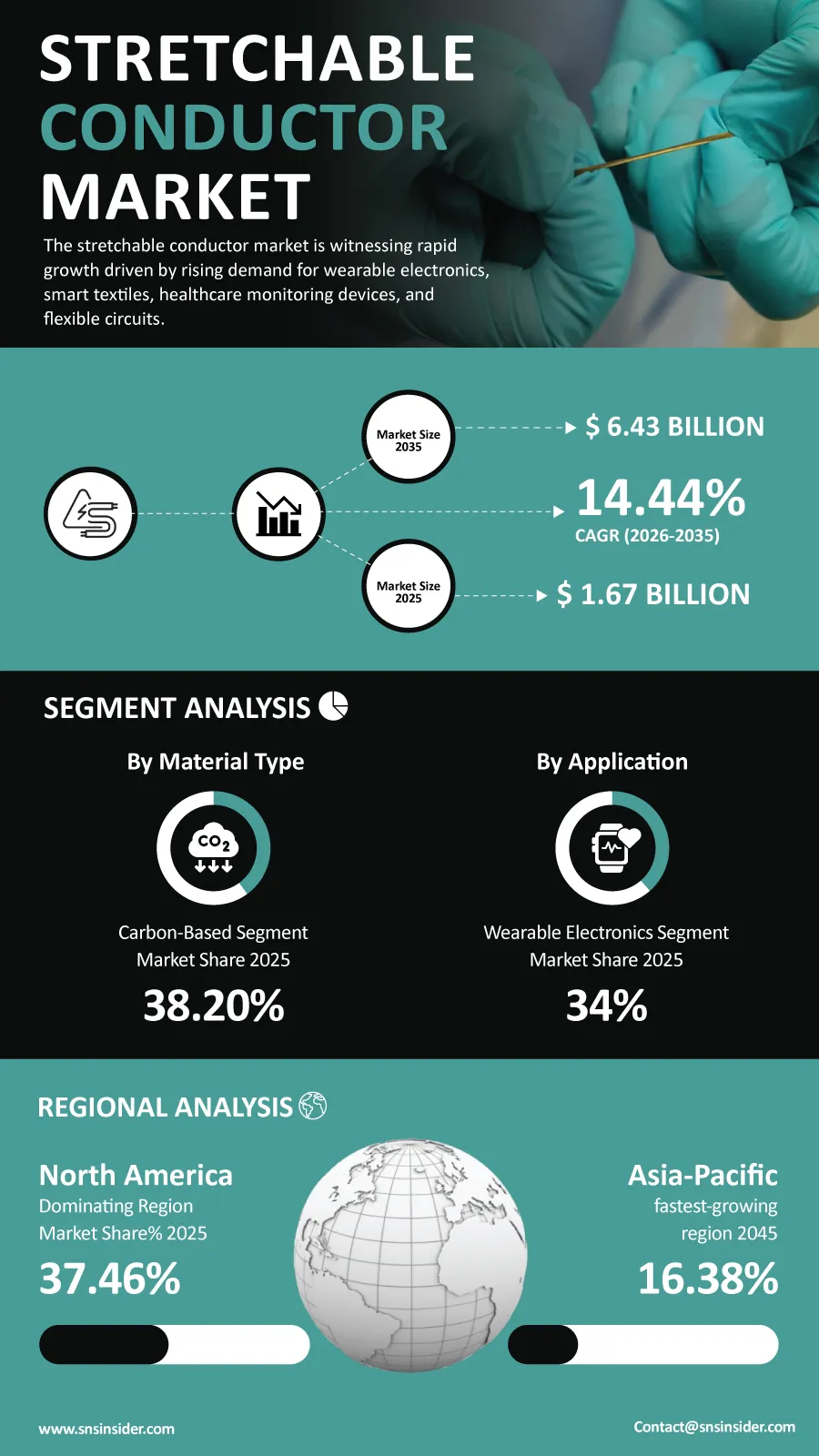
The worldwide Stretchable Conductor market is set to witness strong growth during the next ten years due to rapid developments in flexible electronics technology in sectors such as healthcare, consumer electronics, automotive and industrial. According to a recent study by SNS Insider, the global Stretchable Conductor Market size valued at USD 1.67 billion in 2025, is anticipated to grow to USD 6.43 billion by 2035, registering a CAGR of 14.44% over the 2026–2035 forecast period.
Fast progress in wearable electronics, smart textiles, and flexible sensors is revolutionizing electronic component design and integration into future generation devices. Stretchable conductors have become a crucial breakthrough technology that ensures reliable electrical behavior while being elastic enough for bending and deformation.
The emphasis in manufacturers' work is being increasingly placed on creation of highly conducting, light, and durable materials to satisfy requirements of sophisticated electronic systems. The continuous development of conductive ink, flexible substrate, polymer engineering, and manufacturing technologies is supporting commercialization of multifunctional electronic devices.
To Get Detailed Insights on the Stretchable Conductor Market – Request a Sample Report
Expanding Flexible Electronics Ecosystem Creates Significant Growth Opportunities
Increasing interest in developing small-size, lightweight, and intelligent electronic devices is driving companies to adopt the use of stretchable conductive materials in different kinds of applications. Whether it is about designing devices for continuous monitoring of physiological parameters, wearable devices for exercise monitoring, intelligent textiles or industrial sensors, the development of stretchable conductive materials is leading to innovative designs that not only offer performance but also comfort in use.
Furthermore, developments in the area of architecture of such materials are enhancing their conductivity, mechanical durability, and reliability in terms of service life. Besides, improvements in production technologies have made the process simpler and scalable for commercialization.
Moreover, greater funding in the areas of sustainable materials, biodegradable electronics, and functional conductive systems is creating new opportunities for innovation as companies search for environmentally friendly methods that do not hinder performance.
Key Market Insights Highlight Shifting Demand Patterns
Depending on the material used, carbon-based materials captured a revenue share of 38.20% of the global market by 2025 owing to its superior electrical properties, mechanical strength, and application in flexible electronics. The polymer-based materials will be registering the highest CAGR of 16.89% by 2035 due to the rising demand for light weight and high elasticity conductive materials.
When it comes to the application, the market was led by wearables with a share of 34.00% of revenue generated in 2025. This is as a result of an increased adoption of wearables across various consumer electronics, smart clothing, and connected devices. The fastest-growing segment would be the biomedical device with a CAGR of 17.07%.
Based on end-use industries, the healthcare segment generated 35.50% of global revenue by 2025 due to the increasing use of patient monitoring devices, rehabilitation equipment, and wearable medical devices. On the other hand, emerging applications in other industries will grow at the fastest rate with a CAGR of 17.51% driven by increasing deployment of wearable health monitoring systems, biosensors, and advanced medical electronics.
Based on technology types, flexible and stretchable conductor technologies will account for 40.40% of the market share in 2025. The biodegradable and eco-friendly technologies will show the fastest growth among the segments due to an increased focus on sustainable technologies.
Advanced Material Innovation Continues to Transform Flexible Electronics
Innovations are happening quickly in the world of flexible electronics as the companies are designing new conductive materials that ensure the efficient functioning of electrical circuits despite harsh working environments. New developments in the field of conductive polymers, nanomaterials, silver nanowires, and composites have drastically improved the efficiency of materials, their flexibility, and manufacturing process.
Furthermore, the industry is working on the creation of multifunctional materials that are responsible not only for conductivity but also for sensing, thermal management, and communication tasks. Such technologies will help to create the next generation of wearables and healthcare systems, as well as industrial and consumer electronics.
North America Accounts for 37.46% of Global Revenue in 2025, with Asia Pacific Recording a 16.38% CAGR
In 2025, North America is estimated to dominate the global market with 37.46% share due to the presence of extensive research capabilities, early adoption of flexible electronics technology, and adoption of wearable health care devices. Leading material sciences firms and electronics firms have continued to make the region competitive.
Asia-Pacific is anticipated to register high market growth in the period up to 2035, growing at a CAGR of 16.38%. Rapid growth in the production of electronics, increased production of wearable devices, increased investment in printed electronics, and favorable government policies in China, Japan, and South Korea are fueling growth in the market.
With the increasing commercialization of flexible electronics in different industries, the demand for advanced stretchable conductors is expected to grow consistently around the world.
Industry Participants Focus on Material Innovation
This market is characterized by continued dynamism with companies leading in this industry still focusing on investing in conductive materials, flexible substrates, production technologies, and environmentally sustainable products. Continued research collaborations and advancements in material will be crucial competitive factors in the coming years.
Key companies operating in the global Stretchable Conductor Market include DuPont, 3M, Toyobo Co., Ltd., Henkel AG & Co. KGaA, Advanced Nano Products Co., Ltd., Agfa-Gevaert Group, Applied Nanotech, Inc., Vorbeck Materials Corp., Dow Inc., Indium Corporation, Parker Hannifin Corporation, Creative Materials Inc., PolyOne Corporation, StretchSense Ltd., Canatu Oy, TactoTek Oy, Nissha Co., Ltd., Sun Chemical Corporation, Daikin Industries, Ltd., and Heraeus Holding GmbH.
An SNS Insider analyst Sushant Kadam commented, “The rapid evolution of wearable electronics, flexible healthcare technologies, and smart materials is creating strong momentum for stretchable conductors worldwide. Companies that prioritize material innovation, scalable manufacturing, and multifunctional performance will be well positioned to capitalize on expanding opportunities across the flexible electronics ecosystem.”
About the Author

Get in touch




