
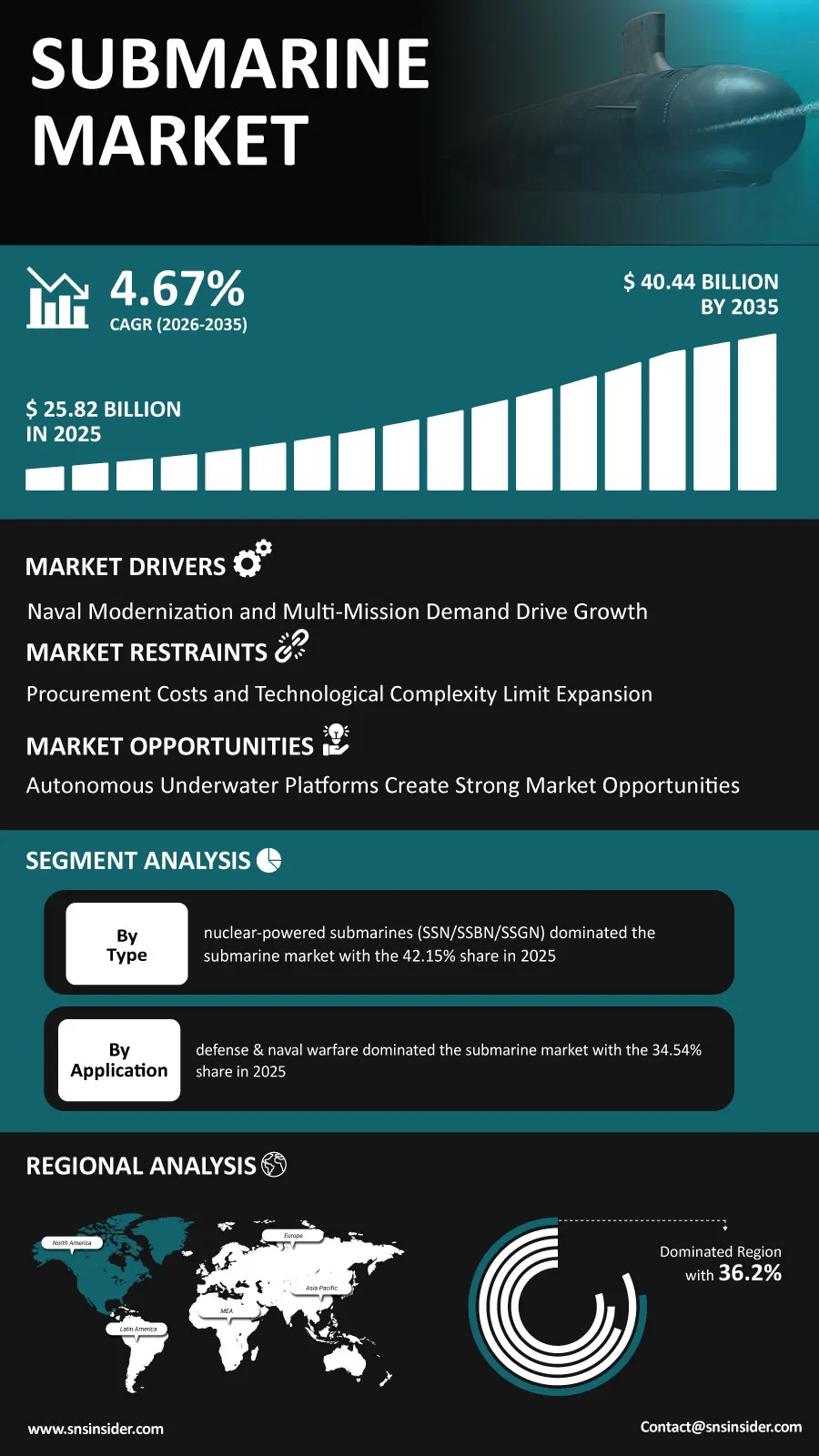
The global Submarine Market is set for steady expansion as governments strengthen underwater defense capabilities, replace aging fleets, and invest in platforms designed for extended maritime missions. “According to a recent study by SNS Insider, the global Submarine Market size valued at USD 25.82 billion in 2025, is anticipated to grow to USD 40.44 billion by 2035, registering a CAGR of 4.67% over the 2026–2035 forecast period.”
An increasing trend of emphasis on maritime domain awareness, strategic deterrence, and underwater intelligence is impacting the procurement trends among several powerful navies around the world. The latest generation platforms are equipped with advanced sensors, communication systems, combat management systems, and low observables in order to perform their missions. The long-term fleet renewal programs are ensuring consistent demand for vessels, modernizations, and components.
The naval fleets are adopting alternative means of propulsion based on the mission demands. The nuclear propulsion is a popular method for enduring operations, whereas the air independent propulsion and hybrid propulsion are getting traction due to their stealth capabilities.
To Get Detailed Insights on the Submarine Market – Request a Sample Report
Naval Modernization and Maritime Security Create New Growth Opportunities
Modernization of defenses continues to be an important catalyst for the submarine industry as countries look to enhance their capabilities in the water without solely depending on their existing fleets. Purchasing programs in the United States, China, India, Europe, and elsewhere have been contributing to the demand for new-generation submarines.
Submarines are not only useful in conventional warfare but also hold significant importance due to their capacity for covert operations. These capabilities make them highly useful for intelligence gathering and surveillance purposes. This is making navies more inclined towards investing in sensors, communication equipment, autonomy, and command-and-control systems.
Increasing developments in digital naval architecture provide an opening for suppliers. Artificial intelligence, autonomous underwater technology, digital twinning, and acoustic innovations can enhance mission planning, maintenance, detection, and management throughout their lifecycle.
Key Market Insights Highlight Changing Submarine Procurement Priorities
By propulsion system, nuclear propulsion represented the largest segment with a 44.51% market share in 2025. Its position reflects the operational endurance and sustained power availability required for strategic and long-range missions. Hybrid/Air-Independent Propulsion systems are projected to achieve the fastest growth as navies seek quieter conventional platforms with improved underwater endurance.
By type, nuclear-powered submarines accounted for 42.15% of market revenue in 2025. Their strategic role and extended operational range continue to support investment. Meanwhile, AIP submarines are expected to record the fastest expansion through 2035, particularly for nations prioritizing coastal defense and stealth-oriented conventional fleets.
By application, Defense & Naval Warfare held 34.54% market share in 2025. Intelligence, Surveillance & Reconnaissance (ISR) is anticipated to grow at the fastest pace as underwater sensing becomes increasingly important for maritime situational awareness.
Based on combat system, Torpedo Systems led with 38.46% of market revenue in 2025, while Sonar & Detection Systems are forecast to register the fastest growth as navies emphasize underwater threat identification and enhanced situational awareness.
Digital Technologies Accelerate Underwater Defense Transformation
Submarines are now evolving towards digital integration systems. Technologies like digital sonar processing, data analysis, communication capabilities, and sensors fusion are assisting crew to understand complicated underwater environments better.
Manufacturers are also focusing on the development of low-noise power systems, better sound insulation techniques, high-tech materials, and stealth technology. Development of autonomous underwater vehicles and artificial intelligence-enabled navigation systems is providing new opportunities for monitoring and reconnaissance as well as increasing mission efficiency and safety.
Such trends are also influencing the way submarines are maintained. Digital engineering and lifetime monitoring will assist in identifying wear and tear at an earlier stage and thus optimizing maintenance plans.
North America Accounted for 36.2% Market Share in 2025; Asia Pacific Forecast to Expand at a 5.39% CAGR by 2035
North America accounted for about 36.2% of total market revenue in 2025 on account of major investments in naval modernization and in developing the capabilities of nuclear submarines. The U.S. is considered the key country as the Virginia and Columbia classes support long-term procurement activities and development of the industry. Submarine capabilities and the defense industry are being developed in collaboration under AUKUS.
The Asia Pacific region is projected to witness the fastest growth of about 5.39% CAGR till 2035. Rising naval fleets, defense budgets, and increasing focus on maritime security drive the need for submarines in China, India, Japan, South Korea, and Australia. Shipbuilding activities in the region are bolstering the capabilities.
Europe is of strategic importance due to the necessity of addressing the issues of maritime security along with modernizing conventional and nuclear submarines. On the other hand, the regions of the Middle East, Africa, and Latin America are slowly building their capabilities in terms of underwater warfare.
Industry Participants Advance Next-Generation Underwater Capabilities
Competition remains centered on propulsion innovation, acoustic performance, combat systems, digital shipbuilding, and lifecycle support. Leading defense contractors are expanding production capabilities while integrating advanced sensors and software into submarine platforms.
Key companies operating in the global Submarine Market include General Dynamics Electric Boat, Huntington Ingalls Industries, BAE Systems, Naval Group, ThyssenKrupp Marine Systems, Fincantieri, Saab Kockums, Mitsubishi Heavy Industries, Kawasaki Heavy Industries, Hyundai Heavy Industries, Hanwha Ocean, United Shipbuilding Corporation, Admiralty Shipyards, Sevmash, Mazagon Dock Shipbuilders, Larsen & Toubro, Lockheed Martin, Northrop Grumman, Thales Group, and Leonardo S.p.A.
An SNS Insider analyst Santosh Bhul commented, “The continued modernization of naval fleets, rising importance of underwater intelligence, and advances in propulsion, sonar, and digital systems are creating durable opportunities for the submarine industry. Companies capable of combining stealth, endurance, connectivity, and advanced mission technologies will be well positioned as maritime security priorities evolve.”
About the Author

Get in touch




