
According to the latest SNS Insider Clinical Documentation Improvement Market report, demand is growing because hospitals and physician groups need accurate records to get paid correctly. Every missed diagnosis or vague note can lead to a denied claim, a lower payment, or an audit finding. Clinical documentation improvement (CDI) programs close these gaps before claims go out.
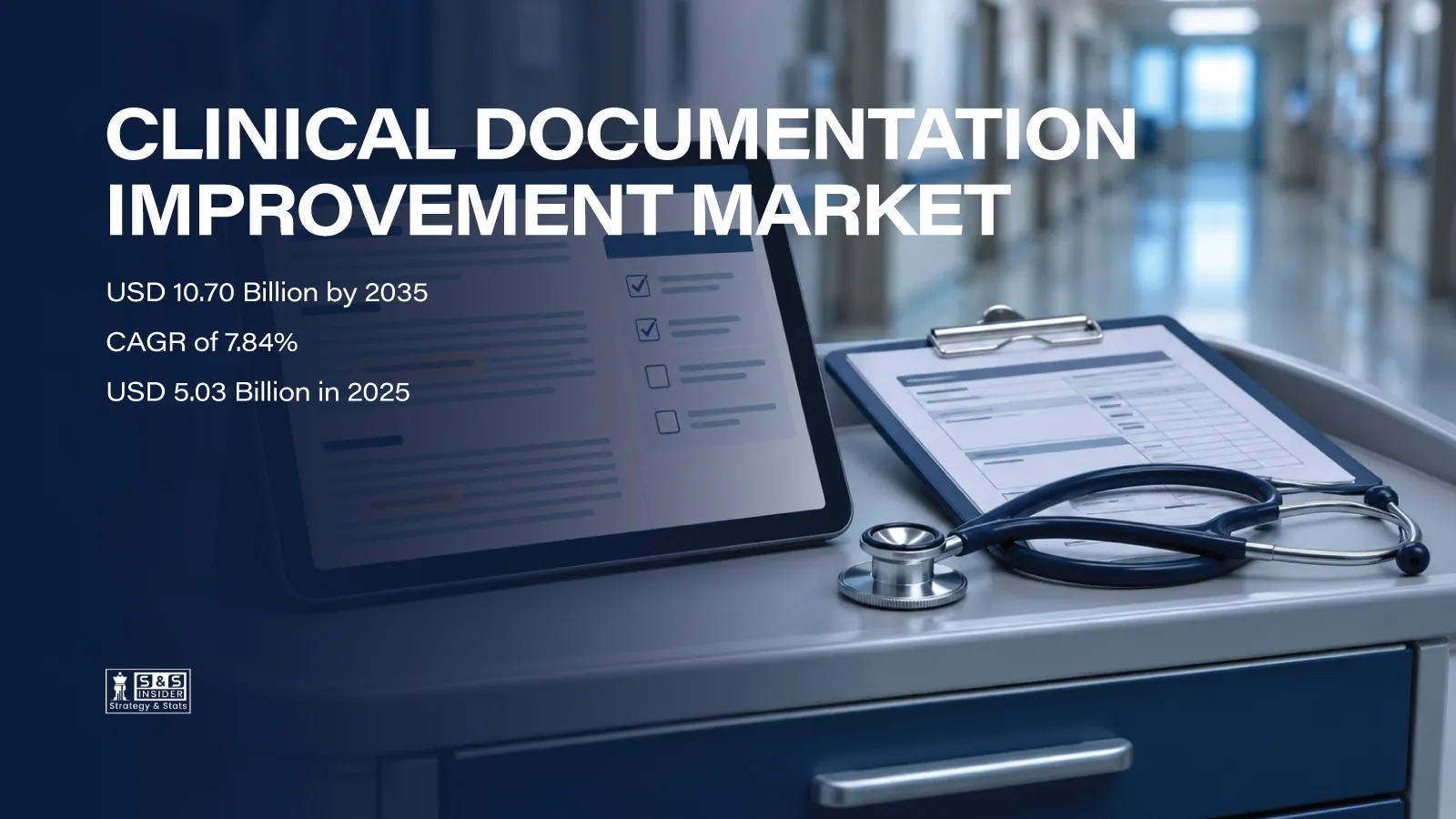
The global clinical documentation improvement market was valued at USD 5.03 Billion in 2025 and is estimated at USD 5.42 Billion in 2026. It is projected to reach USD 10.70 Billion by 2035, growing at a CAGR of 7.84% during 2026–2035.
Services still make up most of the spending, because many providers rely on outside specialists to review charts and manage queries. Software is growing faster as natural language processing and ambient listening tools take over routine review work.
Revenue cycle and coding accuracy remain the main use of CDI today. Risk adjustment and value-based care are growing faster, because payment under these models depends on how fully a patient’s conditions are recorded.
North America is the largest regional market, and Asia Pacific is the fastest growing region.
To Get Detailed Insights on the Clinical Documentation Improvement Market – Request a Sample Report
Demand Drivers and Constraints
Primary Demand Drivers
-
Revenue integrity and claim denials: Providers use CDI to catch gaps in records before billing, which reduces denials and lost payments.
-
Value-based care and risk adjustment: Payment depends more on complete diagnosis capture, so accurate records have a direct effect on revenue.
-
NLP and ambient documentation: AI tools read notes and listen to visits, which makes chart review faster and less manual.
-
Shortage of specialists and coders: Fewer trained staff push providers toward software and outsourced services.
-
Audit scrutiny and quality reporting: Payers and regulators review records more closely, so providers need defensible documentation.
Potential Growth Constraints
-
Compliance risk and regulatory scrutiny of query practices.
-
Physician documentation burden and query fatigue.
-
High integration and implementation costs.
-
Data privacy and interoperability limitations.
Demand Structure by Component
Services (2025 Market Share: 52.37%)
Services held 52.37% of the clinical documentation improvement market in 2025. Many hospitals do not have enough trained CDI specialists, so they hire outside firms to review charts, send queries to physicians, and train staff. Outsourcing gives them access to experienced reviewers without long hiring cycles. Service firms also help with audits and program setup, which smaller providers find hard to manage alone. Demand should stay strong because staff shortages are not expected to ease soon, and new payment rules keep raising documentation standards.
Current trend: More providers outsource chart review and query management to specialist firms.
Major trends: Remote CDI reviews, audit support, staff training programs, and blended service and software contracts.
Software (Forecast CAGR: 9.46%)
Software is projected to grow at a CAGR of 9.46% through 2035. CDI platforms now use natural language processing to scan notes and flag missing or unclear details for review. This lets a small team cover far more charts each day. Ambient tools also capture the visit as it happens, so the first draft of the note is more complete. As vendors build these features into electronic record systems, adoption becomes easier and cheaper. Providers see software as the main way to scale CDI without adding staff.
Current trend: Shift from manual chart review to AI-assisted review platforms.
Major trends: NLP chart scanning, ambient documentation, automated query tools, and EHR-embedded CDI.
Demand Structure by Deployment Mode
On-Premises (2025 Market Share: 54.29%)
On-premises deployment accounted for 54.29% of the market in 2025. Large hospitals often run CDI tools on their own servers next to their electronic record systems. This setup gives them direct control over patient data and fits existing security policies. Many of these systems were installed years ago and are tightly linked to coding and billing workflows. Replacing them takes time and money, so on-premises systems remain common, especially in large health systems with in-house IT teams.
Current trend: Large hospitals keep CDI tools close to their core record and billing systems.
Major trends: Local data control, EHR integration, system upgrades, and gradual hybrid moves.
Cloud-Based (Forecast CAGR: 10.12%)
Cloud-based deployment is projected to grow at a CAGR of 10.12% during 2026–2035. Cloud tools cost less to start, need little local IT support, and receive updates automatically. This suits physician groups and smaller hospitals that lack large IT teams. AI features such as ambient documentation also run best on cloud platforms with large computing capacity. As security controls improve and vendors offer healthcare-specific compliance, more providers are willing to move CDI work to the cloud.
Current trend: Faster adoption of subscription-based CDI tools by smaller providers.
Major trends: Software as a service, cloud AI models, remote access, and usage-based pricing.
Demand Structure by Application
Revenue Cycle and Coding Accuracy (2025 Market Share: 41.62%)
Revenue cycle and coding accuracy represented 41.62% of the market in 2025. This is the original purpose of CDI. Clear and complete notes lead to correct codes, and correct codes lead to correct payment. When records are vague, claims are denied or paid at a lower rate. Hospitals therefore treat CDI as a direct way to protect revenue. Rising denial rates and tighter payer reviews keep this application at the center of most CDI programs.
Current trend: Hospitals link CDI programs closely to denial prevention.
Major trends: Pre-bill reviews, coding validation, denial analytics, and automated coding support.
Risk Adjustment and Value-Based Care (Forecast CAGR: 9.37%)
Risk adjustment and value-based care is projected to grow at a CAGR of 9.37% through 2035. Under these payment models, providers are paid based on how sick their patients are. If chronic conditions are not recorded each year, payment falls even when care is the same. This makes full and accurate diagnosis capture very important. Health systems and physician groups that join value-based contracts are investing in CDI tools that review records before and after visits.
Current trend: Growing focus on full diagnosis capture for risk-based contracts.
Major trends: Pre-visit chart review, hierarchical condition category (HCC) coding support, quality measure tracking, and outpatient CDI.
Demand Structure by End User
Hospitals (2025 Market Share: 61.48%)
Hospitals accounted for 61.48% of the market in 2025. They handle complex inpatient cases, where small documentation gaps can change payment by large amounts. Most large hospitals run formal CDI teams that review charts daily and work with physicians on queries. They also face the most audits and quality reporting duties. These factors make hospitals the largest buyers of both CDI software and services, and their spending is expected to stay steady through the forecast period.
Current trend: Hospitals expand CDI from inpatient units into other departments.
Major trends: Enterprise CDI programs, AI-assisted review, quality reporting support, and physician engagement tools.
Physician Groups and Ambulatory Centers (Forecast CAGR: 9.12%)
Physician groups and ambulatory centers are projected to grow at a CAGR of 9.12% through 2035. More care is moving out of hospitals, and many groups now take part in value-based contracts. Their payment depends on accurate records, but they rarely have full CDI teams. Cloud tools and ambient documentation give them an affordable way to improve notes without adding staff. As outpatient volumes rise, this segment is becoming an important source of new demand.
Current trend: Outpatient providers adopt lighter, cloud-based CDI tools.
Major trends: Ambient scribes, outpatient risk adjustment, point-of-care prompts, and outsourced reviews.
Key Market Participants
The clinical documentation improvement market includes healthcare software companies, electronic record vendors, revenue cycle firms, and AI documentation startups.
Key participants include Solventum Corporation, Microsoft Corporation, Optum, Inc., Waystar Holding Corp. (Iodine Software), Oracle Health, Epic Systems, MEDITECH, CorroHealth, Fathom Health, Suki AI, Abridge AI, and Commure.
Competition centers on AI accuracy, ease of use for physicians, integration with electronic records, and measurable revenue results. Vendors that reduce physician workload while improving record quality are best placed as providers look for tools that pay for themselves.
Regional Market Dynamics
North America (2025 Market Share: 41.38%)
North America led the global clinical documentation improvement market with a 41.38% share in 2025. The United States accounts for 91.46% of regional demand, supported by complex billing rules, high audit activity, and wide use of value-based contracts. The U.S. market was valued at about USD 1.90 Billion in 2025 and is projected to grow at a CAGR of 8.21%. Most large health systems already run CDI programs and are now adding AI tools. Canada adds smaller demand through hospital quality and data programs.
Direction: Continued leadership supported by revenue protection needs and fast AI adoption.
Direction: Steady growth driven by coding quality programs and diagnosis-based funding.
Asia Pacific (Forecast CAGR: 8.43%)
Asia Pacific is expected to grow fastest, with a CAGR of 8.43% through 2035. Japan is the largest country market with 28.37% of regional demand, supported by an aging population and diagnosis-based hospital payment. China, India, Australia, and South Korea are expanding electronic records, which creates the base for CDI tools. Rising insurance coverage also increases the need for accurate claims. Cloud tools give new hospitals an easier way to adopt CDI.
Direction: Fastest regional growth supported by record digitization and wider insurance coverage.
Overall, the clinical documentation improvement market is set for steady expansion through 2035, with success depending on AI accuracy, physician ease of use, record system integration, and clear revenue results.
About the Author

Get in touch




