
According to the latest SNS Insider Mobile TV Market report, the global market is entering a period of sustained growth as consumers increasingly access live television, sports, films and on-demand entertainment through smartphones and other portable devices.
The mobile TV industry is undergoing a transformation driven by affordable internet connectivity, expanding 4G and 5G infrastructure and changing entertainment consumption patterns. Streaming platforms are introducing mobile-specific subscriptions, personalized recommendations and advertising-supported services to attract audiences across different income groups.
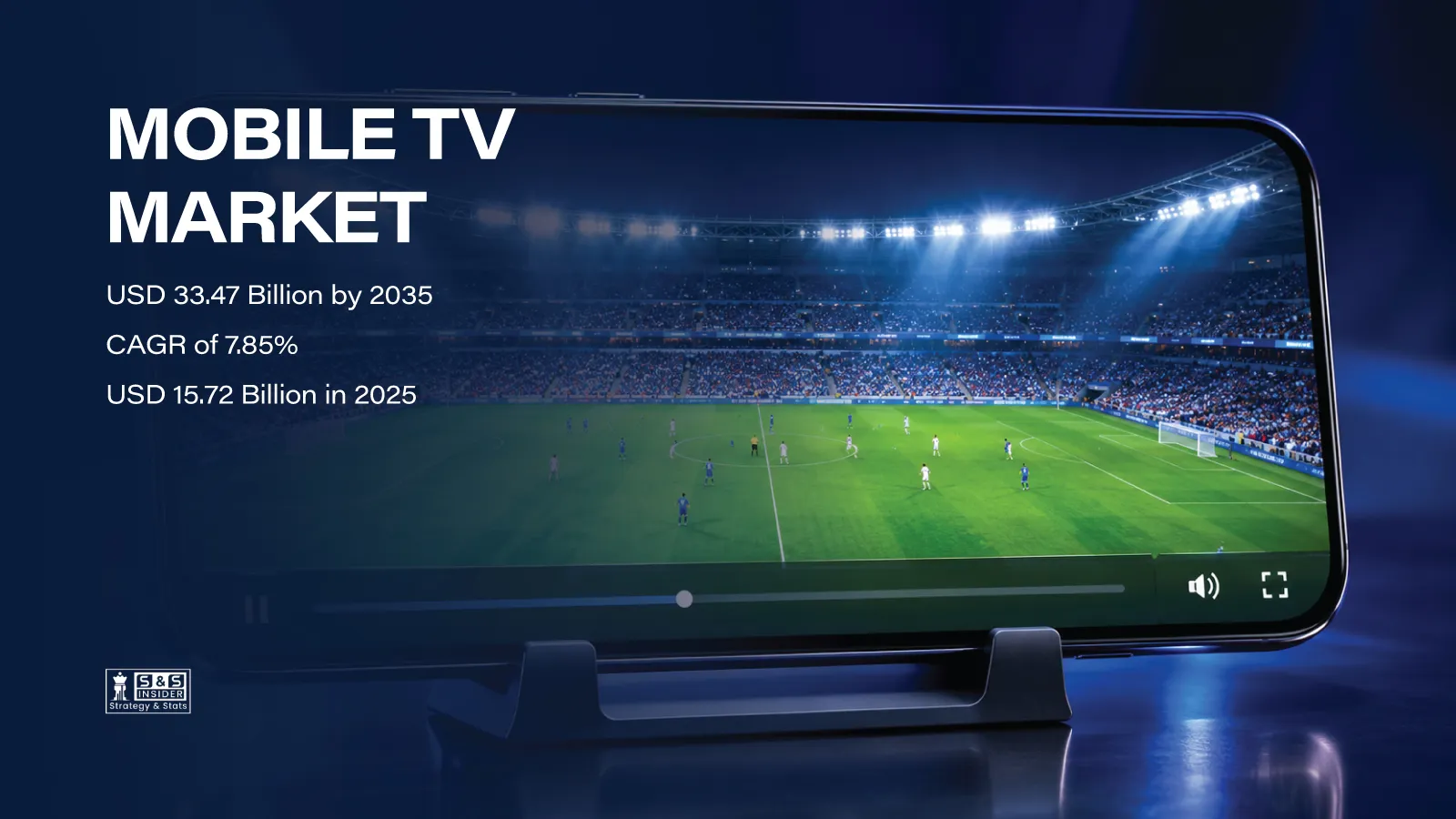
The global mobile TV market was valued at USD 15.72 billion in 2025, is estimated to reach USD 16.95 billion in 2026 and is projected to expand to USD 33.47 billion by 2035, registering a CAGR of 7.85% during 2026–2035.
Live sports broadcasting, regional entertainment and short-form video integration are creating new monetization opportunities. Meanwhile, telecom operators are strengthening partnerships with streaming platforms to combine video subscriptions with mobile data packages.
Technological developments in 5G broadcast and direct-to-mobile transmission could further transform distribution economics by allowing broadcasters to deliver content to multiple devices without requiring individual streaming connections.
To Get Detailed Insights on the Mobile TV Market – Request a Sample Report
Asia-Pacific represents the largest and fastest-growing regional market, supported by widespread smartphone adoption, affordable digital entertainment and expanding mobile connectivity. Through 2035, competitive success will increasingly depend on content differentiation, subscription affordability, advertising technology and network efficiency.
Mobile TV Market Size and Forecast
|
Market Indicator |
Value |
|---|---|
|
Market Size, 2025 |
USD 15.72 Billion |
|
Market Size, 2026 |
USD 16.95 Billion |
|
Market Forecast, 2035 |
USD 33.47 Billion |
|
CAGR, 2026–2035 |
7.85% |
|
Leading Region |
Asia-Pacific (35.60%) |
|
Fastest-Growing Region |
Asia-Pacific (9.00% CAGR) |
|
Leading Delivery Platform |
OTT Unicast Streaming (70.20%) |
|
Leading Device |
Smartphones (81.50%) |
Demand Drivers and Constraints
Primary Demand Drivers
-
Expanding smartphone penetration: Affordable smartphones and larger displays are increasing mobile television accessibility.
-
Growing 5G connectivity: Faster networks and lower latency support high-definition streaming and live entertainment.
-
Rising OTT adoption: Streaming platforms are expanding original programming, regional content and mobile-exclusive subscriptions.
-
Increasing sports consumption: Live cricket, football and other sporting events attract substantial mobile audiences.
-
Advertising-supported streaming: Free services and hybrid subscription models help platforms reach price-sensitive consumers.
-
Telecom-content partnerships: Bundled entertainment packages simplify payments and encourage platform adoption.
Potential Growth Constraints
-
Inconsistent network coverage and high mobile data consumption costs.
-
Rising content licensing expenses and subscription competition.
-
Limited device compatibility with emerging broadcast technologies.
-
Regulatory uncertainty surrounding broadcast spectrum allocation.
-
Consumer preference for larger screens during long-form entertainment.
Demand Structure by Delivery Platform
OTT Unicast Streaming (2025 Market Share: 70.20%)
OTT unicast streaming dominated the mobile TV market with approximately 70.20% revenue share in 2025. Its leadership reflects widespread adoption of streaming applications that deliver personalized video directly to individual devices.
Platforms such as Netflix, YouTube, Disney+ and JioHotstar offer extensive content libraries, flexible subscriptions and mobile-friendly interfaces. Growing demand for regional programming, sports coverage and offline downloads supports continued adoption.
Through 2035, OTT services are expected to maintain their leading position as content providers enhance recommendation engines, advertising capabilities and telecom partnerships.
Current trend: Strong demand for personalized, application-based mobile entertainment.
Major trends: Mobile-only subscriptions, AI-powered recommendations, live sports integration, offline viewing and bundled streaming packages.
5G Broadcast (Forecast CAGR: 10.80%)
The 5G broadcast segment is projected to register the fastest delivery-platform growth, with a CAGR of 10.80% during 2026–2035. Unlike conventional unicast streaming, broadcast technology can distribute a common signal to multiple compatible devices simultaneously. This approach offers potential advantages for live sports, emergency broadcasting and large public events.
Trials involving broadcasters, telecom equipment manufacturers and technology developers are supporting commercial exploration. However, wider adoption depends on compatible devices, regulatory approvals and network investment.
Current trend: Increasing experimentation with direct-to-mobile television transmission.
Major trends: Broadcast-enabled smartphones, spectrum modernization, large-scale live event distribution and network congestion reduction.
Demand Structure by Device
Smartphones (2025 Market Share: 81.50%)
Smartphones accounted for approximately 81.50% of mobile TV market revenue in 2025, reflecting their central role in everyday digital entertainment. Consumers increasingly use smartphones for live television, sporting events, films and news while commuting, traveling, or spending time away from home.
Improved screen resolution, processing capabilities, battery performance and affordable data packages have strengthened mobile viewing experiences. Emerging economies contribute significantly as smartphone ownership expands and streaming applications introduce localized content.
Current trend: Smartphones remain the primary device for portable video consumption.
Major trends: Larger displays, vertical video, mobile-first applications, personalized content discovery and high-definition streaming.
Wearables (Forecast CAGR: 9.64%)
Wearables are projected to expand at a CAGR of 9.64% through 2035, making them the fastest-growing device category. Smartwatches and connected wearable displays are creating opportunities for short video clips, sports highlights, live notifications and companion entertainment applications. Although limited screen sizes and battery capacity restrict extended viewing, improved connectivity and lightweight applications could support additional use cases.
Current trend: Growing integration of video-related functions into connected wearable devices.
Major trends: Sports notifications, short-form video, wearable companion applications and connected entertainment ecosystems.
Demand Structure by Revenue Model
Subscription Video on Demand (2025 Market Share: 48.70%)
Subscription Video on Demand represented approximately 48.70% of the mobile TV market in 2025. Recurring subscriptions allow consumers to access premium films, original series, sports and exclusive entertainment while providing platforms with predictable revenue streams. Mobile-specific pricing, annual subscription discounts and bundled entertainment services are helping providers improve customer retention. Competition increasingly depends on exclusive programming, affordability and viewing convenience.
Current trend: Sustained demand for subscription-based digital entertainment.
Major trends: Exclusive content, mobile subscription plans, sports integration, bundled memberships and personalized viewing experiences.
Hybrid Freemium and FAST (Forecast CAGR: 10.12%)
Hybrid freemium and free ad-supported streaming television (FAST) services are forecast to grow at a CAGR of 10.12% during 2026–2035. These models attract consumers who prefer free or lower-cost entertainment while generating revenue through digital advertising and premium upgrades. Improved audience measurement and targeted advertising tools are increasing their commercial appeal.
Current trend: Accelerating adoption of advertising-funded mobile entertainment.
Major trends: Free streaming channels, targeted advertisements, premium upgrades and advertiser-supported content distribution.
Demand Structure by Network Technology
4G and LTE (2025 Market Share: 59.80%)
4G and LTE accounted for approximately 59.80% of the market in 2025, supported by extensive network availability and compatibility with affordable smartphones. Established 4G infrastructure enables reliable video streaming across developed and emerging economies, particularly where 5G coverage remains limited. Prepaid data packages and optimized streaming applications support continued consumption.
Current trend: Widespread reliance on established LTE networks.
Major trends: Affordable data bundles, adaptive streaming, network optimization and expanding rural connectivity.
5G Networks (Forecast CAGR: 10.46%)
The 5G network segment is projected to grow at a CAGR of 10.46% during 2026–2035. Higher network speeds and reduced latency support ultra-high-definition entertainment, interactive sports coverage and more responsive streaming applications.
Telecom providers are exploring premium video packages, integrated subscriptions and network optimization technologies to monetize expanding 5G infrastructure.
Current trend: Increasing commercialization of high-speed mobile entertainment.
Major trends: Ultra-HD streaming, interactive live events, premium 5G bundles and advanced network management.
Regional Market Dynamics
Asia-Pacific (2025 Market Share: 35.60%; CAGR: 9.00%)
Asia-Pacific dominated the global mobile TV market with approximately 35.60% share in 2025 and is projected to expand at a CAGR of 9.00% through 2035. China, India, Japan, South Korea and Indonesia are important markets, supported by extensive smartphone adoption and expanding streaming ecosystems.
Affordable mobile-only subscriptions, regional-language entertainment and sports broadcasting are increasing platform accessibility. Direct-to-mobile broadcasting trials in India also highlight opportunities for alternative content delivery technologies.
Direction: Largest and fastest-growing regional market, driven by affordable connectivity and mobile-first entertainment.
North America (2025 Market Share: 29.80%)
North America accounted for approximately 29.80% of global revenue in 2025, supported by established streaming platforms, advanced telecommunications infrastructure and strong consumer spending on digital entertainment.
The United States represents the leading national market, with a 2025 valuation of USD 4.05 billion and a projected CAGR of 7.10% through 2035. Canada contributes through mobile entertainment bundles and demand for premium sports programming.
Direction: Mature market expanding through premium streaming, advertising innovation and 5G connectivity.
Europe (2025 Market Share: 22.90%)
Europe held approximately 22.90% of global mobile TV revenue in 2025, led by the United Kingdom, Germany, France and Italy. Established public broadcasters, commercial streaming platforms and advanced telecommunications networks support widespread digital video consumption.
The region is also exploring emerging mobile broadcast technologies, including 5G broadcast demonstrations associated with major sporting events. Regulatory requirements and spectrum allocation decisions will influence the pace of commercialization.
Direction: Steady expansion supported by localized programming, established broadcasters and next-generation broadcast trials.
Latin America
Latin America's mobile TV market is led by Brazil, Mexico, Argentina and Colombia. Growing smartphone penetration, prepaid mobile packages and demand for football broadcasting are supporting digital entertainment adoption.
Streaming providers are introducing affordable subscriptions and locally relevant programming to reach wider audiences. Brazil's transition toward TV 3.0 also creates opportunities for future broadcast innovation.
Direction: Increasing adoption supported by affordable mobile services, local content and digital broadcasting modernization.
Middle East & Africa (2025 Market Share: 5.50%)
The Middle East & Africa accounted for approximately 5.50% of global mobile TV revenue in 2025. Saudi Arabia, the UAE, Egypt, South Africa and other regional markets are benefiting from telecommunications investment and growing mobile entertainment consumption.
Arabic-language programming, sports coverage and carrier billing are supporting service adoption, although affordability and network coverage remain important challenges.
Direction: Emerging growth opportunities through improving connectivity, localized content and accessible subscription models.
Competitive Landscape
The global mobile TV market includes international streaming platforms, regional entertainment providers and broadcast technology developers. Major participants identified by SNS Insider include Netflix, YouTube, JioHotstar, Disney, Tejas Networks, XGN Global and Big Blue Marble.
Competition focuses on exclusive content, subscription pricing, advertising capabilities, streaming quality and distribution partnerships. Technology providers are also developing direct-to-mobile broadcasting infrastructure, creating potential alternatives to conventional streaming delivery.
Market Outlook (2026–2035)
The SNS Insider baseline forecast projects the global mobile TV market to reach USD 33.47 billion by 2035, expanding at a CAGR of 7.85% during 2026–2035.
Continued smartphone adoption, expanding 5G infrastructure and affordable video subscriptions will support market development. Advertising-supported services are expected to become increasingly important for reaching price-sensitive viewers, while premium platforms will compete through exclusive sports rights, original programming and enhanced viewing experiences.
Emerging 5G broadcast technology could improve the economics of large-scale content distribution, although commercial adoption will depend on regulatory approval and device compatibility. Asia-Pacific is expected to maintain regional leadership, while North America and Europe remain important markets for premium services and technology development.
Overall, the mobile TV market is positioned for sustained growth through 2035, with long-term competitiveness increasingly determined by content differentiation, network efficiency, flexible monetization and mobile-first entertainment strategies.
About the Author

Get in touch




