The latest SNS Insider Anastomosis Devices Market report expects the global market to keep growing steadily, as hospitals and surgical centers handle more procedures that join vessels or sections of the bowel. Colorectal disease, heart disease and obesity are all becoming more common, so more patients need surgery that depends on a secure connection between tissues.
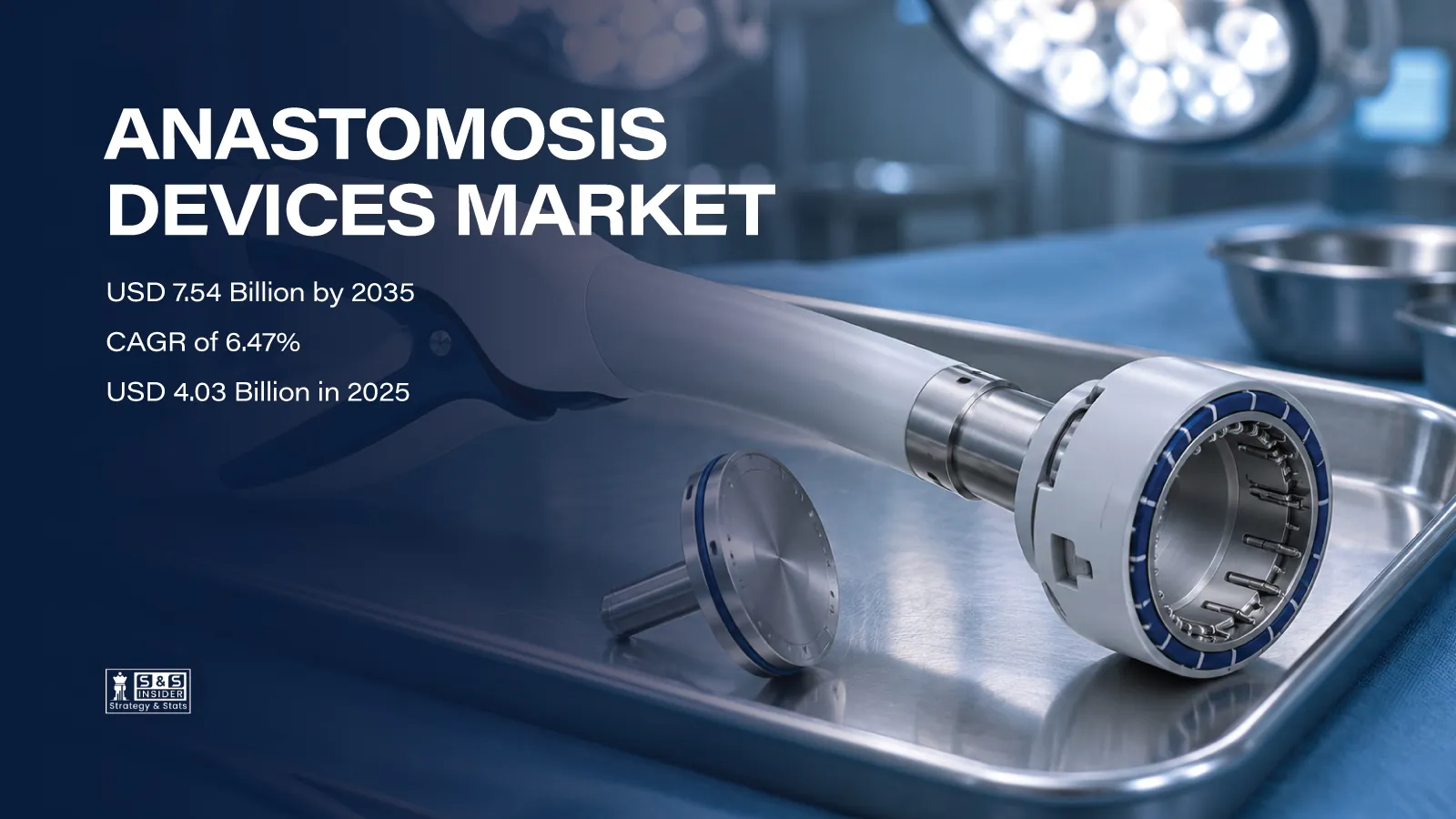
The market was valued at USD 4.03 Billion in 2025. It is estimated at USD 4.29 Billion in 2026 and is expected to reach USD 7.54 Billion by 2035, a CAGR of 6.47% over 2026–2035.
Surgeons are moving toward minimally invasive and robotic procedures. These methods need staplers and closure tools that work through small incisions and fit robotic systems, which is changing the products hospitals buy.
Cardiovascular and thoracic surgery is the largest area of use today. Gastrointestinal surgery is growing fastest, helped by more cancer screening and more bariatric procedures. Hospitals also prefer disposable devices because they lower the risk of infection and save time on cleaning.
North America is the largest regional market. Asia Pacific is growing fastest as hospital capacity and access to surgery expand.
To Get Detailed Insights on the Anastomosis Devices Market – Request a Sample Report
Demand Drivers and Constraints
Primary Demand Drivers
- Rising gastrointestinal disease burden: More cases of colorectal cancer and other bowel disease lead to more resections, and each one needs a secure join.
- Minimally invasive and robotic surgery: Hospitals are adopting laparoscopic and robotic methods, which call for staplers designed for small incisions and robotic arms.
- Cardiovascular and transplant procedures: Bypass surgery, vascular repair and organ transplants all depend on reliable connections between vessels.
- Growth in bariatric surgery: As obesity rates rise, more weight-loss procedures are performed, and each uses several anastomoses.
- Aging population: Older patients are more likely to need surgery for cancer, heart disease and digestive conditions.
Potential Growth Constraints
- Anastomotic leaks and other complications that make surgeons cautious.
- High device costs and pressure on reimbursement.
- Strict regulatory requirements that keep changing.
- Training needs and a lasting preference among some surgeons for hand-sewn techniques.
- Budget limits in smaller hospitals and lower-income markets.
Demand Structure by Product Type
Surgical Staplers (2025 Market Share: 48.63%)
Surgical staplers held 48.63% of the anastomosis devices market in 2025, the largest share of any product type. They create joins faster and more evenly than hand suturing, which shortens time in the operating room. Linear and circular staplers are standard in colorectal, gastric and thoracic surgery, and powered models give steadier firing force. Robotic programs have created demand for staplers that attach directly to surgical systems. As surgical volumes rise and hospitals try to cut procedure times, staplers should stay the main product category through 2035.
Current trend: Wider use of powered and robot-compatible staplers in complex procedures.
Major trends: Powered stapling, 3D staple reloads, robotic stapler integration, and staple-line reinforcement.
Surgical Sutures (Forecast CAGR: 7.62%)
Surgical sutures are expected to grow fastest among product types, at a CAGR of 7.62% through 2035. They are still needed for vascular, microsurgical and delicate repairs where staplers fit poorly or are too costly. Coated and absorbable sutures lower infection risk and remove the need to take stitches out later. Barbed sutures let surgeons close tissue without tying knots, which saves time in laparoscopic work. More cardiovascular and transplant procedures, together with growth in emerging markets, should keep suture demand rising.
Current trend: Rising use of advanced absorbable and barbed sutures.
Major trends: Antibacterial coatings, knotless barbed designs, absorbable materials, and fine sutures for microsurgery.
Demand Structure by Usage
Disposable (2025 Market Share: 74.38%)
Disposable devices made up 74.38% of the market in 2025. Hospitals prefer single-use staplers and loading units because each procedure starts with a sterile, fully working device. This lowers the risk of infection and removes the cost and time of cleaning reusable tools. Disposable products also give the same performance in every case, which matters when a weak join can lead to a leak. Infection control rules and high surgical volumes should keep disposable products dominant.
Current trend: Continued preference for single-use devices in infection-sensitive procedures.
Major trends: Single-use stapler reloads, prepackaged sterile kits, infection control, and standardized device performance.
Reusable (Forecast CAGR: 7.11%)
Reusable devices are expected to grow at a CAGR of 7.11% over 2026–2035. Hospitals under tight budgets are reconsidering reusable handles and instruments that lower the cost per procedure. Pressure to reduce medical waste also encourages devices that can be cleaned and used again. Manufacturers are designing products with reusable handles and disposable cartridges, which balance cost and safety. Demand for cost control is strongest in public hospitals and emerging markets.
Current trend: Growing interest in reusable handles combined with single-use reloads.
Major trends: Hybrid reusable designs, waste reduction, reprocessing programs, and lower cost per procedure.
Demand Structure by Application
Cardiovascular and Thoracic Surgery (2025 Market Share: 49.36%)
Cardiovascular and thoracic surgery accounted for 49.36% of the market in 2025, the largest application. Coronary bypass, aortic repair, lung resection and heart transplants all need precise, durable connections between vessels or airways. Heart disease is still a leading cause of death worldwide, which keeps procedure volumes high. Thoracic surgeons increasingly use staplers in minimally invasive lung surgery. Aging populations and better access to cardiac care should keep this application the largest through the forecast period.
Current trend: Steady growth in cardiac and minimally invasive thoracic procedures.
Major trends: Vascular anastomosis devices, thoracoscopic staplers, transplant surgery support, and less invasive cardiac methods.
Gastrointestinal Surgery (Forecast CAGR: 6.93%)
Gastrointestinal surgery is expected to grow at a CAGR of 6.93% through 2035. Colorectal cancer screening is finding more cases that need resection, and bariatric surgery volumes keep rising. Each procedure needs a reliable join to prevent leaks, which are a serious complication in bowel surgery. New methods such as magnetic compression anastomosis offer an alternative to staples and sutures. More laparoscopic and robotic digestive surgery should keep demand growing in this application.
Current trend: Rising colorectal and bariatric surgery volumes.
Major trends: Circular staplers, magnetic compression systems, leak prevention, and robotic bowel surgery.
Demand Structure by End User
Hospitals (2025 Market Share: 66.74%)
Hospitals accounted for 66.74% of market revenue in 2025. They perform most complex surgeries, including cardiac, transplant and major digestive procedures. Large hospitals have the operating rooms, robotic systems and specialist staff these procedures need. They also buy devices in large volumes through group purchasing contracts. Their role in emergency and cancer surgery means hospitals should remain the main buyers of anastomosis devices.
Current trend: Investment in robotic surgery programs and advanced operating rooms.
Major trends: Robotic surgery centers, volume purchasing contracts, specialist surgical teams, and standardized device use.
Ambulatory Care Centers and Clinics (Forecast CAGR: 7.58%)
Ambulatory care centers and clinics are expected to grow fastest among end users, at a CAGR of 7.58% over 2026–2035. More procedures are moving out of hospitals because outpatient care costs less and lets patients go home sooner. Minimally invasive methods make same-day discharge possible for some digestive and vascular procedures. Payers support this shift to lower overall costs, and more surgical centers are being built.
Current trend: Shift of suitable procedures to outpatient settings.
Major trends: Same-day surgery, compact surgical devices, cost-efficient care, and expanding surgical center networks.
Key Market Participants
The anastomosis devices market includes large medical technology companies, surgical robotics firms, and specialist companies developing new ways to join tissue.
Key participants include Medtronic, Johnson & Johnson MedTech (Ethicon), Intuitive Surgical, GI Windows and GT Metabolic Solutions.
Competition centers on staple-line reliability, compatibility with robotic systems, and fewer complications. Companies that offer powered devices, solid clinical evidence and alternatives such as magnetic compression are best placed to meet changing surgical needs.
Regional Market Dynamics
North America (2025 Market Share: 40.74%)
North America led the global anastomosis devices market with a 40.74% share in 2025. The United States accounts for 85.12% of regional demand. It has high surgical volumes, widespread robotic surgery and quick uptake of new devices. The U.S. market was worth USD 1.40 Billion in 2025 and is projected to grow at a CAGR of 6.19%. Recent FDA clearances for robotic staplers and magnetic anastomosis systems show how actively new products are reaching the market. Canada adds demand through its public hospital networks.
Direction: Continued leadership supported by robotic surgery adoption and steady approval of new devices.
Asia Pacific (Forecast CAGR: 7.77%)
Asia Pacific is expected to grow fastest among regions, at a CAGR of 7.77% through 2035. China leads with a 33.97% share of the region, helped by large hospital networks and rising surgical capacity. Japan has an older population and advanced surgical practice. India is expanding hospital access and insurance coverage. More colorectal cancer screening and growing obesity rates are raising procedure volumes across the region.
Direction: Fastest regional growth supported by hospital expansion, better access to surgery and rising disease burden.
Overall, the anastomosis devices market is set for steady growth through 2035, and success will depend more and more on device reliability, fewer complications, robotic compatibility and cost per procedure.
About the Author

Get in touch