
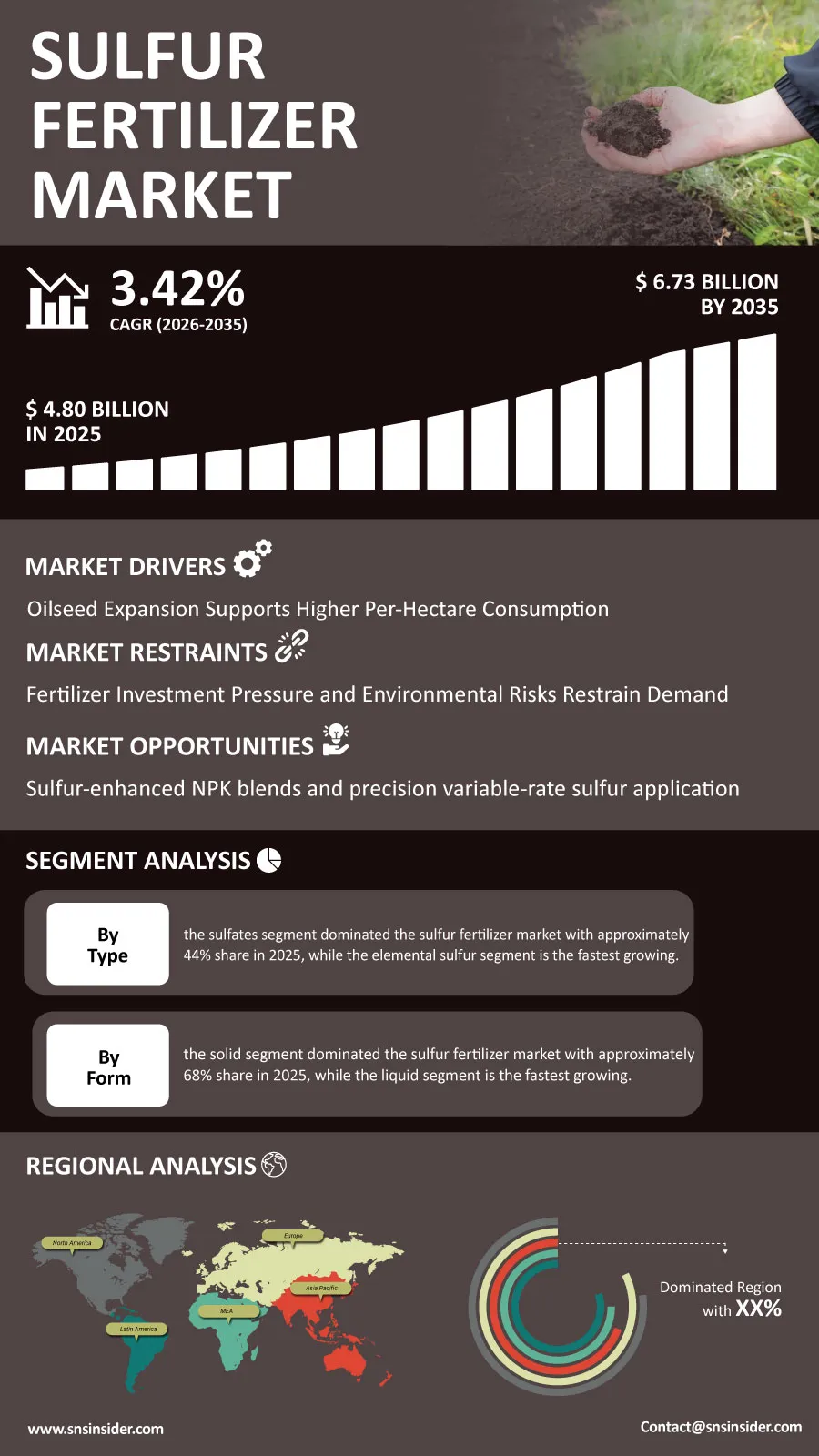
The global market for Sulfur Fertilizers is forecasted to show stable growth as farmers give more importance to balancing nutrients in order to enhance their productivity and soil condition. “According to a recent study by SNS Insider, the global Sulfur Fertilizer Market size valued at USD 4.80 Billion in 2025, is anticipated to grow to USD 6.73 Billion by 2035, registering a CAGR of 3.42% over the 2026–2035 forecast period.”
Increased knowledge about the benefits of sulfur in improving the quality of crops, protein formation, and nutrient uptake is resulting in its increased usage within some of the world's most significant economies. Reduced amounts of sulfur deposition from the atmosphere, more cultivation of sulfur-hungry crops, and the rising emphasis on sustainable agriculture have ensured opportunities for fertilizer companies for the future. The growing promotion of efficient fertilizer usage by governments is making sulfur nutrients an integral part of crop management.
To Get Detailed Insights on the Sulfur Fertilizer Market – Request a Sample Report
Sustainable Agriculture and Soil Health Programs Create Long-Term Market Opportunities
Producers around the globe have been adopting balancing fertilization practices to combat the issue of nutrient depletion that arises from intense agricultural operations. Fertilizers containing sulfur are being included in nutrient management programs for their ability to improve fertilizer use effectiveness, increase crop production, and produce high-quality agriculture produce. The increased adoption of integrated nutrient management systems will drive the market for cereals, oilseeds, fruits, vegetables, and specialty crops.
Growth opportunities are also coming about because of technological innovations in the sector. Companies are developing sulfur containing compound fertilizers, slow-release formulations, and bio-sulfur fertilizers that not only improve nutrient accessibility but are also eco-friendly. Innovations such as precision farming techniques like GPS application systems and soil testing are making the sulfur application process more effective and productive.
Key Market Insights Highlight Evolving Agricultural Demand
On the basis of product type, Sulfates are responsible for around 44% of market revenue share in 2025 because of extensive use, and ability to offer easy availability of sulfur and nutrients to plants. Elemental Sulfur is estimated to witness the fastest growth rate through 2035 because of increasing demand for cost-effective solutions with long-lasting nutrients in crop cultivation.
Solid is one of the leading segments with close to 68% market share in 2025 on the basis of form owing to compatibility with traditional fertilizers and ease of use with conventional equipment. However, liquid is projected to witness the fastest growth rate on account of growing popularity of fertigation systems and adoption of precision farming techniques in irrigated agriculture.
Soil application accounts for around 55% of total market revenue share in 2025 on the basis of mode of application as it is well suited for broad-acre farming. Fertigation will continue to witness strong growth rate during the forecast period with growth in drip irrigation systems and high-efficiency nutrient delivery. In terms of crops cultivated, Cereals & Grains leads with around 36% market share whereas Oilseeds & Pulses are projected to witness highest growth rate on account of higher sulfur requirement.
Advanced Fertilizer Technologies Improve Nutrient Efficiency
Fertilizer manufacturers are continuously innovating to produce products that not only make sulfur more available but also sustain agricultural production sustainably. The forms and types of nutrient sources like controlled-release sulfur formulations, sulfur-enriched NPK blends to impart the positive effects, and water-soluble fertilizers which are proving beneficial in several farming systems by allowing efficient uptake of nutrients and minimizing applications through control.
The transformation of the market is being further sped up by digital agriculture. Producers can also be more efficient in their sulfur applications with precision nutrient management platforms, variable-rate application technologies, and data-driven soil analysis to customize what they apply in a given field. These advancements support crop productivity while enhancing environmental sustainability through more efficient use of fertilizer.
Asia Pacific Accounted for the Largest Sulfur Fertilizer Market Share in 2025; North America to Lead Growth Through 2035
In 2025, Asia Pacific continued to be the largest regional market due to large agricultural produce, expansion of cereal and oilseed cultivation and governmental support for balanced fertilization programs. China was the major driver of regional demand on account of its huge farming sector, while India and Southeast Asian countries have increasing adoption of sulfur-containing fertilizer with the growing awareness regarding soils as deficient in nutrients.
The regional market of North America is expected to be the fastest-growing through 2035. Ongoing depletion of soil sulphur, rising penetration of precision agriculture technologies and greater application of sulphur-fortified fertiliser products across the Corn Belt buttress strong regional growth. Meanwhile, Europe maintains steady demand as farmers react to chronic sulfur deficiencies from lower industrial sulfur emissions and tighter environmental regulations.
Industry Participants Expand Innovation and Product Development
The current competitive environment is centered around creating more advanced sulfur-based fertilizers that are efficient and environmentally friendly. Major companies still invest in research, precision farming techniques, new NPK blends, and controlled release technologies in order to increase their production capacities amid growing global demands.
Key companies operating in the global Sulfur Fertilizer Market include Nutrien Ltd., The Mosaic Company, Yara International ASA, ICL Group Ltd., Koch Agronomic Services LLC, BASF SE, Sociedad Química y Minera de Chile (SQM), K+S AG, Haifa Chemicals Ltd., Tiger-Sul Products LLC, Sulphur Mills Limited, Coromandel International Ltd., Zuari Agro Chemicals, Deepak Fertilisers and Petrochemicals, Arabian Sulphur Company, Nufarm Limited, Helena Agri-Enterprises, Tessenderlo Group, OCI Nitrogen, and Compass Minerals International.
An SNS Insider analyst Himanshu Sharma commented, "Growing emphasis on soil health, precision nutrient management, and sustainable agricultural practices is strengthening the long-term outlook for sulfur fertilizers. Companies investing in advanced sulfur formulations, integrated nutrient solutions, and precision farming technologies are expected to benefit as global agriculture increasingly prioritizes balanced fertilization and higher crop productivity."About the Author

Get in touch




