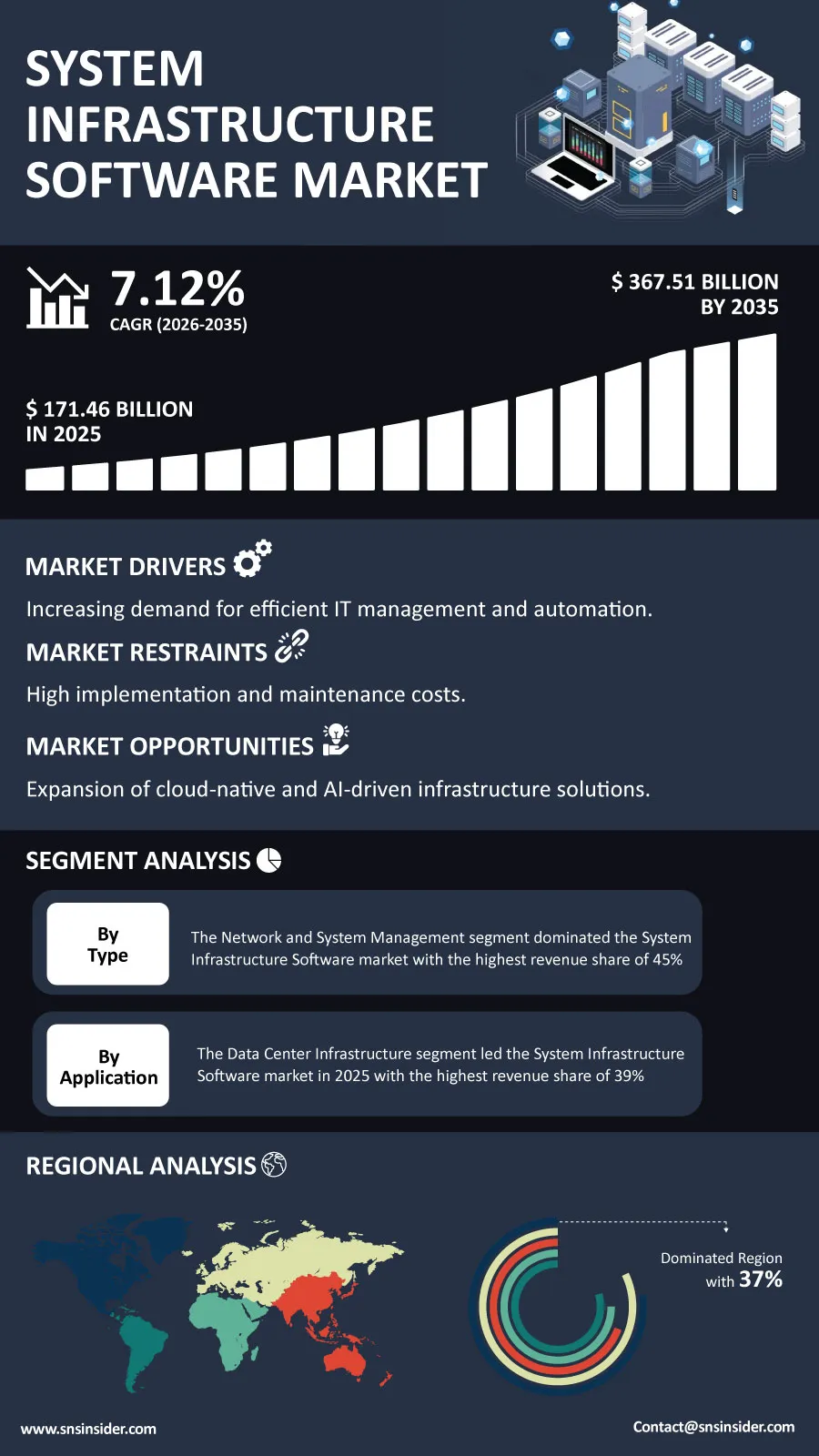
The global System Infrastructure Software Market is entering a new phase of growth as enterprises modernize IT environments to support cloud-native applications, intelligent automation, and increasingly complex digital operations. “According to a recent study by SNS Insider, the global System Infrastructure Software Market size valued at USD 171.46 billion in 2025, is anticipated to grow to USD 367.51 billion by 2035, registering a CAGR of 7.12% over the 2026–2035 forecast period.”
Technology has become a core component of organizations as they seek to increase resiliency and application performance. The increase in the amount of data held by businesses within distributed environments has increased the need for software that manages infrastructure, automates processes, and provides visibility into the system.
There has been a shift from traditional IT architectures to hybrid IT environments which has seen change in the way that businesses invest in their infrastructure. Enterprises have started looking at solutions that make infrastructure management easier while offering scalability, security, and compliance capabilities.
To Get Detailed Insights on the System Infrastructure Software Market – Request a Sample Report
Intelligent Infrastructure Investments Create New Growth Opportunities
Growing enterprise investments in AI-enabled IT operations are creating new opportunities for software vendors delivering intelligent infrastructure management solutions. Predictive monitoring, automated resource allocation, and self-healing capabilities are helping organizations reduce downtime while improving operational efficiency across complex environments.
Businesses are also accelerating software-defined infrastructure deployments to support rapidly changing workloads and distributed computing environments. Modern infrastructure platforms provide greater flexibility for organizations operating across public cloud, private cloud, and on-premises systems, enabling more efficient utilization of computing resources.
Increasing regulatory requirements surrounding cybersecurity, data governance, and operational resilience are further encouraging enterprises to modernize legacy infrastructure. Vendors that combine automation, security, and centralized management capabilities are expected to benefit from sustained enterprise demand over the coming decade.
Key Market Insights Highlight Enterprise Modernization Trends
Based on type, the Network and System Management segment accounted for approximately 45% of market revenue in 2025, supported by growing demand for centralized monitoring and infrastructure optimization across enterprise IT environments. The Security segment is expected to record the fastest growth through 2035 as organizations strengthen cyber resilience and regulatory compliance.
By application, Data Center Infrastructure represented nearly 39% of total market revenue in 2025 due to continued expansion of enterprise data processing capacity. Meanwhile, Cloud Integrations is anticipated to witness the fastest growth as organizations increasingly deploy hybrid and multi-cloud operating models.
In terms of end users, the IT & Telecom sector generated around 23% of overall market revenue in 2025, supported by network modernization and next-generation connectivity initiatives. The BFSI segment is projected to expand at the highest pace through 2035 as financial institutions continue investing in secure, highly available digital banking infrastructure.
Automation and AI Continue Transforming Enterprise IT Operations
Infrastructure software providers are increasingly integrating artificial intelligence, machine learning, and automation into their platforms to simplify IT administration and improve service reliability. Intelligent analytics enable organizations to identify potential issues before service disruptions occur while reducing manual intervention in day-to-day infrastructure management.
Growing adoption of containerized applications, virtualization technologies, and edge computing is also reshaping infrastructure requirements. Enterprises are seeking platforms capable of supporting dynamic workloads across geographically distributed environments while maintaining security, performance, and operational consistency.
North America Held 37% of the System Infrastructure Software Market Share in 2025; Asia Pacific Projected to Register the Fastest CAGR Through 2035
The North American region represented about 37% share of the overall market revenue in 2025 owing to adoption of cloud services, high spending on enterprise technologies, presence of well-developed data center infrastructure, and regular investment made in artificial intelligence and cybersecurity by enterprises.
The Asia Pacific region is anticipated to experience the highest growth rate up to 2035 owing to the accelerated efforts towards digital transformation in countries including China, India, Japan, and Southeast Asian countries. Rising adoption of cloud services, growing investments in next-generation network infrastructure, and increasing investments in enterprise IT infrastructure are some of the key factors driving regional market growth.
The European market is continuing to benefit from the efforts being taken by the enterprises in modernizing their infrastructures along with the increasing adoption of hybrid cloud platforms. The Latin American and Middle East & Africa regions are showing steady growth.
Industry Participants Strengthen AI, Cloud, and Infrastructure Capabilities
Leading companies continue expanding their infrastructure software portfolios through innovation, cloud partnerships, and investments in AI-enabled operations management. Vendors are prioritizing automation, security, workload optimization, and hybrid cloud management to address evolving enterprise requirements while improving operational efficiency across increasingly distributed IT environments.
Key companies operating in the global System Infrastructure Software Market include Amazon Web Services, Inc., BMC Software, Inc., Broadcom Inc., Red Hat, Inc., Hewlett Packard Enterprise, Nutanix, SolarWinds, Cisco Systems, Inc., Dell Inc., IBM Corporation, Microsoft Corporation, Oracle Corporation, TIBCO Software Inc., Symantec Corporation, EMC Corporation, Hewlett Packard Co., and Apple Inc.
An SNS Insider analyst Sakshi Kale commented, "Enterprise IT strategies are increasingly centered on intelligent infrastructure capable of supporting automation, cybersecurity, and scalable cloud operations. Organizations investing in AI-driven infrastructure management and hybrid cloud optimization will be well positioned to improve operational resilience while supporting long-term digital transformation objectives."
About the Author

Get in touch