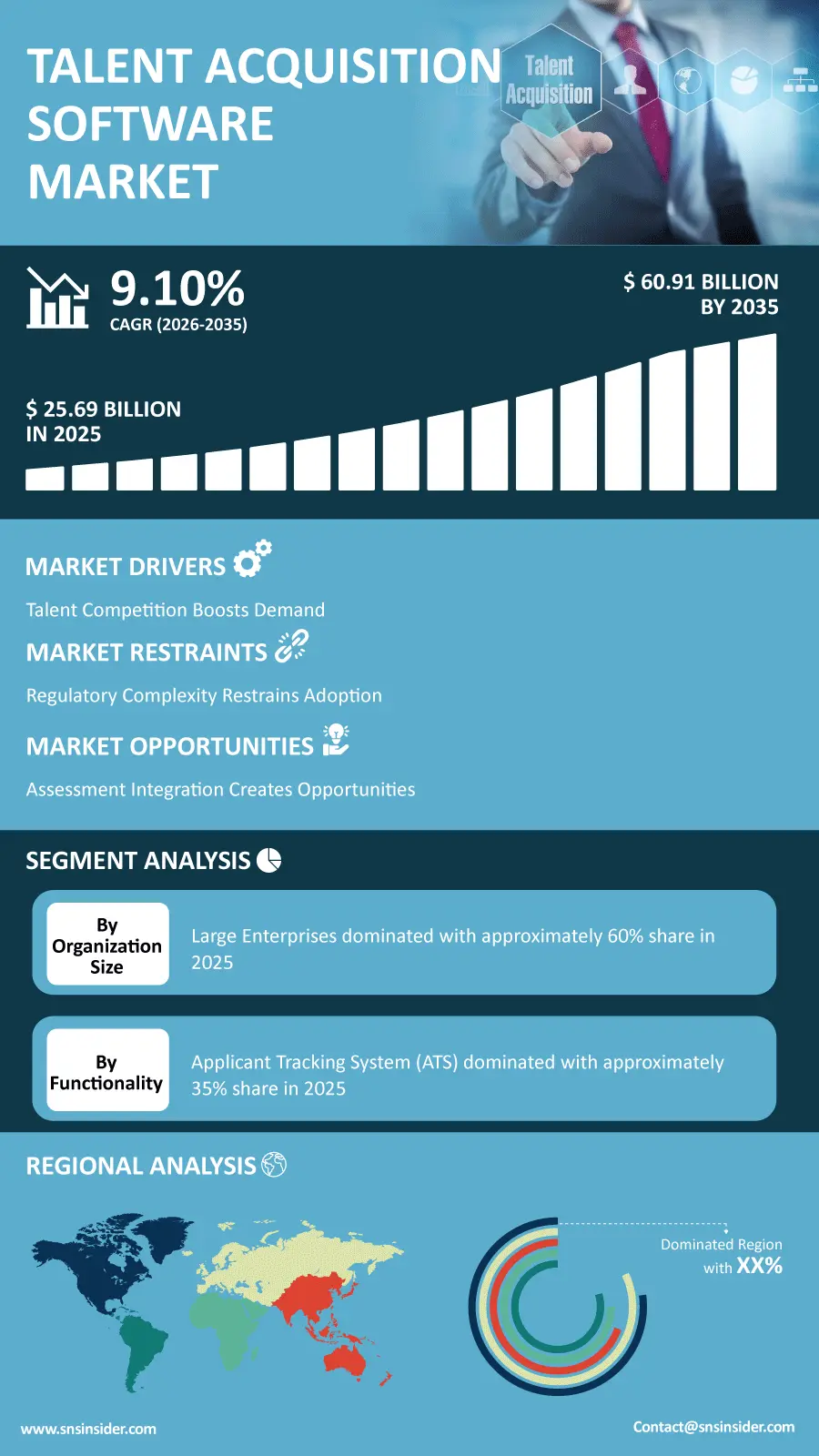
The global Talent Acquisition Software Market is expected to witness strong expansion as organizations accelerate digital transformation across human resource operations and increasingly adopt intelligent recruitment technologies. “According to a recent study by SNS Insider, the global Talent Acquisition Software Market size valued at USD 25.69 billion in 2025, is anticipated to grow to USD 60.91 billion by 2035, registering a CAGR of 9.10% over the 2026–2035 forecast period.”
Recruitment has now emerged as an essential strategic business process as companies are fighting for skilled workers in sectors such as technology, healthcare, manufacturing, finance, and others. The conventional recruitment processes are fast being taken over by a comprehensive software platform that not only integrates sourcing, screening, interviews, and onboarding but also facilitates quick and informed recruiting decisions.
The fast development in artificial intelligence, machine learning, and cloud computing is revolutionizing talent acquisition platforms to be smart workforce management systems. Some of the functionalities include automatic matching of candidates, predictive analytics in hiring, conversational AI assistants, and skills assessments.
To Get Detailed Insights on the Talent Acquisition Software Market – Request a Sample Report
AI-Driven Recruitment Technologies Create Long-Term Growth Opportunities
Intelligent recruitment systems are being adopted extensively by organizations in order to decrease the hiring time span, increase candidate quality, and better workforce planning. With the increasing scope of globalization among enterprises and remote hiring gaining traction, talent acquisition solutions that are cloud-based are making it possible for organizations to hire employees from multiple locations through digital processes.
The rise in the demand for skills-first hiring practices has created many avenues for companies that are designing sophisticated testing tools that can help in assessing skills and abilities of individuals instead of only focusing on their educational qualifications. Recruiters are also able to find potential candidates through intelligent recommendation engines and save themselves from having to conduct screening sessions manually.
Additionally, innovations such as workforce analytics, automated compliance management, and intelligent interview scheduling are allowing enterprises to streamline their recruiting process as well as support diversity initiatives and retain employees effectively in the long term.
Key Market Insights Highlight Shifting Demand Patterns
Based on deployment, cloud solutions are estimated to account for approximately 71% of global market revenue in 2025 owing to their scalability, simplified implementation, automatic software updates, and lower infrastructure costs. Cloud deployment is also projected to remain the fastest-growing segment through 2035 as organizations continue migrating recruitment operations toward SaaS-based environments.
By organization size, large enterprises are expected to generate nearly 60% of total market revenue in 2025 due to high recruitment volumes, complex workforce requirements, and greater investment capacity for enterprise-grade hiring platforms. Small and medium-sized enterprises (SMEs) are anticipated to witness the fastest growth during the forecast period as affordable subscription-based recruitment software becomes increasingly accessible.
In terms of industry vertical, IT & Telecom held approximately 31% market share in 2025 because of continuous demand for technical talent and high recruitment activity across digital industries. Healthcare is forecast to experience the strongest growth through 2035 owing to persistent workforce shortages, expanding healthcare infrastructure, and increasing demand for qualified clinical professionals. By functionality, Applicant Tracking Systems (ATS) represented around 35% of market revenue in 2025, while Candidate Relationship Management (CRM) solutions are projected to record the fastest expansion as employers increasingly focus on proactive talent engagement.
Advanced AI Technologies Accelerate Recruitment Transformation
The development of talent acquisition software is constantly advancing, with vendors embedding artificial intelligence throughout the entire process of recruitment. AI in resume parsing, candidate suggestions, scheduling interviews, engaging candidates through chatbots, and hiring analytics are some of the ways that companies are streamlining their recruitment efforts while saving time on administration.
Some current platforms have added capabilities for using explainable AI and bias detection, as well as tools that manage compliance in the changing legal landscape surrounding hiring. Such advancements help companies enhance the quality of recruitment and build inclusive hiring practices.
North America Held the Largest Share of the Talent Acquisition Software Market in 2025; Asia Pacific Projected to Register the Fastest CAGR Through 2035
North America will constitute the largest proportion of the global Talent Acquisition Software Market in 2025, with support from the presence of enterprise technology, sophisticated SaaS systems, and continuous investment in human capital management solutions through artificial intelligence. The United States will continue to be the leading market for this region with businesses increasingly adopting faster and more effective recruitment approaches.
The Asia Pacific is expected to be the fastest-growing region till 2035, owing to digital economies, rapid enterprise modernization, and extensive hiring operations within India, China, Singapore, and Australia. Growing adoption of cloud computing HR solutions and hiring operations within multinational companies are further boosting market prospects.
Europe too holds high growth opportunities, with enterprises spending on recruitment technology solutions that comply with GDPR, as well as work force analytics and AI solutions. Changes in the regulatory environment of AI management and employment management are spurring the development of compliance and enterprise digitalization efforts among software vendors.
Industry Participants Focus on Innovation and Intelligent Hiring Solutions
The competitive landscape remains highly dynamic as leading technology providers continue investing in artificial intelligence, cloud-native architecture, predictive analytics, and intelligent automation to enhance recruitment performance. Strategic product innovation, AI integration, and expanded platform capabilities are enabling vendors to strengthen customer engagement while supporting organizations in attracting and retaining top talent in increasingly competitive labor markets.
Key companies operating in the global Talent Acquisition Software Market include Workday Inc., SAP SE (SuccessFactors), Oracle Corporation (Taleo), iCIMS Inc., Greenhouse Software Inc., Lever Inc. (Employ Inc.), LinkedIn Corporation (LinkedIn Talent Solutions), Jobvite Inc. (Employ Inc.), SmartRecruiters Inc., Bullhorn Inc., JazzHR (Employ Inc.), Zoho Corporation (Zoho Recruit), Cornerstone OnDemand Inc., Phenom People Inc., Eightfold AI Inc., Beamery Ltd., Ashby Inc., Paradox AI Inc., HireVue Inc., and Karat Inc.
An SNS Insider analyst Sakshi Kale commented, “Artificial intelligence is fundamentally reshaping recruitment by enabling organizations to identify, engage, and hire talent with greater speed and precision. As enterprises continue prioritizing workforce quality, automation, and data-driven hiring strategies, talent acquisition software providers delivering intelligent, scalable, and compliant recruitment platforms will be well positioned to capture long-term market growth.”
About the Author

Get in touch