
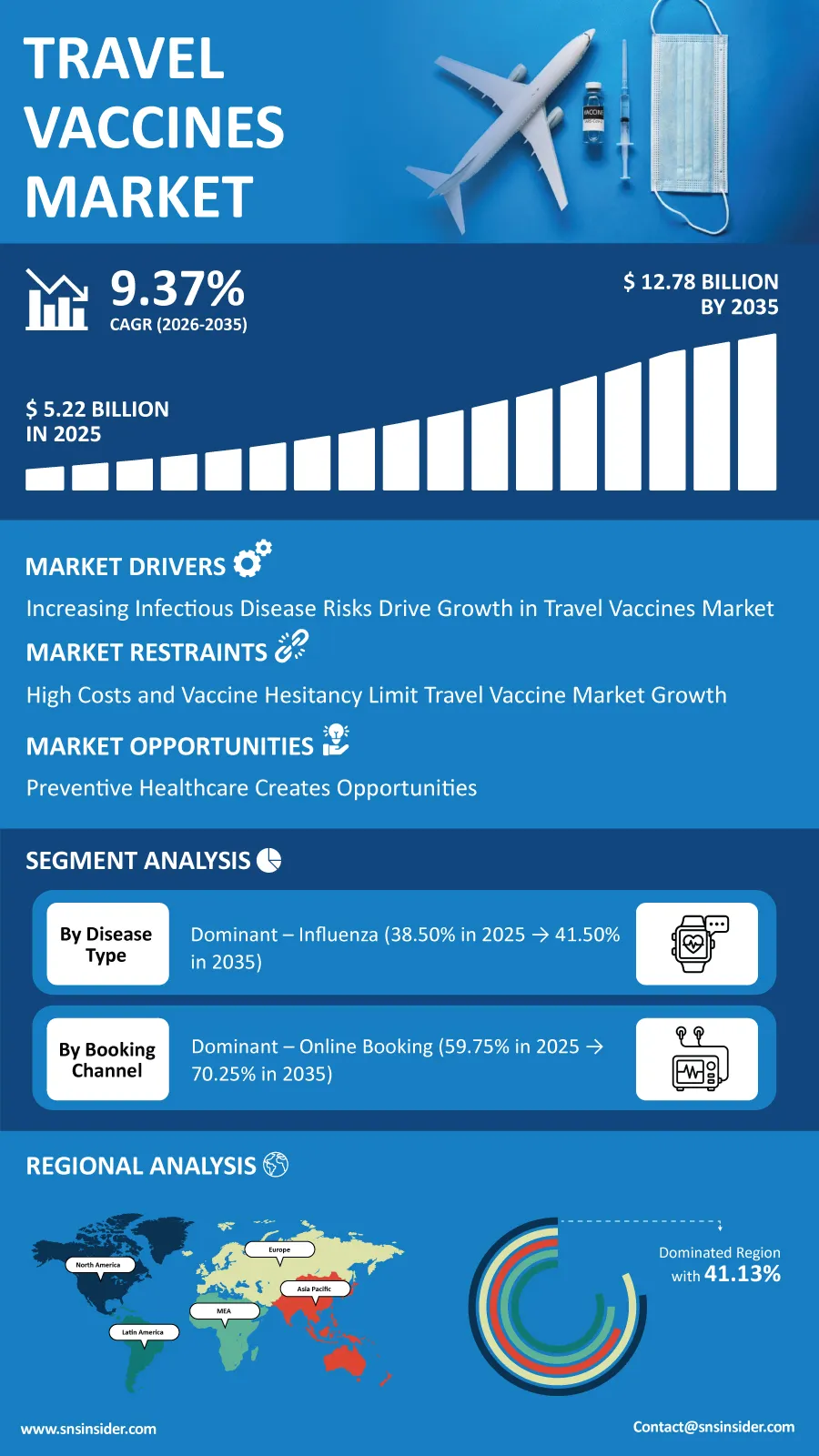
The global Travel Vaccines Market is projected to witness substantial growth over the next decade as international travel continues to recover and governments strengthen efforts to prevent the cross-border spread of infectious diseases. “According to a recent study by SNS Insider, the global Travel Vaccines Market size valued at USD 5.22 billion in 2025, is anticipated to grow to USD 12.78 billion by 2035, registering a CAGR of 9.37% over the 2026–2035 forecast period.”
Concerns over health risks at specific destinations, rising demand for preventive medicine services, and the growing list of vaccines have prompted tourists to consider getting vaccinated prior to traveling abroad. Health care professionals and institutions are collaborating in order to increase vaccine availability and raising awareness about travel diseases' prevention.
There is an additional positive influence on the market due to increased business travels, medical tourism, educational trips, and global events that require compliance with specific destination vaccines.
To Get Detailed Insights on the Travel Vaccines Market – Request a Sample Report
Preventive Healthcare Becomes an Essential Part of International Travel
As international mobility increases, preventative vaccination becomes an increasingly vital part of the traveling experience. Health care professionals are stressing the need for pre-travel consultation that will educate individuals about the risk factors in a region and provide them with the required vaccinations before traveling.
The use of digital appointment scheduling, vaccination through pharmacies, and expansion of travel clinics is providing convenience to travelers when getting vaccinated. On the other hand, innovative vaccines that offer better immunity from diseases are being introduced by vaccine producers.
Collaboration among government institutions, health care providers, and vaccine producers is helping to increase public awareness and improve immunization opportunities.
Key Market Findings Highlight Strong Growth Potential
Among disease categories, influenza vaccines accounted for 38.50% of global market revenue in 2025, reflecting their continued importance in international travel health programs.
Booking preferences continue to evolve as digital healthcare services gain momentum. Online booking represented 59.75% of market revenue in 2025 and is expected to remain the fastest-growing booking channel through 2035, supported by increasing adoption of digital healthcare platforms and mobile applications.
Based on traveler type, domestic travelers accounted for 61.13% of total market revenue in 2025, while international travelers are projected to experience the strongest growth through 2035, driven by expanding global tourism, business travel, and cross-border mobility.
By tour type, independent travelers represented 47.00% of global revenue in 2025 and are expected to maintain the fastest growth over the forecast period as travelers increasingly prefer personalized itineraries and flexible travel planning.
Expanding Vaccination Awareness Supports Market Growth
Despite the continued efforts of public health bodies in promoting vaccination to curb the spread of infections across international boundaries, educational drives coupled with new travel advisories and vaccines are pushing travelers to consider preventive vaccination an important aspect of traveling preparations.
Travel vaccinations are now being incorporated into general preventive care initiatives by healthcare practitioners, which not only increases convenience for patients but also promotes greater vaccination coverage of international travelers.
Increased investment in vaccine research, production, and distribution will promote future market development.
Regional Markets Continue to Create New Opportunities
In 2025, North America had a revenue share of 41.13% of the global market due to heavy international travel activity, well-developed healthcare infrastructure, high level of public awareness, and successful vaccination programs. Continuous efforts in terms of research in vaccines and healthcare have ensured the dominance of the region.
On the other hand, Asia Pacific is anticipated to be the fastest growing regional market up to 2035 owing to increased travel activity, developed healthcare infrastructure, high disposable income levels, and increasing government spending on immunization programs. Increased awareness about disease prevention provides lucrative prospects in many countries in the region.
Industry Leaders Continue to Expand Vaccine Portfolios
Competition within the travel vaccines market remains dynamic as leading pharmaceutical companies invest in vaccine innovation, manufacturing expansion, strategic partnerships, and broader global distribution networks. Industry participants continue to focus on developing vaccines that address evolving travel-related health risks while improving patient access and vaccination coverage.
Key companies operating in the global travel vaccines market include GlaxoSmithKline, Merck & Co., Sanofi, Pfizer, Dynavax Technologies, Emergent BioSolutions, Bharat Biotech, Serum Institute of India, Takeda, and Moderna.
An SNS Insider analyst Parry Kardani commented, "Preventive healthcare is becoming an integral part of international travel planning. As awareness of infectious disease risks continues to increase and healthcare systems expand access to immunization services, travel vaccines will remain an essential component of global public health strategies."
About the Author

Get in touch




