
Tuberculosis Therapeutics Market is experiencing a surge in global interest due to increased focus on improving accessibility and tackling the growing issue of resistant strains of tuberculosis. The continued commitment to developing new drugs, reducing the length of treatment, and procuring them on a large scale has bolstered the prospects for anti-tuberculosis treatments around the world.
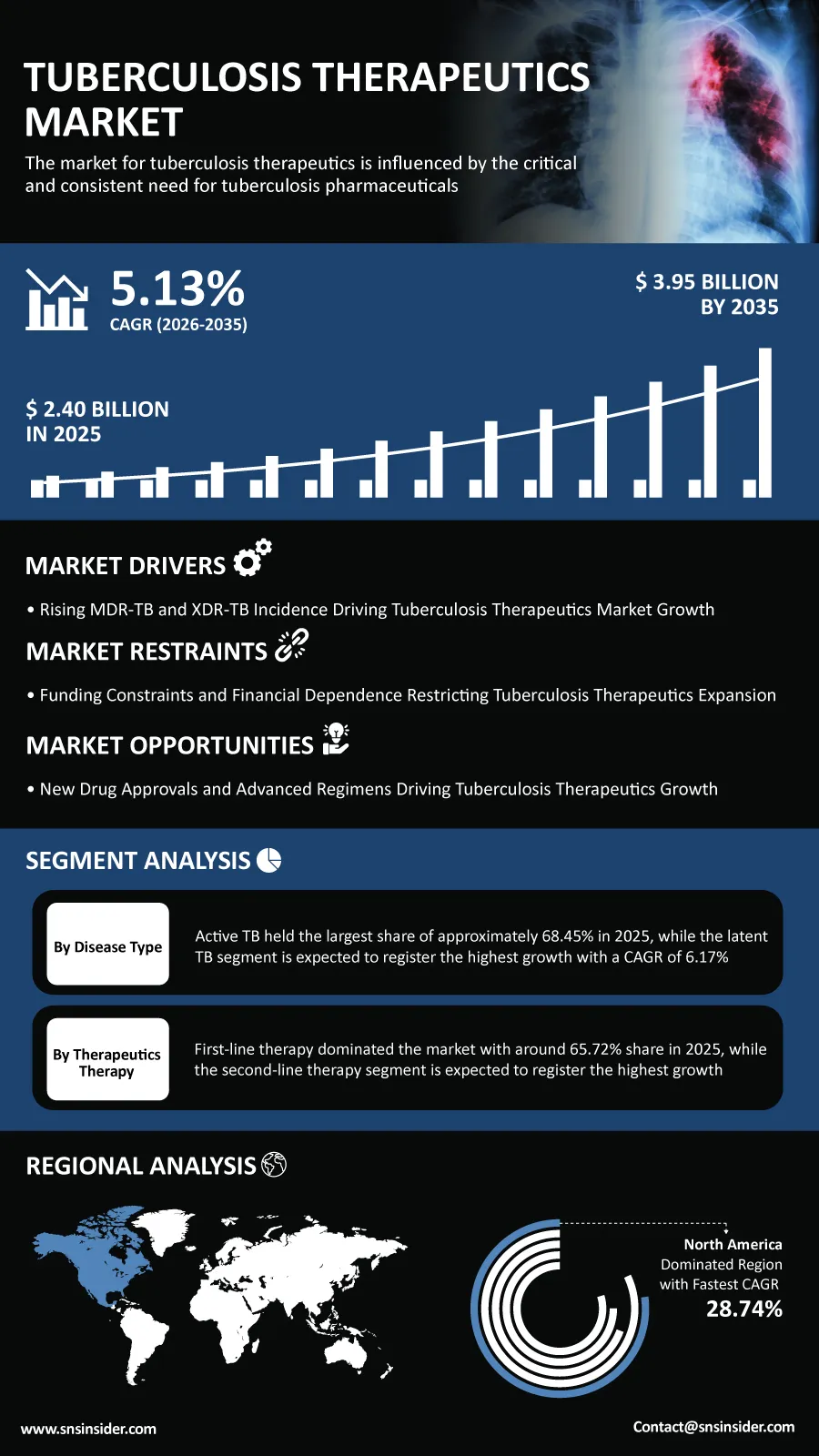
According to a recent study by SNS Insider, the global Tuberculosis Therapeutics Market size valued at USD 2.40 billion in 2025, is anticipated to grow to USD 3.95 billion by 2035, registering a CAGR of 5.13% over the 2026–2035 forecast period. Rising healthcare funding, expanding access to essential medicines, and increasing adoption of advanced therapies for multidrug-resistant tuberculosis (MDR-TB) continue to support long-term market expansion.
Increasing collaboration among international health organizations and pharmaceutical companies is making newer medications available at a faster pace, along with increasing accessibility in high-burden nations. Stable market growth is being aided by continued regulatory backing of anti-TB drugs and increased government purchases.
To Get Detailed Insights on the Tuberculosis Therapeutics Market – Request a Sample Report
New Treatment Strategies Strengthen Global TB Response
Global healthcare systems have been giving preference to those treatment options which increase patients' compliance and shorten the duration of therapy. Shorter drug-resistant TB regimens are contributing to achieving better results in treating TB cases and promoting the use of more effective combination treatments.
On the other hand, drug developers are working on child-formulations of drugs, fixed-dose combination pills, and new medicines capable of overcoming the problem of resistance emergence. More than twenty medicines under investigation prove the active involvement of scientists into the problem of TB treatment.
It is worth mentioning that international investment in the development of drug therapy remains crucial in order to increase access to treatment. Procurement programs funded by state authorities and global health agencies facilitate the spread of TB treatment medicines in Asia, Africa, and Latin America.
Market Segments Highlight Expanding Treatment Opportunities
Among disease types, active tuberculosis accounted for approximately 68.45% of market revenue in 2025, reflecting continued demand for standardized treatment protocols across national healthcare systems. Latent tuberculosis is projected to record the fastest growth, expanding at a 6.17% CAGR through 2035 as preventive treatment programs gain wider adoption.
By therapy type, first-line therapeutics represented around 65.72% of total market revenue during 2025, supported by widespread use of established anti-tuberculosis medicines. Second-line therapies are expected to deliver the strongest growth at a 6.89% CAGR, driven by increasing diagnosis of MDR-TB and XDR-TB cases worldwide.
The oral route of administration dominated the market with approximately 72.34% share in 2025 and is also projected to register the highest growth rate at a 5.47% CAGR, reflecting the global transition toward all-oral treatment protocols.
By dosage form, tablets held approximately 56.28% of market revenue in 2025, while the injection segment is forecast to expand at a 5.82% CAGR as specialized therapies remain important for selected patient populations.
Across distribution channels, hospital pharmacies accounted for nearly 61.47% of global revenue during 2025. Online pharmacies are anticipated to experience the fastest expansion, recording a 7.24% CAGR as digital healthcare services continue to evolve.
Asia Pacific Emerges as the Fastest-Growing Regional Market
In North America, the regional revenue share of 28.74% was registered in 2025 because of high spending on pharmaceutical research, positive regulatory policies, and development of new treatments for tuberculosis. The estimated market size for the U.S. Tuberculosis Therapeutics was USD 0.63 billion in 2025 and will increase to USD 1.04 billion by 2035, recording a CAGR of 5.15% during the forecast period.
The highest regional CAGR of 6.42% will be recorded by Asia Pacific during the forecast period due to its key importance to the global efforts aimed at controlling tuberculosis. This region has a large number of patients with tuberculosis; in particular, India is responsible for 27% of the total number of tuberculosis cases in the world, while India, Indonesia, China, the Philippines, and Pakistan have more than 57% of the total cases.
Europe maintains a significant position through ongoing investment in drug-resistant tuberculosis management, while Latin America and the Middle East & Africa continue benefiting from international funding, domestic manufacturing expansion, and broader treatment access initiatives.
Industry Leaders Focus on Innovation and Global Access
Competition within the tuberculosis therapeutics market continues to evolve as manufacturers invest in innovative medicines, voluntary licensing agreements, pediatric formulations, and expanded production capacity.
During January 2025, Johnson & Johnson (Janssen Pharmaceuticals) expanded its voluntary licensing program for bedaquiline across 44 countries, supporting broader generic manufacturing and improving medicine availability in high-burden regions. Otsuka Pharmaceutical Co., Ltd. received WHO prequalification in May 2024 for additional delamanid tablet strengths, while Lupin Limited secured regulatory approval during August 2024 for an optimized pediatric fixed-dose combination therapy designed to improve treatment accessibility for children.
Major companies operating in the global tuberculosis therapeutics market include Johnson & Johnson (Janssen Pharmaceuticals), Otsuka Pharmaceutical Co., Ltd., Lupin Limited, Pfizer Inc., Novartis AG, Sanofi S.A., Viatris Inc., Cipla Limited, Sun Pharmaceutical Industries Ltd., Aurobindo Pharma Ltd., Macleods Pharmaceuticals Ltd., Hikma Pharmaceuticals PLC, Laurus Labs Ltd., Mankind Pharma Ltd., GlaxoSmithKline PLC, Daiichi Sankyo Co., Ltd., Strides Pharma Science Ltd., Alembic Pharmaceuticals Ltd., Akums Drugs & Pharmaceuticals Ltd., and Astellas Pharma Inc.
An SNS Insider analyst Parry Kardani commented, "The future of tuberculosis treatment will be shaped by continued investment in innovative medicines, improved patient adherence through shorter treatment regimens, and stronger collaboration between governments, healthcare organizations, and pharmaceutical companies. Expanding access to effective therapies will remain essential to global tuberculosis control over the coming decade."
About the Author

Get in touch




