
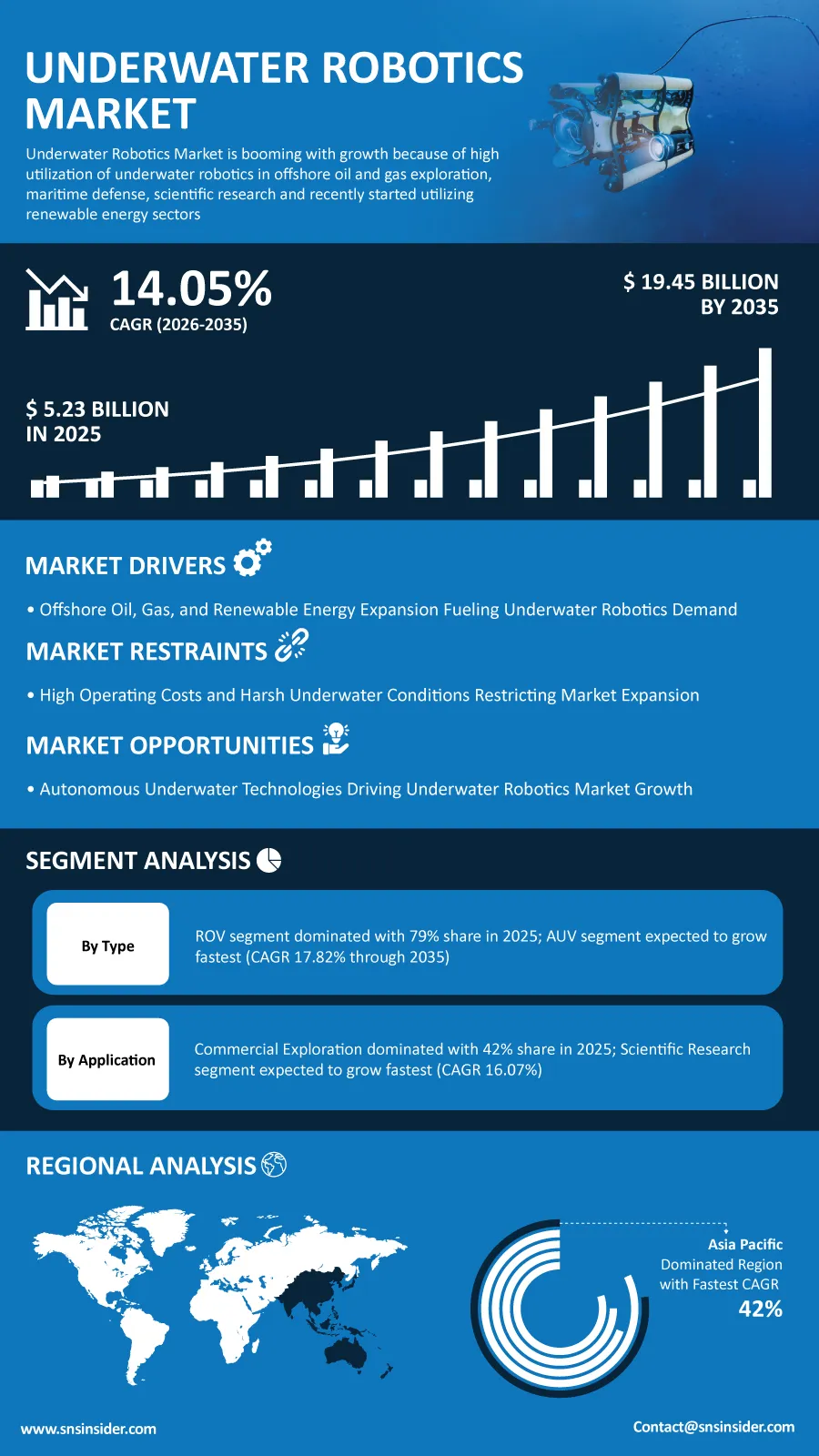
The global Underwater Robotics Market is entering a high-growth phase due to increased demand by offshore energy companies, defense agencies, scientific organizations, and the marine industry for underwater robots. According to a recent study by SNS Insider, the global Underwater Robotics Market size valued at USD 5.23 billion in 2025, is anticipated to grow to USD 19.45 billion by 2035, registering a CAGR of 14.05% over the 2026–2035 forecast period.
The increased demand for inspection of underwater structures, deep sea exploration, and execution of dangerous underwater operations without putting humans through harsh conditions is increasing technology use. ROVs and AUVs are becoming increasingly important in various applications such as offshore energy, maritime safety, scientific research, and management of underwater infrastructure.
The quick evolution of artificial intelligence, autonomous navigation systems, underwater sensors, and imaging is increasing the capabilities of robotic technology. Operators will be able to conduct complex missions for a longer time period and obtain high quality information from inaccessible underwater locations through these technologies.
To Get Detailed Insights on the Underwater Robotics Market – Request a Sample Report
Offshore Energy Expansion Creates New Growth Opportunities
The ongoing growth in offshore oil and gas production and the fast-paced rise in offshore wind farm construction have created steady demand for underwater robotics. ROVs are finding more use in inspection, maintenance, repair and intervention tasks, whereas AUVs are being utilized in seabed mapping, cable routing and environmental monitoring operations.
However, the rise in offshore renewable energy represents an important trend that holds promise for the future. Deeper waters in which offshore wind farms operate demand robotic platforms for inspection of their infrastructure through the whole life-cycle.
Furthermore, government-sponsored marine research has opened additional prospects for the use of underwater robotic systems. Increasingly often, AI-powered autonomous vehicles are being used for the purpose of studying marine biodiversity, mapping oceanic ecosystems and obtaining data from distant areas where traditional methods are costly or ineffective.
Key Market Insights Highlight Shifting Demand Patterns
By type, Remotely Operated Vehicles (ROVs) segment held approximately 79% of global market revenue in 2025 caused by their established use in offshore energy, marine construction, and subsea intervention continues to support market leadership. Autonomous Underwater Vehicles (AUVs) segment is projected to be the fastest-growing segment, registering a CAGR of 17.82% through 2035 as improvements in autonomous navigation, battery technology, and onboard intelligence enable longer independent missions.
Based on application, commercial exploration segment held around 42% of market revenue in 2025 as offshore energy operations and subsea infrastructure projects remain major contributors to demand. Scientific research is expected to experience the fastest growth, with a projected CAGR of 16.07%, driven by the surging oceanographic studies, environmental monitoring programs, and deep-sea exploration initiatives.
AI and Autonomous Navigation Transform Underwater Operations
The use of intelligent machines along with sonars, LiDARs, acoustic communication, and high-definition images is transforming the field of underwater robotics. It is now possible to analyze large amounts of underwater data, enhance navigation capabilities, and detect anomalies while conducting inspections with the help of intelligent machines.
Another significant advancement in this field relates to the emergence of multi-robot cooperation. With the help of swarm robots, more than one robot may be utilized to conduct surveys and collect complementary datasets simultaneously.
There are advancements taking place in energy technology as well that enhance the feasibility of autonomous underwater vehicles. Energy harvesting technologies have made it easier for the robots to conduct surveys in distant areas when it is not feasible to recharge batteries.
Europe Leads with 34% Revenue Share While Asia Pacific Advances at a 17.03% CAGR
The largest regional market is anticipated to continue being Europe, holding close to 34% of the total global revenue in 2025. Growth in oil and gas exploration activities off-shore, growth in wind farms off-shore, sophisticated maritime technology, and well-developed subsea services sector will help maintain regional supremacy.
Asia Pacific region is forecasted to be the fastest growing regional market at a CAGR of around 17.03% from 2025 to 2035. Increased investment in offshore energy projects, growing naval modernization activities, growth in oceanic research, and increasing developments in deep sea technologies in countries like China, Japan, South Korea, India, and Australia are some of the factors contributing towards regional growth.
Also, the strong manufacturing capability and increasing government expenditure on marine technology in the region is anticipated to promote the adoption of next generation underwater robots.
Industry Participants Focus on Autonomous Technology and Mission Expansion
The competitive landscape is evolving rapidly as manufacturers and subsea technology providers invest in autonomous capabilities, advanced sensing systems, energy-efficient platforms, and specialized robotic solutions. Companies are increasingly focused on expanding applications beyond traditional offshore energy into renewable power, scientific research, defense, marine conservation, and infrastructure inspection.
Key companies operating in the global Underwater Robotics Market include Oceaneering International, Inc., Saab AB, TechnipFMC plc, Kongsberg Maritime, Teledyne Marine, Fugro N.V., General Dynamics Mission Systems, Inc., ECA GROUP, Atlas Elektronik GmbH, Hydroid, Inc. (Kongsberg), Soil Machine Dynamics Ltd., Forum Energy Technologies, Inc., VideoRay LLC, Subsea 7 S.A., DOF Subsea AS, International Submarine Engineering Limited, Deep Ocean Engineering, Inc., ATLAS MARIDAN Aps, Perry Slingsby Systems, and Eddyfi Technologies.
An SNS Insider analyst Sushant Kadam commented, “The expanding offshore energy ecosystem, rising investment in marine research, and growing defense requirements are creating a diverse demand base for underwater robotics. As artificial intelligence and autonomous navigation mature, robotic platforms capable of performing longer, safer, and more complex missions will play an increasingly important role across the global subsea economy.”
About the Author

Get in touch




