
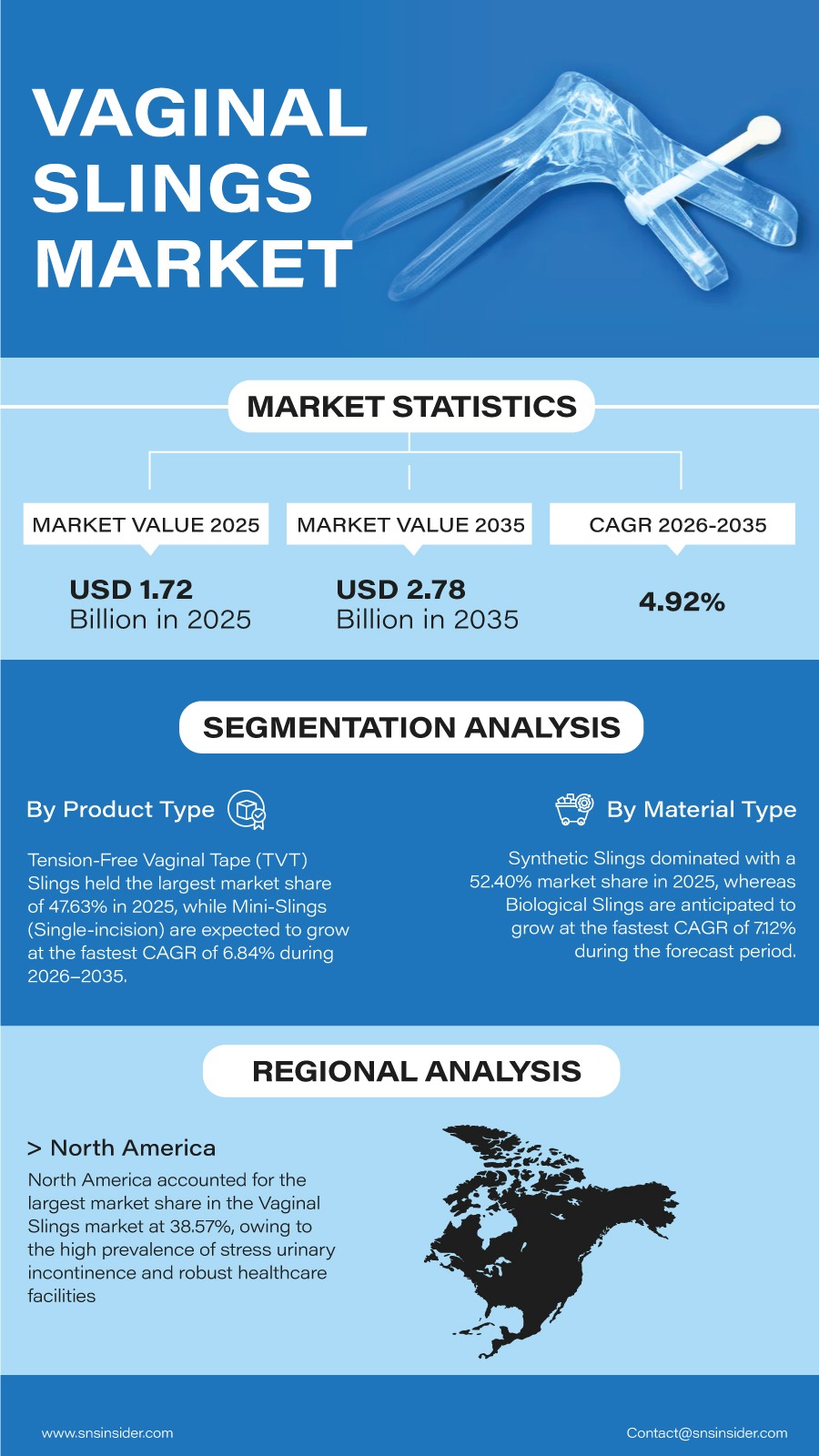
The global Vaginal Slings Market is projected to witness sustained growth over the next decade as healthcare providers increasingly adopt advanced surgical solutions for the management of urinary incontinence. “According to a recent study by SNS Insider, the global Vaginal Slings Market size valued at USD 1.72 billion in 2025, is anticipated to grow to USD 2.78 billion by 2035, registering a CAGR of 4.92% over the 2026–2035 forecast period.”
With increased understanding about pelvic floor dysfunction, wider availability of women’s health care services, and a preference for minimally invasive surgery, a change in treatment strategies is taking place across the world. The focus by healthcare providers on those treatment strategies which can help achieve better and lasting results, shorter recovery times, and provide greater comfort is paving the way for future market growth.
The market is also benefiting from increasing investments in urogynecology services and specialized women's health centers, enabling greater access to advanced treatment options for patients seeking long-term symptom relief.
Innovation in Surgical Technologies Supports Market Expansion
The development and manufacturing companies of medical devices are still developing new slings, which will help them gain accuracy in the process and increase the performance and biocompatibility. The use of new product developments, like lighter products, advanced implantation, and patient-focused designs, have helped increase the confidence of the physicians.
The rise in the use of outpatient surgeries has also played an important role in the market growth, as healthcare facilities can perform less invasive procedures on patients. This trend will further increase the use of vaginal slings in healthcare institutions.
Ongoing clinical research aimed at improving procedural safety and expanding treatment options is expected to further strengthen the long-term outlook for the market.
Key Market Findings Highlight Emerging Opportunities
Among product categories, Tension-Free Vaginal Tape (TVT) slings accounted for 47.63% of global market revenue in 2025, reflecting their well-established role in surgical management and broad clinical acceptance.
Meanwhile, mini-slings are expected to register the fastest growth through 2035, expanding at a CAGR of 6.84%, supported by increasing demand for less invasive procedures and shorter recovery times.
By procedure type, midurethral slings represented 79.70% of total market revenue in 2025, maintaining their position as the preferred surgical approach across many healthcare settings. At the same time, traditional sling procedures are projected to witness the fastest growth at a CAGR of 5.28%, reflecting their continued relevance for selected patient populations.
Material preferences are also evolving. Synthetic slings accounted for 52.40% of market revenue in 2025, while biological slings are anticipated to expand at the fastest CAGR of 7.12% through the forecast period, driven by growing interest in materials designed to support improved tissue compatibility.
From an end-user perspective, hospitals captured 48.30% of global market revenue in 2025, whereas ambulatory surgical centers are expected to record the fastest growth, registering a CAGR of 6.35% through 2035, reflecting the continued shift toward outpatient surgical care.
Growing Focus on Women's Health Drives Long-Term Demand
In many countries, there are rising expenditures on women’s health, diagnostic tools, and pelvic services. The heightened level of awareness about urinary incontinence along with better access to treatment options is resulting in more people seeking treatment without putting it off any further.
The growth of specialized practices of urogynecology, along with better surgical training and patient education, presents new opportunities for healthcare professionals and medical device companies. With increasing patient-centric approaches to treatment procedures, there will be ongoing high demand for modern sling products in the next ten years.
Regional Markets Continue to Expand
North America accounted for 38.57% of global market revenue in 2025, supported by advanced healthcare infrastructure, strong adoption of minimally invasive surgical techniques, favorable reimbursement systems, and the presence of leading medical device manufacturers.
Meanwhile, Asia Pacific is projected to emerge as the fastest-growing regional market, expanding at a CAGR of 6.85% through 2035. Rising healthcare investments, improving surgical capabilities, expanding access to women's healthcare services, and growing awareness of pelvic floor disorders are creating significant opportunities across the region.
Industry Leaders Continue to Strengthen Innovation
The vaginal sling market still has some competition in it as there are medical device firms that keep on working towards developing innovative products along with educating physicians and growing their operations globally. The manufacturers are concerned with making their procedures more efficient and ensuring their safety.
Key companies operating in the global vaginal slings market include Boston Scientific Corporation, Coloplast, Ethicon, Medtronic, CooperSurgical, Becton Dickinson, B. Braun, Caldera Medical, Promedon Group, and A.M.I. GmbH.
An SNS Insider analyst commented, "Growing emphasis on minimally invasive pelvic floor procedures, combined with ongoing innovations in sling design and biomaterials, is reshaping the treatment landscape for urinary incontinence. Continued advancements in surgical technologies and patient-centered care are expected to support sustainable market growth over the coming years."
An Infographic Representation of the Global Vaginal Slings Market
About the Author

Get in touch




