
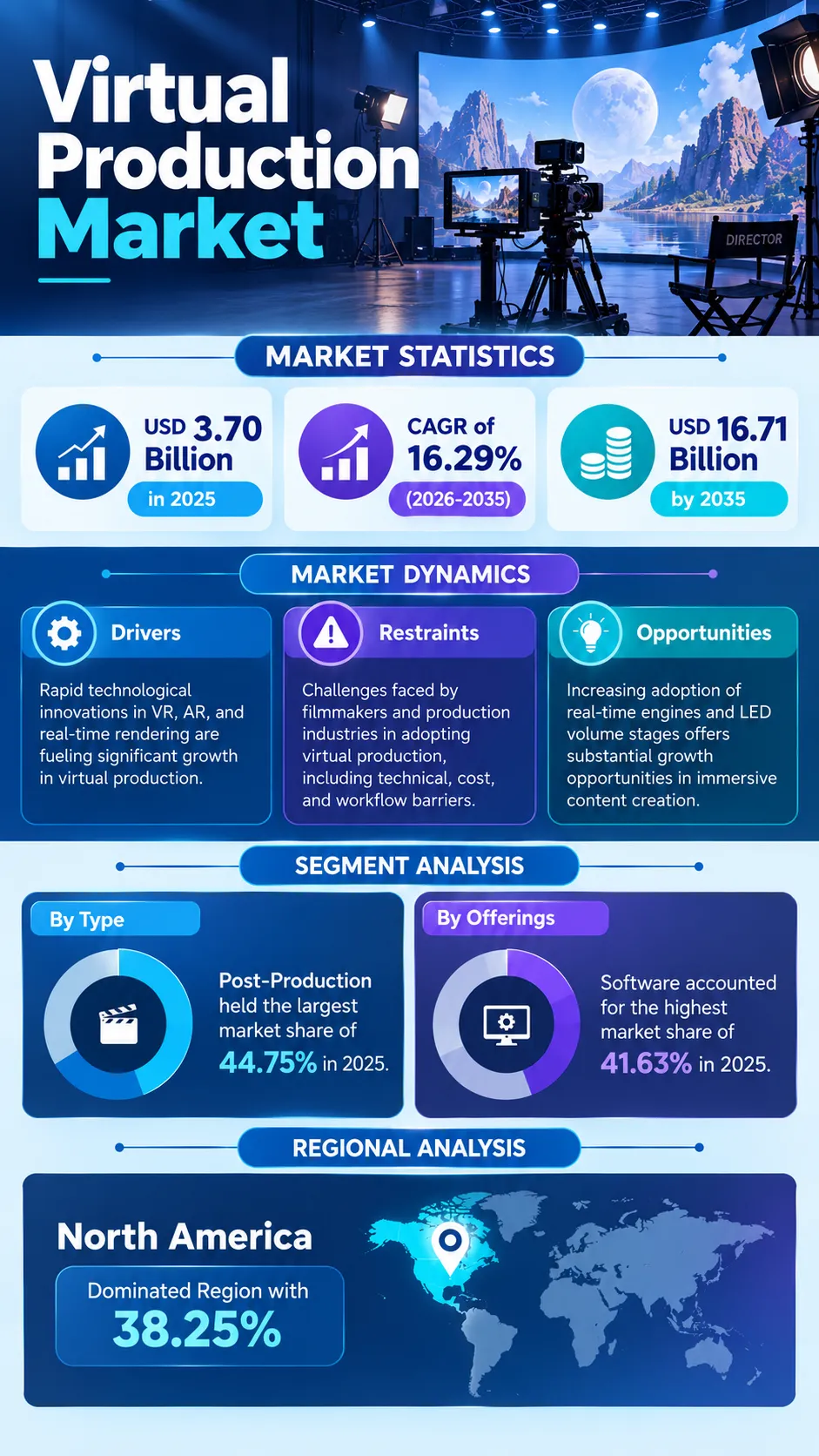
The global Virtual Production Market is about to enter an accelerated growth phase due to the increasing adoption of immersive production technologies by film studios, broadcasters, and streamers. “According to a recent study by SNS Insider, the global Virtual Production Market size valued at USD 3.70 billion in 2025, is anticipated to grow to USD 16.71 billion by 2035, registering a CAGR of 16.29% over the 2026–2035 forecast period.”
The move toward film production driven by digital technologies is being aided through advancements made in the areas of real-time graphics, virtual environments, motion capture, and extended reality. There is an increasing requirement for producers to adopt film production processes where they get creative freedom and can develop, visualize, and edit scenes without necessarily having physical set up.
Moreover, the demand is growing as more entertainment firms vie for premium content in the form of films in theatres, televisions, streaming services, advertisements, and videos posted online. Virtual production techniques have been adopted by more than 3,500 productions across the world in 2025.
To Get Detailed Insights on the Virtual Production Market – Request a Sample Report
Real-Time Production Technology Opens New Growth Opportunities
Virtual production is gradually turning out to be an essential element in the industry’s move to a more adaptive and technology-enabled way of filmmaking. With the help of real-time rendering tools, directors and cinematographers are able to visualize the digital environment while filming, thereby improving their decision-making process.
Another technology that is increasingly significant is LED volume stage, as it allows producing dynamic digital background and interactive lighting right on the set. This solution can decrease reliance on green screen techniques and give production teams greater control over the environment.
The emergence of artificial intelligence adds yet another dimension of possibilities as AI facilitates the creation of visual effects, assets, and pre-visualization among other things. The combination of AI, real-time engines, and immersive hardware is likely to contribute to the wider adoption of virtual production.
Key Market Insights Highlight Shifting Demand Patterns
By type, post-production sector is anticipated to capture 44.75% of the total global revenue market share in 2025, backed by considerable demand for editing, visual effects, color grading, and finishing activities. But it is the production sector that is estimated to witness the highest growth rate of 15.87%, growing through 2035 owing to the use of LED stage, virtual environment, and real-time rendering.
Based on offerings, software had the highest market share of 41.63% in 2025, owing to the increasing requirement for rendering, virtual set management, animations, and visual effects software. Hardware is expected to have the highest CAGR of 16.78%, due to increased investments by studios in LED displays, computers, cameras, and motion tracking hardware.
By end user, movies have taken the lead with a market share of 37.88% in 2025 due to the ongoing utilization of virtual environments and visualization in mass production. The online video segment is expected to grow at the fastest pace, with a CAGR of 17.64% as streaming services, independent creators, and digital media platforms increase their use of immersive production tools.
AI and LED Volumes Reshape Filmmaking Workflows
Artificial intelligence, extended reality, and real-time graphics technologies are coming together and this is influencing the way content creation happens. The virtual environment can be manipulated during the process of creating the video game, and therefore the team gets a chance to test the locations, lighting, camera angles, etc.
One other trend in video game creation is that of remote collaboration, where teams can work together in the process of creating the game despite the physical distance between the participants.
North America Holds 38.25% Virtual Production Market Share in 2025 as Asia Pacific Grows at a 17.45% CAGR Through 2035
North America is likely to lead in regional market share by taking up about 38.25% of the total revenue share globally in 2025. The development of advanced studio infrastructure, massive investments in media, and the presence of leading entertainment and technology companies continue to propel regional dominance.
The Asia Pacific region will show the fastest growth rate with a CAGR of 17.45% during the period 2025-2035. Growing entertainment investments, the emergence of streaming ecosystems, growing adoption of VR and AR technologies, and LED volume stage deployments have led to increasing demand in countries such as China, Japan, South Korea, and others within the region.
The U.S. continues to be one of the prominent national markets where revenue is set to grow from USD 1.02 billion in 2025 to USD 4.35 billion in 2035 at a CAGR of 14.8%. China is also becoming an important player within the Asia Pacific region owing to the development of studio infrastructure and virtual environments.
Industry Participants Focus on Integrated Production Ecosystems
Competition in the virtual production market is centered on software innovation, real-time rendering, immersive hardware, AI-enabled workflows, and integrated production platforms. Technology providers are increasingly developing interconnected ecosystems designed to simplify content creation from pre-visualization through final delivery.
Key companies operating in the global Virtual Production Market include Adobe, Epic Games, HumanEyes Technologies, NVIDIA Corporation, Technicolor, Autodesk, HTC Corporation, Mo-Sys Engineering, Pixar, Vicon Motion Systems, Foundry, Blackmagic Design, Weta Digital, Unity Technologies, Samsung, Blender, Blaize, Microsoft, Intel Corporation, and Rohde & Schwarz.
An SNS Insider analyst Sushant Kadam commented, “Virtual production is moving beyond specialized filmmaking environments as real-time rendering, LED volumes, AI, and immersive technologies become increasingly accessible. The continued convergence of creative software and production hardware will create substantial opportunities for companies capable of delivering efficient, scalable, and collaborative content-production ecosystems.”
About the Author

Get in touch




