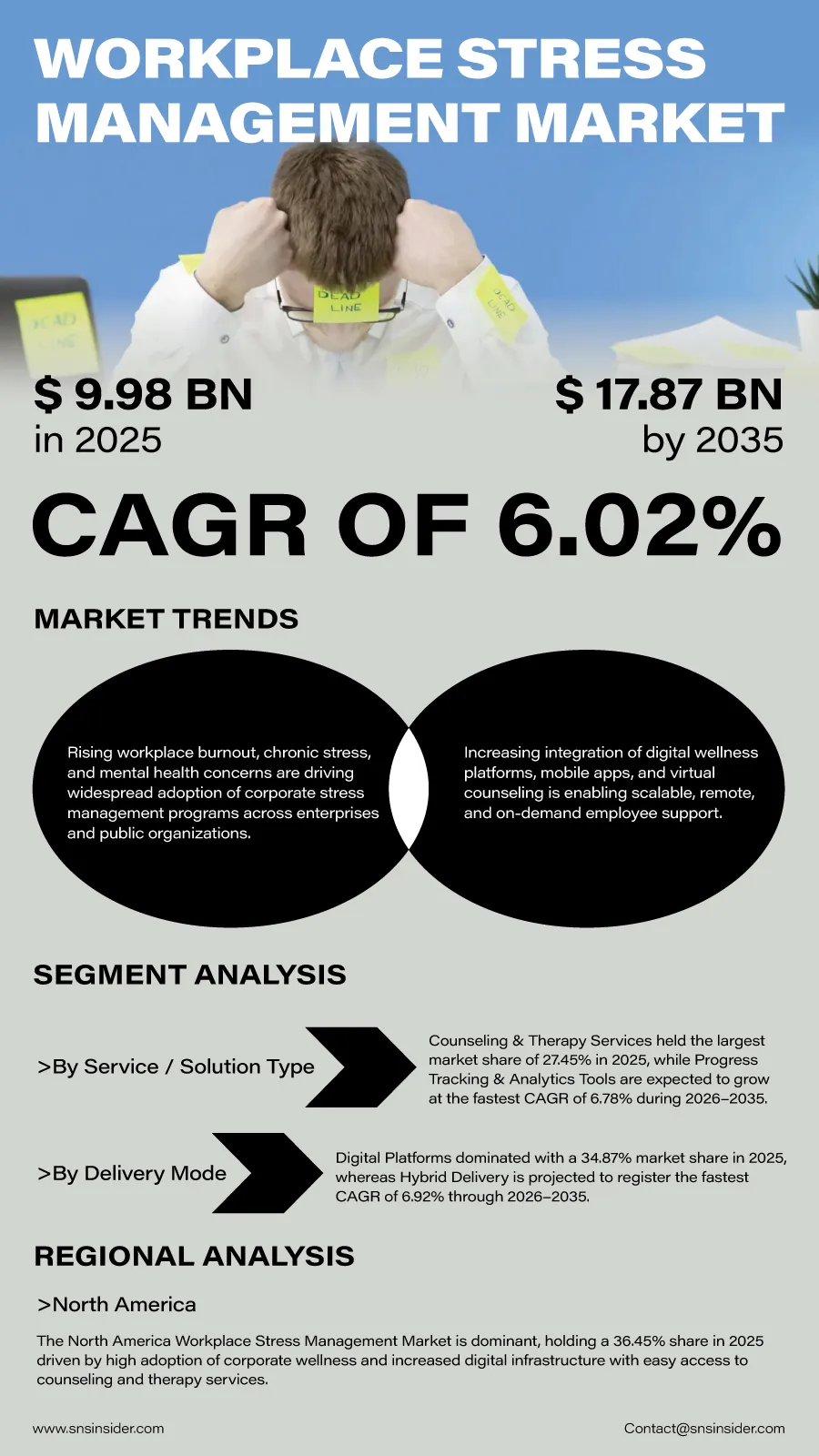
The global Workplace Stress Management Market is projected to witness sustained growth as organizations increasingly recognize employee mental well-being as a strategic business priority. “According to a recent study by SNS Insider, the global Workplace Stress Management Market size valued at USD 9.98 Billion in 2025, is anticipated to grow to USD 17.87 Billion by 2035, registering a CAGR of 6.02% over the 2026–2035 forecast period.”
Many firms, irrespective of their industry verticals, are making efforts to build up their workplace wellness programs to counter the high levels of occupational stress among their employees. This is being done through higher investments in their employee assistance programs, behavioral health programs, digital wellness tools, and resiliency programs.
With hybrid working arrangements becoming prevalent in modern workplaces, organizations are coming up with technology-based approaches that make it easy for their employees to access mental health facilities from wherever they want.
Digital Innovation Reshapes Workplace Well-Being Strategies
The environment for workplace wellness is changing quickly due to the incorporation of AI, behavioral analytics, virtual coaching, and digital health platforms. Companies are taking advantage of technology in order to detect patterns of workplace stress, offer personalized support and encourage participation in wellness programs.
Also, organizations are adopting holistic well-being initiatives that incorporate professional counseling, mindfulness programs, resilience building and immediate employee assistance into one well-being ecosystem. This approach is aiding firms to develop healthier work environments along with increased productivity and reduced turnover of employees.
Increasing cooperation between employers, technology companies, healthcare institutions, and experts in behavioral health is likely to further fuel the innovation process in the field of work stress management.
Key Market Findings Highlight Emerging Opportunities
Among service categories, counseling and therapy services generated 27.45% of the worldwide market share revenue in 2025, indicating a need for professional psychological assistance in corporate wellness programs.
Meanwhile, the progress tracking and analytics segment is expected to witness the highest CAGR growth of 6.78% over the forecast period from 2022 to 2035, due to the growing use of AI-based workforce insights and analytics solutions.
By delivery model, digital platforms accounted for 34.87% of the market’s total revenue in 2025, due to the increasing use of mobile wellness apps, online counseling, and cloud-based platforms for engaging employees. Meanwhile, hybrid engagement approaches will see the most rapid growth in terms of CAGR of 6.92%, as employers increasingly combine in-person wellness initiatives with digital engagement tools.
Organization size also continues to influence adoption patterns. Large enterprises accounted for 46.53% of market revenue in 2025 due to their ability to invest more money and having already implemented their employee wellness programs. On the other hand, medium enterprises will grow at a higher rate of 6.41%, with the highest CAGR among all market participants, reflecting broader accessibility of scalable subscription-based wellness solutions.
Employee engagement strategies continue to evolve as well. Group-based wellness programs held the largest share of the market revenue of 41.26% in 2025. Individualized programs are expected to experience the highest growth rate in terms of CAGR, which is estimated to be 6.58%, highlighting growing demand for personalized mental health support and customized employee care.
Employee Well-Being Becomes a Strategic Business Priority
The connection between the wellness of the organization’s people, their retention, productivity, and overall performance has become more evident in recent times. With an increase in competition in terms of hiring competent individuals, companies have started taking efforts towards implementing wellness programs that can help promote a healthy work environment.
Behavioral science advancements, technology, and prevention of mental illnesses have made it possible for organizations to move beyond reactive measures and implement proactive programs to manage wellness in the workplace.
Regional Markets Continue to Expand
In 2025, North America was the dominant regional market for global market revenue generation with a share of 36.45%. This can be attributed to high popularity of employee well-being solutions among organizations, advanced digital infrastructure, and rising spending on mental health of employees. High levels of awareness regarding employee well-being and well-established framework of employee assistance will further strengthen the position of North America in the regional market.
The other emerging regional market is the Asia Pacific region, which will witness a CAGR of 7.35% during 2025-2035. Urbanization, rising awareness of organizations regarding employee well-being, and increasing spending on well-being programs are key opportunities in the region.
Leading Companies Continue to Expand Workplace Wellness Solutions
Competition within the workplace stress management market remains dynamic as technology providers, healthcare organizations, and corporate wellness specialists continue investing in digital innovation, personalized care, and integrated employee support platforms.
Key companies operating in the global workplace stress management market include ComPsych Corporation, Lyra Health, Headspace, BetterUp, Modern Health, Optum, CVS Health, TELUS Health, Personify Health, and Unmind.
An SNS Insider analyst Parry Kardani commented, "Organizations are increasingly viewing employee well-being as a long-term strategic investment rather than a workplace benefit. Continued advancements in AI-powered wellness platforms, personalized mental health support, and digital engagement technologies are expected to reshape workplace stress management over the next decade."
About the Author

Get in touch