
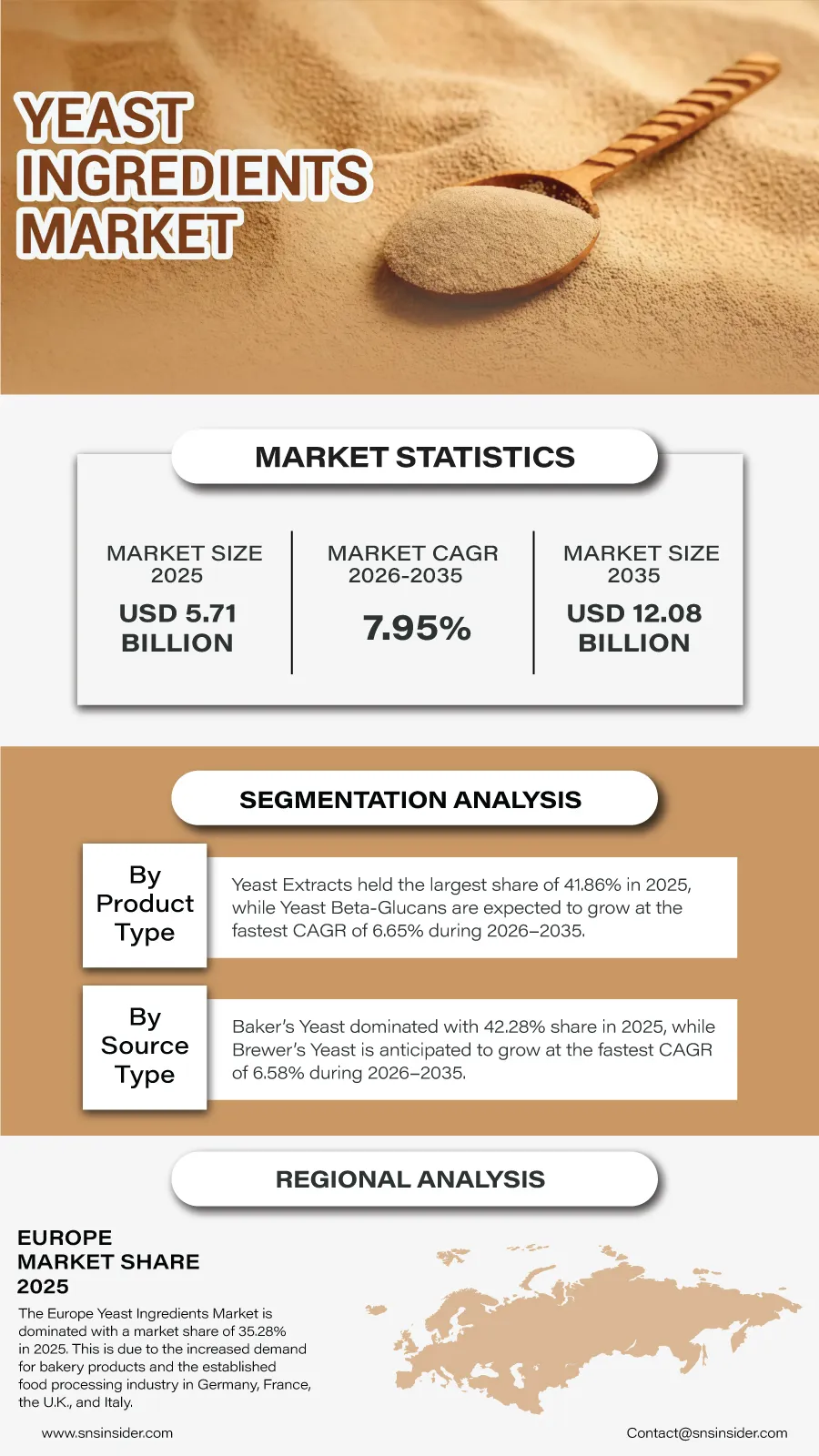
The global market for Yeast Ingredients is expected to experience significant growth due to the growing use of yeast ingredients in food, biotechnology, and nutraceuticals, owing to the changing preferences of consumers for natural and functional foods. “According to a recent study by SNS Insider, the global Yeast Ingredients Market size valued at USD 5.71 billion in 2025, is anticipated to grow to USD 12.08 billion by 2035, registering a CAGR of 7.95% over the 2026–2035 forecast period.”
Evolving consumption practices of consumers, preference towards clean labels and fermentation-based ingredients is revolutionizing the industry of food and nutrition. Suppliers are focusing on developing new ingredients that not only enhance the taste and nutritional value of products but also make their manufacturing process efficient and easier.
Apart from conventional uses in the production of food products, yeast-based ingredients have found increased popularity in dietary supplements, animal feed, biotechnology, and specialty industrial operations.
To Get Detailed Insights on the Yeast Ingredients Market – Request a Free Sample Report
Fermentation Innovation Strengthens Industry Outlook
Further innovations in the field of fermentation technology keep transforming the yeast ingredients industry by allowing producers to create ingredients with improved functionalities and wide commercial use. Continued investments into technologies and biotechnological platforms are boosting production efficiency and helping to produce innovative yeast ingredients in the future.
The increasing demand for sustainable manufacturing methods is also driving the industry towards applying fermentation technologies to produce ingredients that will allow the manufacturer to apply sustainable production practices. With the continued reformulation of food products to meet new consumer requirements, the demand for versatile yeast ingredients will grow globally.
Furthermore, the yeast ingredients industry is profiting from the growing cooperation between ingredient producers, food manufacturers, and biotechnology firms.
Key Market Findings Highlight Emerging Opportunities:
By Product Categories, yeast extracts accounted for 41.86% of global market revenue in 2025, reflecting their widespread use in flavor enhancement and food formulation across multiple applications.
Meanwhile, yeast beta-glucans are projected to register the fastest growth through 2035, expanding at a CAGR of 6.65%, driven by increasing interest in functional nutrition and wellness-oriented products.
By form, dry yeast ingredients represented 68.25% of total market revenue in 2025, supported by their long shelf life, handling convenience, and broad adoption across commercial food production. At the same time, liquid yeast ingredients are expected to record the fastest growth at a CAGR of 6.70%, reflecting growing demand for high-performance fermentation solutions.
The application segment analysis underscores the prominence of the food sector. The food & beverages category had a market revenue share of 55.35% in 2025, and nutraceuticals and dietary supplements are projected to have the highest growth rate of 6.30% during the forecast period due to the growing consumer demand for health-based nutritional products.
In terms of end-users, the food processing segment had a global market revenue share of 51.86% in 2025, while nutraceutical manufacturing is expected to have the fastest growth CAGR of 6.58% till 2035 due to the rising use of yeast-based ingredients in health products.
An Infographic Representation of the Global Yeast Ingredients Market
Expanding Plant-Based Nutrition Creates New Growth Potential Globally
Consumer awareness about the benefits of plant-based diets and natural sources of ingredients provides interesting prospects for producers of yeast-based products. Nutritional yeast, yeast proteins, and specialized fermentation ingredients are more widely used nowadays as components of food products created in order to enrich nutrition profiles and produce products with clean label.
The market also gains from growing demands for functional ingredients that provide such important qualities as taste improvement, protein fortification, and stabilization of products. Further advancements in science of ingredients may open new business prospects for producers of yeast-based products.
Regional Markets:
The European region held a share of 35.28% in the global market revenue in 2025 owing to its developed food processing sector, proficiency in fermentation technology, and high consumer preference for natural food ingredients. The focus on ingredient innovations and sustainable food production further enhances Europe’s dominance in the global market.
On the other hand, the Asia Pacific region is expected to register the highest growth among all regions with a CAGR of 9.78% during 2025-2035. This is because of the fast-paced urbanization, higher intake of processed foods, growth in bakery sectors, and investments in biotechnology/fermentation production technology.
Industry Leaders Focus on Innovation and Capacity Expansion Globally
However, the competition in the yeast-based ingredients market is becoming increasingly competitive as companies develop their manufacturing processes, increase fermentation facilities, and produce innovative ingredient products.
Leading companies operating in the global yeast ingredients market include Associated British Foods, Lesaffre, Angel Yeast, Lallemand, Kerry Group, DSM-Firmenich, Sensient Technologies, Alltech, Leiber GmbH, and AB Mauri.
An SNS Insider analyst Santosh Bhul commented, "Consumer demand for natural ingredients, sustainable production methods, and functional nutrition continues to reshape the global yeast ingredients industry. Companies investing in fermentation innovation and diversified product portfolios are expected to capitalize on expanding opportunities across food, health, and biotechnology markets."
About the Author

Get in touch




