
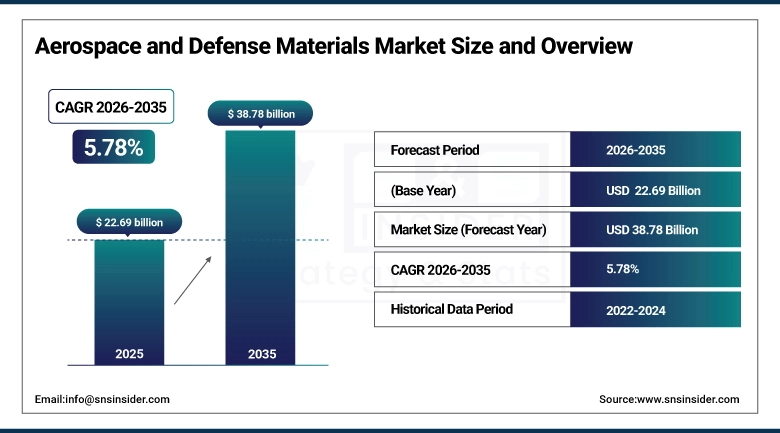
As per the SNS Insider Report titled, Aerospace and Defense Materials Market by Material Type, by Manufacturing Technology, by Application, by End User, by Region, And Global Forecast 2026–2035, “The global Aerospace and Defense Materials Market size valued at USD 22.69 Billion in 2025, is anticipated to grow to USD 38.78 Billion by 2035, registering a CAGR of 5.78% over the 2026–2035 forecast period.”
Key Takeaways
-
Aluminum alloys dominated the market by material type in 2025 owing to their extensive use in lightweight aircraft structures and defense systems.
-
Composites are projected to be the fastest-growing material segment during 2026–2035 due to increasing demand for high-strength and fuel-efficient aerospace materials.
-
Advanced machining & forging led the market by manufacturing technology in 2025 as manufacturers continued to rely on precision engineering for aircraft production.
-
Additive manufacturing (3D printing) is expected to emerge as the fastest-growing manufacturing technology segment during the forecast period.
-
Airframe & structural components accounted for the highest application share in 2025 due to rising aircraft production and modernization programs.
-
Engine & propulsion systems are anticipated to be the fastest-growing application segment during 2026–2035 driven by advancements in high-temperature resistant materials.
-
Commercial aviation dominated the market by end user in 2025 owing to rising global passenger traffic and increasing aircraft fleet expansion.
-
North America accounted for the highest regional revenue share of approximately 39.89% in 2025, while Asia-Pacific is projected to grow at the fastest CAGR of 8.87% during 2026–2035.
Why Aerospace and Defense Materials Market is Growing?
Aerospace and Defense Materials Market is experiencing robust growth owing to the rise in the production of commercial aircraft, increase in the modernization programs by the defense industry, and the surge in investments made in advanced aerospace technology. There is an increased spending by governments in major countries in terms of military budgets that is stimulating the demand for aerospace materials.
There is also an increasing demand for lightweight materials that can deliver efficiency in fuel consumption along with durability. Manufacturers of aerospace parts are incorporating advanced composite materials and titanium alloys to enhance the performance of the aircraft while also reducing their weight and fuel consumption. Advanced technology adoption in space and aircraft design is also fueling growth in this market.
Innovations in manufacturing processes like additive manufacturing and precision forging are facilitating the growth of this market. These technologies are not only cost-effective but also offer greater flexibility in designing and provide superior quality components. Additionally, rising investments in satellite systems, reusable spacecraft, and UAVs (Unmanned Arial Vehicles) are also driving the demand for advanced materials.
Aerospace and Defense Materials Market Statistics
-
International commercial air passengers' traffic is continuously growing, amounting to billions of passengers each year.
-
More than 39,000 new deliveries of aircraft into service will take place on international and domestic flights in the next two decades.
-
The total worldwide military budget surpassed USD 2 trillion, facilitating the upgrade of military aircraft and defense equipment.
-
Aerospace companies utilize composite materials more often; the amount of composite parts exceeds 50% by mass in some of the future generations of aircraft.
-
More aerospace companies use additive manufacturing technologies because they help cut down waste and reduce time in production processes.
-
The satellite market is growing rapidly, with many satellites being launched to orbit for various purposes.
-
Many aerospace companies focus on developing environmentally-friendly aviation technology to increase efficiency and reduce aircraft carbon emissions.
-
The number of space expeditions and activities grows, requiring advanced materials to withstand extreme conditions in space.
Emerging Trends
One of the important trends that will affect the Aerospace and Defense Materials Market is the use of composite materials in making aircraft parts. Many aerospace manufacturers are currently looking at ways to substitute metals with lightweight composite materials to increase fuel efficiency.
Another important trend impacting the market is additive manufacturing or 3D printing. Advanced 3D printers are now being used by manufacturers to create aerospace parts with improved accuracy and shortened production time.
Rising investments in sustainable aviation materials and manufacturing processes are also becoming a trend among aerospace manufacturers. Recycling composites, sustainable manufacturing processes, and environmentally-friendly bio-materials are some of the areas where there is growing interest.
Moreover, an increasing need for aerospace materials owing to expanding satellite programs and commercial space activities is also driving growth in the market.
Top 10 Companies
-
Hexcel Corporation
-
Alcoa Corporation
-
ATI Inc.
-
Toray Industries Inc.
-
Arconic Corporation
-
Carpenter Technology Corporation
-
Solvay S.A.
-
DuPont de Nemours Inc.
-
Kobe Steel Ltd.
-
Constellium SE
About the Author

Get in touch




