
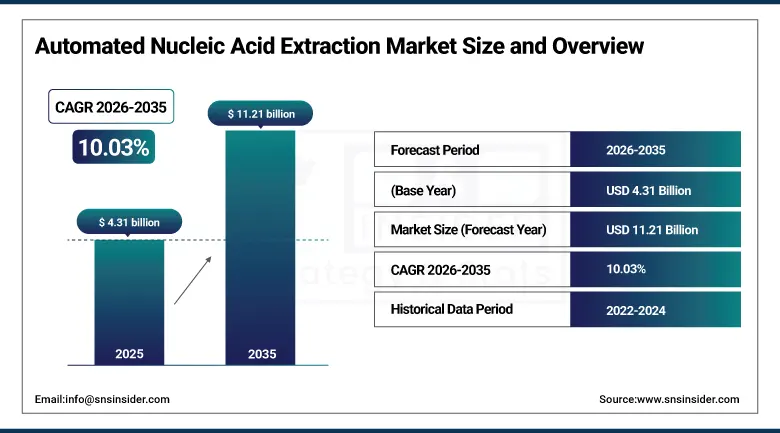
As per the SNS Insider Report titled, Automated Nucleic Acid Extraction Market by Product Type, by Extraction Technology, by Sample Type, by Application, by End User, by Region and Global Forecast 2026–2035, “The global Automated Nucleic Acid Extraction Market size valued at USD 4.31 billion in 2025, is anticipated to grow to USD 11.21 billion by 2035, registering a CAGR of 10.03% over the 2026–2035 forecast period.”
Key Takeaways
-
Instrument Segment occupied almost 42.78% of market share in 2025 owing to the growing use of automated lab-based equipment and extraction systems.
-
Software & Data Analysis Tool Segment is estimated to experience the highest growth at a CAGR of 12.47% in the coming years of 2026-2035 due to rising demand for advanced bioinformatics solutions.
-
Magnetic Bead-Based Extraction Segment dominated the Extraction Technique Category and accounted for a market share of 48.15% in 2025 attributed to higher efficiency and capability to be used with automated systems.
-
PCR-Based Extraction Segment is projected to grow at the highest CAGR of 13.05% through 2035 fueled by the increasing adoption of molecular diagnostics and genomics applications.
-
Blood Sample Segment held almost 37.64% market share in 2025 backed by their extensive application in diagnostic testing, disease identification, and genetic analysis.
-
Swabs (Buccal/Nasal) Segment is estimated to experience the highest growth at a CAGR of 12.89% during the forecast period.
-
Clinical Diagnostics Segment accounted for almost 40.52% of market revenue in 2025 due to the growing popularity of nucleic acid extraction techniques.
-
Personalized Medicine Segment is expected to grow at the highest CAGR of 13.21% during the period of 2026 to 2035.
-
Hospitals & Diagnostic Labs Segment captured approximately 45.36% of overall market revenue in 2025, whereas Biotech & Pharmaceuticals companies are expected to record the highest CAGR of 12.88% over the forecasted period.
-
North America occupied nearly 41.87% market share in 2025, and Asia Pacific region is estimated to witness the highest growth at a CAGR of 12.51% through 2026-2035.
Why Automated Nucleic Acid Extraction Market is Growing?
There has been tremendous growth in the Automated Nucleic Acid Extraction Market owing to the increased requirement for molecular diagnostics, sequencing, and precision medicine solutions across the globe. The rising number of cases of infectious diseases, cancer, and genetic abnormalities has necessitated the need for sophisticated nucleic acid extraction systems that would provide accurate, efficient, and reproducible results. Automated systems have been used by many laboratories and institutions to minimize human error and improve their efficiency.
Automation technology, robotics, and artificial intelligence are further enhancing the scope of the market. There has been an increase in spending on R&D initiatives, development of new drugs, and genomics projects, which has added substantially to the rise in demand for automated extraction solutions. In addition, developments in PCR tests, next-generation sequencing, and precision medicine are further fuelling the growth of the market.
Automated Nucleic Acid Extraction Market Statistics
-
According to global healthcare trends, molecular diagnostic testing volumes have increased significantly over the past decade due to rising infectious disease surveillance and genetic screening initiatives.
-
The growing adoption of next-generation sequencing technologies is accelerating demand for efficient nucleic acid extraction solutions in genomics research and clinical applications.
-
Biotechnology and pharmaceutical companies are increasing investments in genomic research, biomarker discovery, and precision medicine development worldwide.
-
Automation in laboratory workflows is expanding rapidly as healthcare institutions focus on improving testing accuracy, reducing turnaround times, and enhancing operational efficiency.
-
Global demand for personalized medicine continues rising due to increasing emphasis on targeted therapies and patient-specific treatment strategies.
-
Government and private sector funding for genomics and molecular biology research programs has increased substantially across major healthcare markets.
-
The use of automated extraction systems in forensic testing and public health surveillance programs is expanding globally.
-
Advances in AI-powered laboratory informatics and data analysis tools are improving the efficiency and scalability of molecular diagnostic workflows.
Emerging Trends
The Automated Nucleic Acid Extraction Market is undergoing some major changes, such as the rise of the application of artificial intelligence and machine learning techniques within molecular diagnostics. It can be noted that laboratories are now employing more cloud-connected systems for automated nucleic acid extraction, as they can be monitored remotely and facilitate the process of workflow optimization. There is also a need for point-of-care testing that is fueling innovations in terms of portable extraction equipment.
Techniques using PCR and magnetic beads are becoming increasingly popular because of the high efficiency of high-throughput automation and rapid tests performed by using these technologies. The emerging trend of personalized medicine and precision oncology is also boosting interest in the development of innovative extraction methods that will be able to work with complex genomic samples. There is also an increased focus on creating software tools and automation bioinformatics processes.
Top 10 Companies
-
Thermo Fisher Scientific Inc.
-
QIAGEN N.V.
-
F. Hoffmann-La Roche Ltd.
-
Danaher Corporation
-
Bio-Rad Laboratories, Inc.
-
Agilent Technologies, Inc.
-
PerkinElmer, Inc.
-
Promega Corporation
-
Hamilton Company
-
Tecan Group Ltd.
About the Author

Get in touch




