
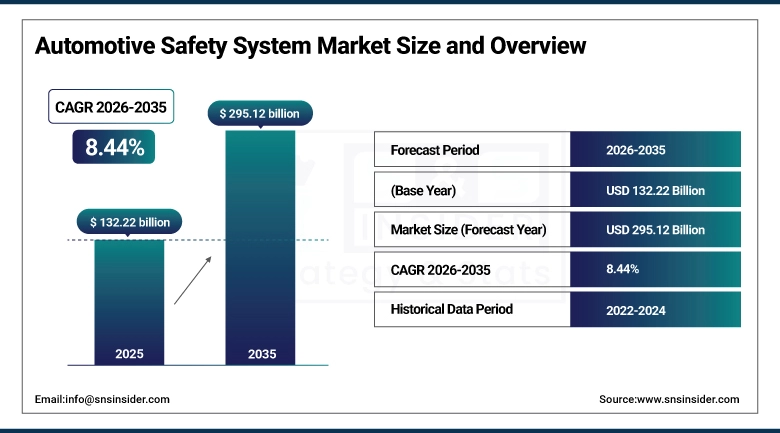
As per the SNS Insider Report titled, “Automotive Safety System Market Size, Share & Segmentation, By Technology, By Sensor Type, By Vehicle Type, By Propulsion Type, By End Market, By Region, And Global Forecast 2026–2035, “the global Automotive Safety Engineering market was valued at USD 132.22 billion in 2025 and is anticipated to reach USD 295.12 billion by 2035, registering a CAGR of 8.44% over the 2026–2035 forecast period.”
Key Takeaways
- The Active Safety Systems segment dominated the market in 2025, accounting for 61.46% of the total market share due to increasing adoption of advanced driver assistance technologies.
- Blind Spot Detection and Lane Departure Warning systems are projected to witness the fastest CAGR of 10.87% during 2026–2035, driven by growing road safety awareness and regulatory mandates.
- Radar Sensors led the sensor category with a 36.55% market share in 2025 owing to their widespread deployment in adaptive cruise control and collision avoidance systems.
- LiDAR Sensors are expected to expand at the fastest CAGR of 12.98% through 2035 as automakers accelerate autonomous and semi-autonomous vehicle development.
- Passenger Cars accounted for the largest market share of 66.12% in 2025 due to rising integration of safety technologies across premium and mid-range vehicles.
- Heavy Commercial Vehicles (HCVs) are projected to register the fastest CAGR of 9.71% during the forecast period amid growing fleet safety regulations and logistics sector expansion.
- ICE Vehicles held a dominant 69.72% market share in 2025, while Battery EVs are anticipated to grow at the fastest CAGR of 12.64% through 2035.
- North America accounted for the largest share of 76.69% in 2025, whereas the Asia-Pacific region is expected to witness the fastest CAGR of 10.11% during 2026–2035.
Why Automotive Safety System Market is Growing?
There is immense growth in the automotive safety system market owing to the rise in attention worldwide towards the reduction in number of deaths in accidents, passenger safety, and the implementation of safety norms in vehicles. Governments in various countries have made mandatory the installation of features such as automated emergency braking, lane departure warning system, blind spot detection system, and adaptive cruise control in newly manufactured cars.
Due to increasing awareness among consumers about the importance of safety rating and advanced technologies in preventing accidents, there is high demand for automotive safety systems. There is rising implementation of advanced safety features in internal combustion engine cars and electric vehicles through the use of sensors. The growing production of electric cars and implementation of connected and intelligent transportation systems are providing impetus to the market growth.
Further, developments in radar technology, LiDAR technology, and cameras are enhancing the vehicle detection capacity and safety monitoring abilities of drivers.
Automotive Safety System Market Statistics
As per the World Health Organization, there are roughly 1.19 million deaths recorded annually owing to fatalities in road accidents. This makes the development of more sophisticated vehicle safety technologies extremely important.
Research done by the National Highway Traffic Safety Administration shows that automatic emergency braking technology can help reduce the incidence of rear-end collisions, thus prompting regulations that mandate the deployment of ADAS in all vehicles.
The European New Car Assessment Programme keeps enhancing vehicle safety through its rating programs by urging the inclusion of advanced driver assistance systems in new vehicles manufactured in Europe.
Production rates of electric vehicles are rising around the globe owing to increased funding of automotive giants and government policies promoting the transition towards the use of electrified cars. This is boosting the incorporation of intelligent sensing and safety electronics in automobiles.
Autonomous driving technologies are another area of heavy focus among automotive firms with sensor fusion, artificial intelligence driver monitoring and predictive analytics at the forefront of their innovations.
Emerging Trends
One of the most prominent developments within the automotive safety system market involves the introduction of advanced driver assistance systems with built-in AI technology for real-time decision-making and prediction of potential dangers.
Another notable development in the field relates to the introduction of LiDAR and radar sensors in premium vehicles and self-driving cars. Advanced sensor fusion techniques with the use of radar, camera, ultrasonic sensors, and LiDAR are being used in modern automobiles to enhance their environmental awareness and navigation capabilities.
Moreover, the concept of software-defined vehicles has brought about another important development. Software updates can be provided remotely, and improvements can be made on a regular basis without physically altering hardware components. Finally, cybersecurity remains an important issue that should not be overlooked in today's automotive safety systems.
Top 10 Companies
- Robert Bosch GmbH
- Continental AG
- ZF Friedrichshafen AG
- Denso Corporation
- Aptiv PLC
- Valeo
- Autoliv Inc.
- Magna International Inc.
- Hyundai Mobis
- Veoneer
About the Author

Get in touch




