
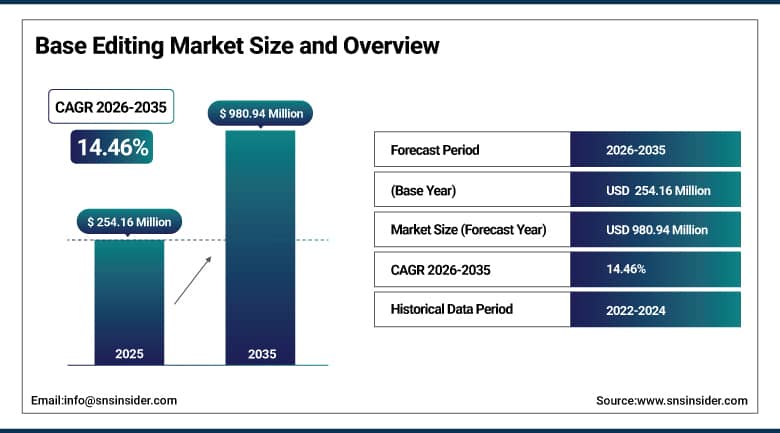
As per the SNS Insider Report titled, Base Editing Market by Type, Products & Services, by Application, by End Use, and by Region, and Global Forecast 2026–2035, “The global Base Editing Market size was valued at USD 254.16 Million in 2025, is anticipated to grow to USD 980.94 Million by 2035, registering a CAGR of 14.46% during the forecast period 2026–2035.”
Key Takeaways
-
DNA Base Editing accounted for approximately 53% of the market share in 2025, driven by its widespread adoption in gene correction studies, therapeutic development, and precision genome engineering applications.
-
RNA Base Editing is projected to witness the fastest growth during 2026–2035, registering a CAGR of 15.81% due to increasing research into reversible genetic modifications and RNA-targeted therapies.
-
Products dominated the Products & Services segment with a 52.34% revenue share in 2025 owing to strong demand for base editing reagents, enzymes, kits, and genome engineering platforms.
-
Services are expected to register the fastest CAGR of 16.05% through 2035 as biotechnology companies increasingly outsource genome editing research and development activities.
-
Drug Discovery and Development held approximately 50% market share in 2025, supported by growing utilization of base editing technologies for target validation and therapeutic development.
-
Agriculture is anticipated to emerge as the fastest-growing application segment with a CAGR of 15.80% during the forecast period due to increasing demand for precision crop improvement and trait enhancement technologies.
-
Pharmaceutical & Biotechnology Companies represented around 50.14% of total market revenue in 2025 as investments in advanced gene-editing research continued to expand globally.
-
Academic & Research Institutes are expected to witness the fastest growth with a CAGR of 15.30% during 2026–2035, supported by increasing funding for genomic research and molecular biology studies.
-
North America captured more than 42% of market revenue in 2025, while Asia Pacific is projected to record the fastest CAGR of 15.81% from 2026 to 2035.
Why Base Editing Market is Growing?
The Base Editing Market is witnessing high growth owing to rising demands for base editing technologies that can edit DNA or RNA bases precisely by not forming double-strand breaks. As compared to conventional gene-editing techniques, base editing allows higher precision with minimal risks of off-targets and increased safety. Base editing is therefore considered a potential solution for several treatment purposes.
Increasing investments in genetic medicine, development of cell and gene therapies, and rare diseases studies are contributing to the rapid growth in the market. The pharmaceutical and biotech industries are utilizing the potential of base editing to design novel therapies for curing hereditary diseases, cancer, and other genetic conditions.
Furthermore, the adoption of base editing technology is rapidly increasing in the field of agricultural biotechnology wherein scientists use such technologies to develop crops having better performance with regards to disease resistance, yield, climate resistance, and other features. Increasing food security issues across the globe are anticipated to fuel the growth rate in the market.
Increasing funding for genomics research and advances in CRISPR technologies coupled with partnerships between academic organizations and biotech firms are also propelling the market forward.
Base Editing Market Statistics
-
Genetic diseases impact hundreds of millions of people around the world, necessitating innovations in genome editing technology that could lead to targeted therapies.
-
Global investments in gene therapy and precision medicine programs have continued to grow due to the shift towards a more personalized approach to health care delivery.
-
Firms in the biotechnology industry are investing more in R&D for innovative gene editing technology that will be more accurate and efficient.
-
Agriculture biotech programs are integrating genome editing technology into their operations as a means of breeding new crops that are both resilient and productive.
-
Global research institutes are increasing research and investigations into genomics with the aim of discovering disease mechanisms and drug targets.
-
Funding in molecular biology, synthetic biology, and genetic engineering research from both public and private sources continues to increase.
-
There is long-term growth potential in advanced genome editing solutions due to the rise in cancer and genetic diseases cases.
Emerging Trends
The Base Editing Market is witnessing paradigm shifts based on advanced genome engineering technology. Scientists are increasingly coming up with new base editors that have improved specificity, minimal off-target effects, and high editing efficiency.
RNA base editing represents another innovation that is currently witnessing rapid adoption owing to its ability to make temporary and reversible changes to the genome without making permanent changes to the DNA in the body. The technology has found use in therapies involving regulation of gene expression.
On the other hand, the use of artificial intelligence (AI) and bioinformatics tools in genome-editing processes for improved target site selection and editing results, among others, represents another innovation currently witnessing rapid adoption in the market.
Delivery technology for genome editors is also witnessing rapid adoption and investment by companies owing to its importance in achieving effective therapeutic treatments. Potential applications of base editing in various sectors are also expanding.
Top 10 Companies
-
Beam Therapeutics Inc.
-
Prime Medicine, Inc.
-
Verve Therapeutics, Inc.
-
Editas Medicine, Inc.
-
CRISPR Therapeutics AG
-
Intellia Therapeutics, Inc.
-
Precision BioSciences, Inc.
-
Sangamo Therapeutics, Inc.
-
Thermo Fisher Scientific Inc.
-
Merck KGaA
About the Author

Get in touch




