
Base Editing Market Report Scope & Overview:
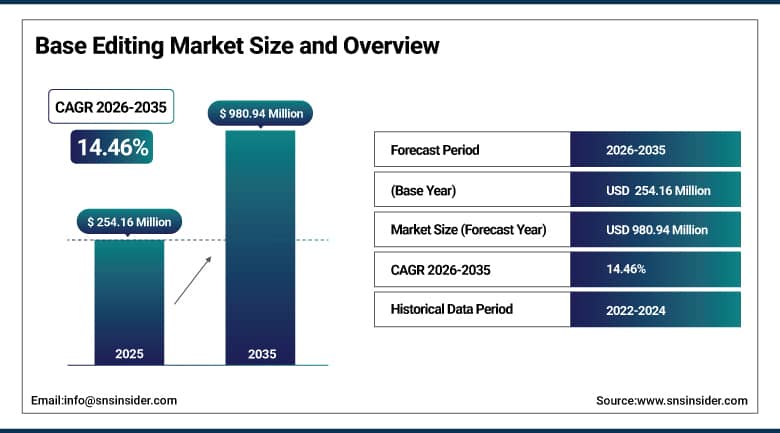
The Base Editing Market size is valued at USD 254.16 Million in 2025 and is expected to reach USD 980.94 Million by 2035 and grow at a CAGR of 14.46% over the forecast period 2026-2035.
The Base Editing Market analysis, driven by advancements in genome editing technologies and rising demand for precise, efficient, and safe gene therapies. Base editing enables the correction of single-nucleotide mutations without inducing double-strand DNA breaks, offering significant advantages over traditional CRISPR-Cas9 methods in terms of accuracy and reduced off-target effects.
According to study, Single-nucleotide correction accounts for nearly 60–65% of base editing research focus, reflecting its critical advantage over traditional CRISPR-Cas9 approaches.
Base Editing Market Size and Forecast:
-
Market Size in 2025: USD 254.16 Million
-
Market Size by 2035: USD 980.94 Million
-
CAGR: 14.46% from 2026 to 2035
-
Base Year: 2025
-
Forecast Period: 2026–2035
-
Historical Data: 2022–2024
To Get more information on Base Editing Market - Request Free Sample Report
Base Editing Market Trends:
-
Agricultural biotechnology increasingly adopting base editing to enhance crop yield and resilience.
-
Integration with AI and high-throughput platforms accelerates research efficiency.
-
Emerging economies investing in genomic medicine and biotech research for market growth.
-
Pharmaceutical companies expanding pipelines for gene-editing therapies using base editors.
-
Advances in CRISPR-derived base editors improve precision and reduce off-target effects.
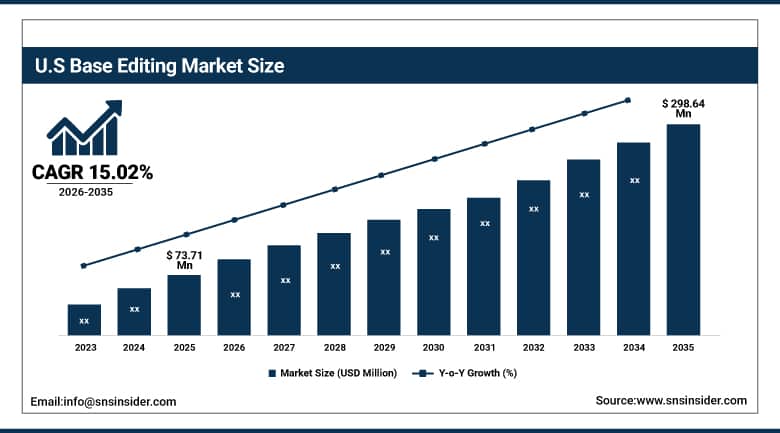
The U.S. Base Editing Market size is valued at USD 73.71 Million in 2025 and is expected to reach USD 298.64 Million by 2035, growing at a CAGR of 15.02% over the forecast period 2026–2035.
The U.S. base editing market is a leader, driven by advanced biotechnology research, high R&D investment, and early adoption of gene-editing technologies. Strong focus on therapeutics, precision medicine, and disease modeling, supported by collaborations between academic institutions and biotech companies, fuels market growth.
Base Editing Market Growth Drivers:
-
Rising demand for precise gene-editing technologies drives base editing market growth.
A significant driver for the base editing market growth is the increasing demand for precision gene-editing technologies to treat genetic disorders and advance therapeutic research. Base editing allows targeted modification of individual DNA nucleotides without causing double-strand breaks, reducing off-target effects compared to traditional CRISPR techniques. The rising prevalence of genetic diseases, coupled with advances in biotechnology and genome research, is accelerating adoption across research institutes, biotechnology companies, and pharmaceutical organizations. The technology is also gaining traction for applications in agriculture, where precise genome modifications can enhance crop yield, disease resistance, and nutritional value.
Research institutes, biotech, and pharmaceutical organizations contribute approximately 60–65% of market adoption.
Base Editing Market Restraints:
-
Regulatory hurdles and ethical concerns restrain widespread adoption of base editing.
The stringent regulatory environment and ethical concerns surrounding human genome editing is major setbacks for the base editing market is. Regulatory authorities closely monitor gene-editing applications to ensure safety, efficacy, and ethical compliance, particularly in therapeutic and clinical contexts. Lengthy approval timelines, complex trial requirements, and public apprehension about genome modification can slow adoption. Additionally, high R&D costs and technical complexities in developing and validating base editing systems further limit accessibility, especially for smaller biotech startups and research organizations.
Base Editing Market Opportunities:
-
Therapeutics and agricultural applications create significant growth opportunities for base editing.
the opportunity lies in the market to expanding use of base editing for treating genetic disorders and improving agricultural traits. Base editors are being applied to develop therapies for blood disorders, metabolic diseases, and hereditary cancers, while agricultural applications include enhancing crop yield, drought tolerance, and disease resistance. Emerging economies in Asia-Pacific, Latin America, and the Middle East are increasingly investing in biotech research, genomic medicine, and crop innovation, creating new markets. Integration with AI and high-throughput screening platforms further enhances efficiency, offering significant growth potential for market participants.
Therapeutic applications for blood disorders, metabolic diseases, and hereditary cancers could drive 40–45% of market adoption.
Base Editing Market Segmentation Analysis:
-
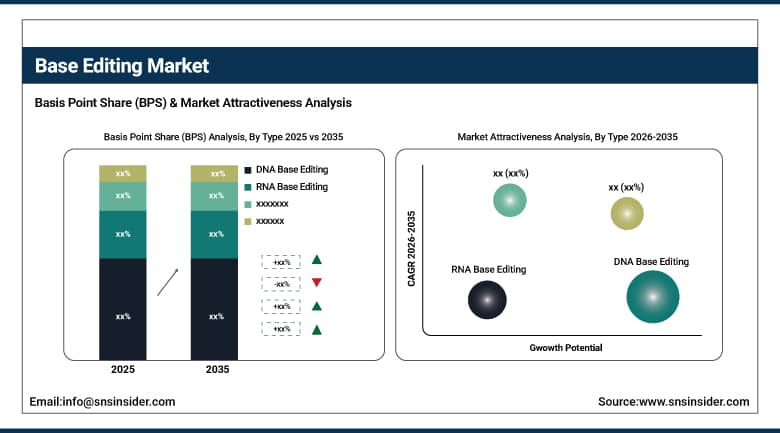
By Type: In 2025, DNA Base Editing led the market with a share of 53%, while RNA Base Editing is the fastest-growing segment with a CAGR of 15.81%.
-
By Products & Services: In 2025, Product led the market with a share of 52.34%, while Services is the fastest-growing segment with a CAGR of 16.05%.
-
By Application: In 2025, Drug Discovery and Development led the market with a share of 50%, while Agriculture is the fastest-growing segment with a CAGR of 15.80%.
-
By End Use: In 2025, Pharmaceutical & Biotechnology Companies led the market with a share of 50.14%, while Academic & Research Institutes is the fastest-growing segment with a CAGR of 15.30%.
By Type, DNA Base Editing Lead Market and RNA Base Editing Fastest Growth
DNA base editing leads the market, as it is the most mature and widely adopted form of base editing technology. It enables precise single-base substitutions without creating double-strand breaks, making it highly suitable for therapeutic gene correction and functional genomics. Strong investment in genetic disease research and drug discovery has reinforced DNA base editing’s dominant position across pharmaceutical and biotechnology applications.
RNA base editing is the fastest-growing segment, driven by its reversible and transient nature, which reduces long-term safety risks. Growing interest in RNA-targeted therapies, neurological disorders, and precision medicine is accelerating adoption, particularly in early-stage research and clinical development.
By Products & Services, Product Lead Market and Services Fastest Growth
Products lead the market, including base editing reagents, plasmids, kits, and editing tools that form the core of experimental workflows. High demand from research laboratories and biopharma companies for reliable and scalable editing tools has sustained product dominance. Continuous innovation in editing efficiency and specificity further strengthens this segment.
Services are the fastest-growing segment, fueled by increasing outsourcing of gene editing experiments, custom cell line development, and validation studies. Limited in-house expertise and rising demand for specialized editing services are accelerating growth in this segment.
By Application, Drug Discovery and Development Lead Market and Agriculture Fastest Growth
Drug discovery and development lead the market, as base editing is extensively used to identify disease-causing mutations, validate drug targets, and develop gene-based therapies. Its ability to create precise genetic models without off-target damage makes it a critical tool in modern pharmaceutical R&D pipelines.
Agriculture is the fastest-growing segment, driven by the need for improved crop traits such as yield, disease resistance, and climate resilience. Base editing offers precise genetic modification without introducing foreign DNA, supporting rapid adoption in sustainable agriculture and food security initiatives.
By End Use, Pharmaceutical & Biotechnology Companies Lead Market and Academic & Research Institutes Fastest Growth
Pharmaceutical and biotechnology companies lead the market, due to strong investment in genetic medicine, rare disease research, and therapeutic development. These organizations leverage base editing to accelerate innovation, reduce development timelines, and improve treatment precision.
Academic and research institutes are the fastest-growing segment, supported by rising public and private funding for genomics research. Expanding research programs, collaborations, and early-stage innovation in gene editing technologies are driving rapid growth in this segment.
Base Editing Market Regional Analysis:
North America Base Editing Market Insights
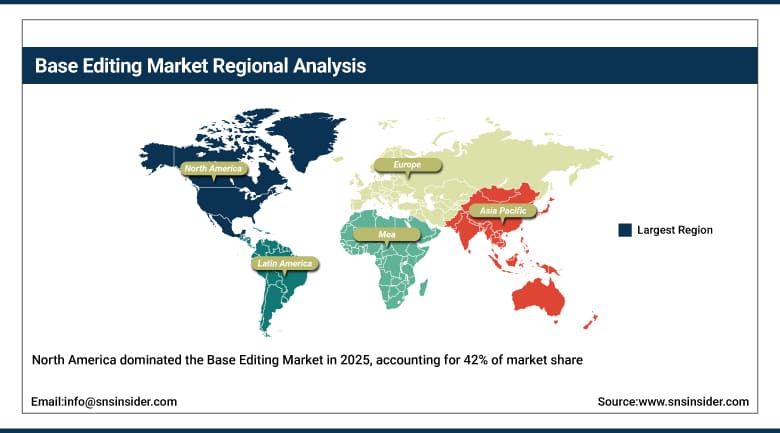
The North America dominated the Base Editing Market in 2025, with over 42% revenue share, due to significant investments in genomics research, biotechnology, and pharmaceutical development. High adoption of advanced gene-editing technologies in academic and commercial research drives market leadership. Presence of major biotechnology companies, robust R&D infrastructure, and government funding for genetic therapies further strengthen the region’s dominance. Increasing focus on precision medicine, disease modeling, and drug discovery accelerates adoption of base editing tools across research institutions, clinical trials, and pharmaceutical organizations.
Get Customized Report as per Your Business Requirement - Enquiry Now
U.S and Canada Base Editing Market Insights
The U.S. and Canada lead base editing adoption due to advanced biotechnology research, strong R&D investment, and well-established gene therapy and precision medicine initiatives, supported by collaborations between academic institutions and biotech companies.
Asia Pacific Base Editing Market Insights
The Asia Pacific region is expected to have the fastest-growing CAGR 15.81%, driven by rising biotechnology investments, expanding research facilities, and growing government initiatives in genetic engineering. Countries like China, Japan, and India are investing in gene therapy research, personalized medicine, and disease modeling. Increasing collaborations between local biotech firms and international companies, combined with expanding academic research programs, support strong market expansion. Rising awareness of genetic disorders and demand for advanced therapeutic solutions further propel growth in this region.
China and India Base Editing Market Insights
China and India are rapidly expanding in base editing, driven by growing biotech and pharmaceutical sectors, government funding for genetic research, and increasing academic-industry collaborations focused on therapeutics, disease modeling, and agricultural applications.
Europe Base Editing Market Insights
Europe maintains a significant share in the base editing market due to well-established research institutions, advanced biotechnology infrastructure, and strict regulatory standards. Adoption is driven by gene therapy research, drug development, and academic studies in molecular genetics. Government initiatives supporting precision medicine, healthcare innovation, and genomics research foster market growth. Collaborations between biotech companies and universities, coupled with increasing focus on rare disease treatment and personalized therapies, contribute to steady market development.
Germany and U.K. Base Editing Market Insights
Germany and the U.K. show steady growth, supported by strong research infrastructure, regulatory support, and increasing applications in drug discovery, therapeutics, and academic research in gene-editing technologies.
Latin America (LATAM) and Middle East & Africa (MEA) Base Editing Market Insights
Latin America and the Middle East & Africa are gradually developing in the base editing market, driven by growing research initiatives, biotechnology adoption, and investments in genetic research. In Brazil and Mexico, academic and clinical institutions focus on disease modeling, therapeutics, and agricultural applications, while government programs support biotechnology infrastructure and funding. In the UAE and Saudi Arabia, initiatives in healthcare innovation, research centers, and partnerships with biotech companies accelerate adoption. Though overall adoption is slower than mature markets, increasing collaborations, supportive policies, and rising biotechnology awareness enhance long-term growth potential across these regions.
Base Editing Market Competitive Landscape:
Intellia Therapeutics, Inc. focuses on developing in vivo and ex vivo genome-editing therapies using CRISPR-based and base editing technologies. Its pipeline targets genetic disorders, leveraging precise gene correction for therapeutic applications. Intellia emphasizes cutting-edge research, clinical trials, and delivery systems to maximize efficacy and safety. With strong scientific expertise and partnerships with leading biopharma organizations, Intellia is a key innovator driving the development and commercialization of base editing therapies in the biotechnology market.
-
In July 2025, Intellia Therapeutics announced a strategic collaboration with a biopharma partner to co‑develop in vivo base‑editing therapies for metabolic diseases, advancing its platform beyond traditional CRISPR/Cas9 into therapeutic editing applications.
CRISPR Therapeutics AG specializes in developing gene-editing therapies, including CRISPR-Cas9 and base editing platforms for rare genetic diseases, oncology, and regenerative medicine. The company focuses on precision genome modification, research collaborations, and clinical development of therapeutic applications. With strategic partnerships and strong R&D capabilities, CRISPR Therapeutics advances innovation in genome engineering. Its technologies enable targeted DNA modifications, accelerating the growth of the base editing market and expanding possibilities for next-generation precision medicine.
-
In October 2025, CRISPR Therapeutics initiated the first patient dosing of a base‑editing therapy for sickle cell disease, representing a major clinical milestone toward curing genetic blood disorders and validating base editing’s therapeutic potential.
Takara Bio Inc. is a biotechnology company specializing in gene-editing technologies, including CRISPR and base editing tools. Its products support research, therapeutic development, and precision genetic modifications. Takara Bio emphasizes high-quality reagents, innovative delivery systems, and technical support for academic and industrial clients. With a strong R&D focus and collaborations, the company enables advanced genome engineering applications, contributing to the growth and adoption of base editing technologies in healthcare, agriculture, and life sciences research.
-
In January 2025, Takara Bio acquired Curio Bioscience, adding advanced spatial biology capabilities to its genomics portfolio and expanding tools for single‑cell and spatial analysis that support gene editing research across life sciences.
Base Editing Market Key Players:
-
CRISPR Therapeutics AG
-
Editas Medicine, Inc.
-
Beam Therapeutics Inc.
-
Intellia Therapeutics, Inc.
-
Caribou Biosciences, Inc.
-
Precision BioSciences, Inc.
-
Sangamo Therapeutics, Inc.
-
Verve Therapeutics, Inc.
-
Takara Bio Inc.
-
Merck KGaA
-
Danaher Corporation
-
Thermo Fisher Scientific, Inc.
-
QIAGEN N.V.
-
Horizon Discovery Group (PerkinElmer)
-
F. Hoffmann‑La Roche Ltd.
-
Pfizer Inc.
-
Novartis AG
-
Astellas Pharma Inc.
-
Bayer AG
-
GlaxoSmithKline plc
| Report Attributes | Details |
|---|---|
| Market Size in 2025 | USD 254.16 Million |
| Market Size by 2035 | USD 980.94 Million |
| CAGR | CAGR of 14.46% From 2026 to 2035 |
| Base Year | 2025 |
| Forecast Period | 2026-2035 |
| Historical Data | 2022-2024 |
| Report Scope & Coverage | Market Size, Segments Analysis, Competitive Landscape, Regional Analysis, DROC & SWOT Analysis, Forecast Outlook |
| Key Segments | • By Type (DNA Base Editing, RNA Base Editing) • By Products & Services (Product (Platform, Kits & Reagents, Plasmids, Base Editing Libraries), Services (gRNA Design, Cell Line Engineering)) • By Application (Drug Discovery and Development, Agriculture, Veterinary) • By End Use (Academic & Research Institutes, Contract Research Organizations, Pharmaceutical & Biotechnology Companies) |
| Regional Analysis/Coverage | North America (US, Canada), Europe (Germany, UK, France, Italy, Spain, Russia, Poland, Rest of Europe), Asia Pacific (China, India, Japan, South Korea, Australia, ASEAN Countries, Rest of Asia Pacific), Middle East & Africa (UAE, Saudi Arabia, Qatar, South Africa, Rest of Middle East & Africa), Latin America (Brazil, Argentina, Mexico, Colombia, Rest of Latin America). |
| Company Profiles | CRISPR Therapeutics AG, Editas Medicine, Inc., Beam Therapeutics Inc., Intellia Therapeutics, Inc., Caribou Biosciences, Inc., Precision BioSciences, Inc., Sangamo Therapeutics, Inc., Verve Therapeutics, Inc., Takara Bio Inc., Merck KGaA, Danaher Corporation, Thermo Fisher Scientific, Inc., QIAGEN N.V., Horizon Discovery Group (PerkinElmer), F. Hoffmann‑La Roche Ltd., Pfizer Inc., Novartis AG, Astellas Pharma Inc., Bayer AG, and GlaxoSmithKline plc |

Frequently Asked Questions
The Base Editing Market is valued at USD 254.16 million in 2025 and is projected to grow significantly over the forecast period.
The market is anticipated to grow at a CAGR of 14.46% during the forecast period 2026–2035.
Base editing is a genome editing technique that enables precise conversion of one DNA base into another without causing double-strand breaks.
The market is expected to reach USD 980.94 million by 2035, reflecting strong growth potential.
Major drivers include rising demand for gene therapies, increasing prevalence of genetic disorders, and advancements in CRISPR-based technologies.
