
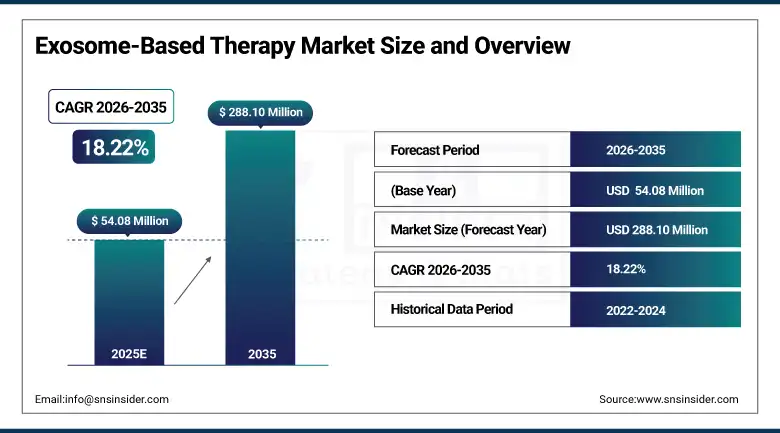
As per the SNS Insider Report titled, Exosome-based Therapy Market By Source, By Therapeutic Application, By Technology, By End User, By Region, And Global Forecast 2026–2035, “The global Exosome-Based Therapy Market size valued at USD 54.08 Million in 2025, is anticipated to grow to USD 288.10 Million by 2035, registering a CAGR of 18.22% over the 2026–2035 forecast period.”
Key Takeaways:
- The Exosomes derived from Mesenchymal Stem Cells (MSC) are expected to hold the largest share of more than 45% in 2025 due to their capacity for regeneration and immune modulation.
- The fastest growing share of exosome types between 2026 and 2035 will belong to the immune cells due to the rising trend toward immunotherapies and oncology solutions.
- The largest therapeutic area in 2025 belonged to oncology, which made up about 38% of the total revenues.
- The neurological disorders market is expected to register the fastest rate of increase over the forecast period due to the growing interest in exosomes as a means of delivering drugs through the blood-brain barrier.
- In 2025, native exosomes are predicted to be the market leaders in terms of technologies, with more than 42% shares due to being natural products and having less adverse effects.
- The fastest increase over the forecast period in technological segments will come from modified exosomes, as companies are increasingly investing in them as platforms for therapeutic delivery.
- Pharmaceuticals and biotechnology firms represented nearly 50% of the total market share in 2025, owing to their numerous clinical trials and collaborations.
- The North American region holds the largest market share of over 44%, while APAC is forecasted to exhibit the fastest growth with CAGR estimated at 23.31%.
Why Exosome-based Therapy Market is Growing?
This market is experiencing significant growth due to the growing interest in cell-free regenerative medicine and biologically active delivery systems. There is a growing interest in using exosomes in therapy because they can deliver proteins, nucleic acids, and other active components with great specificity and low immune response.
The growing investments into precision medicines, cancer drug development, and regenerative medicine studies have increased the number of studies associated with exosomes. This increase is caused by the fact that more and more patients suffer from cancer, neurological diseases, autoimmune diseases, and chronic inflammation.
The pharmaceutical companies and biotechnological firms are developing a wide range of cooperation in the areas related to exosome engineering and scaling up production. Furthermore, there is an improvement in isolation methods, purification technologies, and exosome analysis techniques.
Besides, the supportive attitude toward advanced biological treatments in terms of regulations along with the increase in stem cells research contributes to the development of the next generation of exosomes used in medical practice.
Exosome-based Therapy Market Statistics
- There are more than 2,000 ongoing clinical trials all around the world on extracellular vesicles and exosome applications in diagnostic, therapeutic, and regenerative medicine.
- One of the most common targets of exosomes is cancer treatment as oncology drug pipelines incorporate increasing numbers of extracellular vesicles into the therapy process.
- Nearly 3 billion people suffer from neurological disorders; therefore, there is a high need for novel drug delivery methods able to pass through the blood-brain barrier.
- R&D investments for stem cells and biologics keep growing all over the world, especially in key healthcare markets where double-digit growth was registered.
- The FDA and similar organizations around the world raise their efforts to develop guidelines on the characterization and manufacturing of therapeutic exosomes.
- Biotech startups developing new exosomes engineering solutions receive more venture capital funding each year.
- Nanotechnologies and molecular engineering improve exosome loading, targeting, and stability issues.
Emerging Trends:
One significant trend affecting the market for exosome therapies includes the increasing use of artificial and genetically engineered exosomes in delivering medications and conducting gene therapies. Scientists have been actively developing exosome-based systems for administering various drugs including RNA therapies, CRISPR, and cancer medicines to specific targets.
In recent years, the incorporation of artificial intelligence and machine learning has become widespread in identifying new biomarkers and characterizing exosomes. Furthermore, the range of diseases that could be treated using exosome therapies is not limited to oncological diseases but has also extended to heart-related ailments, neurodegeneration, wound healing, and autoimmune diseases.
Scalability in manufacturing is one of the major considerations that have emerged in recent years as researchers progress with their developments towards late-stage clinical studies and product launches. Additionally, the collaboration between academic institutions and private firms in the field of biotechnology is on the rise.
Top 10 Companies
- Evox Therapeutics Ltd.
- Codiak BioSciences Inc.
- Aegle Therapeutics
- Exopharm Ltd.
- Aruna Bio Inc.
- Capricor Therapeutics Inc.
- Kimera Labs
- ReNeuron Group plc
- Creative Medical Technology Holdings Inc.
- Direct Biologics LLC
About the Author

Get in touch




