
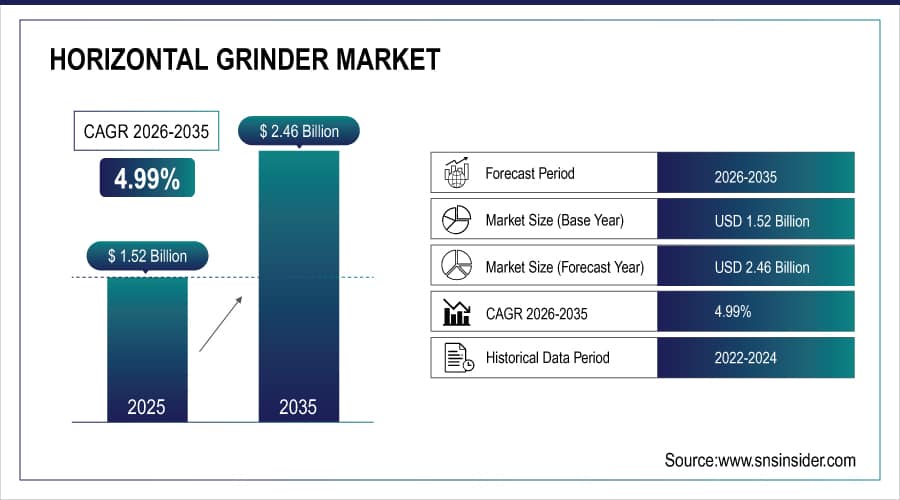
As per the SNS Insider Report titled, Horizontal Grinder Market by Type, by Power Source, by Capacity, by Application, by End User, and by Region, Global Forecast 2026–2035, “The global Horizontal Grinder Market size was valued at USD 1.52 billion in 2025, is anticipated to grow to USD 2.46 billion by 2035, registering a CAGR of 4.99% during the forecast period 2026–2035.”
Key Takeaways
-
Portable Horizontal Grinders accounted for approximately 63% of the market revenue in 2025, driven by their flexibility, ease of transportation, and growing use across forestry, land clearing, and recycling operations.
-
Stationary Horizontal Grinders are projected to witness the fastest CAGR of 6.12% during 2026–2035 owing to increasing adoption in high-volume industrial processing facilities and biomass production plants.
-
Diesel-Powered Horizontal Grinders dominated the power source segment with a 69% revenue share in 2025 due to their superior mobility, high power output, and suitability for remote operating environments.
-
Hybrid (Diesel–Electric) Horizontal Grinders are expected to register the fastest CAGR of 9.11% through 2035 as operators increasingly seek fuel-efficient and environmentally sustainable grinding solutions.
-
Medium Capacity Horizontal Grinders held the largest market share of 45% in 2025, supported by their balanced performance, operational flexibility, and broad applicability across end-use industries.
-
High-Capacity Horizontal Grinders are anticipated to grow at the fastest CAGR of 7.98% during the forecast period as demand rises for large-scale waste processing and biomass feedstock production.
-
Waste Management & Recycling Companies represented nearly 35% of market revenue in 2025 due to increasing recycling activities and growing emphasis on sustainable waste processing.
-
Biomass Power Plants are expected to emerge as the fastest-growing end-user segment, registering a CAGR of 6.08% during 2026–2035.
-
North America accounted for approximately 42% of the global Horizontal Grinder Market revenue in 2025, while Asia-Pacific is projected to witness the fastest CAGR of 6.97% over the forecast period.
Why Horizontal Grinder Market is Growing?
There are several factors responsible for driving the growth of the Horizontal Grinder Market. Increasing demand for efficient processing of wood waste, land clearing activities, biomass generation, and recycling services around the world is driving the global market towards growth. Horizontal grinders help to process huge amounts of organic waste and construction waste to make them usable, helping in achieving sustainability and circular economy goals.
Increasing investments in the production of energy from biomass sources have contributed significantly to the growth of the market. Many governments and power generators are increasingly turning to wood waste and forestry waste as energy sources, which has led to an increased demand for better grinding machinery.
Moreover, increasing construction and demolition activities all around the world are presenting a good opportunity for players in this industry. Horizontal grinders help to recycle construction waste, saving space and avoiding dumping it in landfills.
Also, increasing forestry management operations and land developments are creating demand for advanced grinding machinery.
Horizontal Grinder Market Statistics
-
Biomass energy production continues to gain momentum globally as countries focus on renewable energy generation and carbon emission reduction targets.
-
Construction and demolition waste volumes are increasing worldwide, driving demand for equipment capable of converting waste materials into reusable resources.
-
Municipal waste management agencies are expanding recycling infrastructure investments to improve landfill diversion rates and resource recovery efficiency.
-
Forestry operations are increasingly adopting advanced grinding equipment to process logging residues and improve land management practices.
-
Growing adoption of sustainable waste processing technologies is encouraging businesses to invest in efficient material reduction and recycling equipment.
-
Industrial operators are focusing on reducing operational costs through fuel-efficient machinery and improved material processing productivity.
-
Emerging economies are investing heavily in waste management infrastructure and biomass energy projects, creating long-term growth opportunities for the market.
Emerging Trends
The market for Horizontal Grinder Technology is experiencing various developments intended to enhance operational efficiencies, ensure sustainability, and increase production performance. The development of fuel-efficient machines that are capable of producing a lot despite being fitted with fuel-saving features is becoming commonplace.
The technology in use in this market involves the use of automation and advanced monitoring capabilities, enabling users to monitor the performance, maintenance needs, and efficiencies associated with such machines.
There is increasing demand for high-efficiency grinders as companies involved in biomass production, waste management, and recycling continue to invest in production processes that require higher production rates. Durability and lower emissions are two major areas of focus during the development of new models.
Telematics, predictive maintenance, and remote diagnostics have been adopted in this market, making it possible for operators to optimize the operation and performance of their fleets.
Top 10 Companies
-
Vermeer Corporation
-
Morbark, LLC
-
Peterson Pacific Corp.
-
CBI (Continental Biomass Industries)
-
Bandit Industries, Inc.
-
Komptech GmbH
-
Doppstadt GmbH
-
Terex Corporation
-
Rotochopper, Inc.
-
Diamond Z Manufacturing
About the Author

Get in touch




