
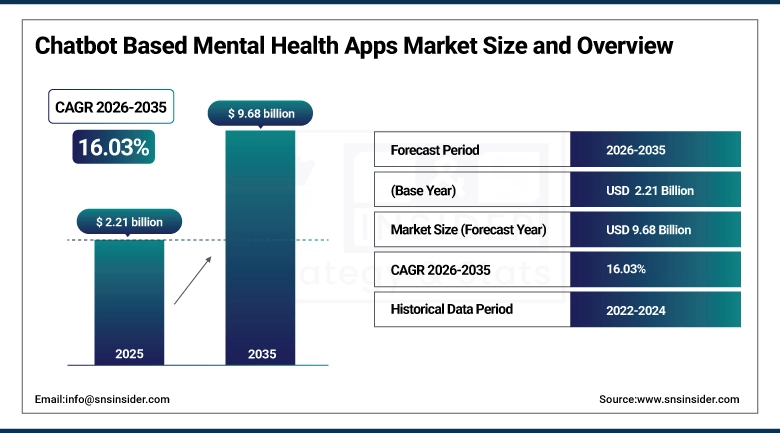
As per the SNS Insider Report titled, Chatbot Based Mental Health Apps Market By Technology, By Application, By Platform, By Device, By Region, And Global Forecast 2026–2035, “The global Chatbot Based Mental Health Apps Market size valued at USD 2.21 Billion in 2025, is anticipated to grow to USD 9.68 Billion by 2035, registering a CAGR of 16.03% over the 2026–2035 forecast period.”
Key Takeaways
- Machine Learning and Deep Learning technologies have had the highest shares of the market, contributing close to 45% of the total revenue, owing to its better conversational abilities and behavior prediction features.
- The Natural Language Processing (NLP) technology is anticipated to witness the highest growth in the forecast period owing to increased developments in multilingual and context-aware interactions.
- Depression & Anxiety Management is the most preferred application category, generating a market share of about 35% in 2025, due to the rising prevalence of mental illnesses globally.
- The fastest-growing applications will be Stress Management apps, as the cases of work-related stress have been rising steadily across the world over recent years.
- Android is the dominant platform for Digital Mental Wellness Market, holding a market share of 56% in 2025, driven by smartphone popularity in emerging markets.
- The Smartphones are the preferred devices, contributing almost 82% of the total market in 2025.
- North America holds the largest market, contributing close to 39% of the revenue generated in 2025 due to the advanced digital health infrastructure and high adoption of AI-based tools.
- The fastest-growing region is Asia Pacific, anticipated to grow at a rate of 17.43% CAGR between 2026 and 2035.
Why Chatbot Based Mental Health Apps Market is Growing?
Anxiety disorders, depressive conditions, stress-induced disorders, and even burnouts are becoming common in the society today; hence increasing demand for affordable mental health care services. Mental health apps that rely on chatbots are increasingly being utilized as an affordable way to offer immediate emotional support, behavior training, mood monitoring, and counseling sessions to patients.
Innovation in the field of AI, machine learning algorithms, and natural language processing is enhancing chatbot interactions to make them more responsive and personalized. The current mental health chatbots can recognize the feelings of the users and provide them with evidence-based strategies and encourage continuous engagement. In this regard, they are useful supplementary therapy programs.
Lack of mental health specialists in different parts of the world is another key driver of the industry's growth. Digital mental health programs can enhance accessibility, especially in remote regions where there is a shortage of professional psychologists. Consumer acceptance of telehealth and mental wellbeing applications is fueling industry growth.
Finally, the increasing use of technology-based behavioral health management platforms among employers, health organizations, and insurers is creating more opportunities. Investments in behavioral health and increasing awareness about preventive mental care are opening up new growth avenues for the industry.
Chatbot Based Mental Health Apps Market Statistics:
- As per the reports of the World Health Organization (WHO), there are more than 280 million individuals suffering from depression throughout the globe, thus emphasizing the rising demand for scalable mental health solutions.
- The global number of smartphone users exceeds 6.9 billion, thereby facilitating the development of mobile mental wellness apps to cater to more patients.
- Research suggests that almost 70 percent of young adults opt for mental wellness apps to cope with stress and receive emotional support initially.
- Increasing prevalence of workplace stress is fueling the deployment of digital wellness initiatives by enterprises around the world.
- The AI-enabled healthcare sector is witnessing robust growth worldwide owing to the integration of conversational AI into the patient engagement system.
- The internet usage rate is constantly rising across emerging countries, thus increasing the adoption rate of digital mental healthcare solutions.
- The number of downloads of apps related to mental health has gone up dramatically due to the increasing use of telehealth solutions.
- Rising awareness regarding emotional wellbeing and suicide prevention campaigns are prompting patients to seek digital mental healthcare solutions.
Emerging Trends:
Among some of the key trends that have been observed in the market include the incorporation of technologies such as generative AI and emotions recognition technology in the chatbot apps to provide personal interactions for mental wellness. Some of the other trends include voice assistant integration, multi-lingual apps and predictive analytics.
Hybrid models in which chatbots are incorporated to offer support to therapists or telepsychiatry are another trend worth considering. The integration of wearables to measure the various parameters such as stress levels, quality of sleep among others is also gaining prominence.
In terms of features that have improved user retention in the industry, gamification, mindfulness exercises, cognitive behavior therapy among others come under consideration.
Top 10 Companies
- Woebot Health
- Wysa
- Youper
- Headspace Health
- Replika
- Ginger
- Talkspace
- BetterHelp
- Tess by X2AI
- Mindstrong Health
About the Author

Get in touch




