
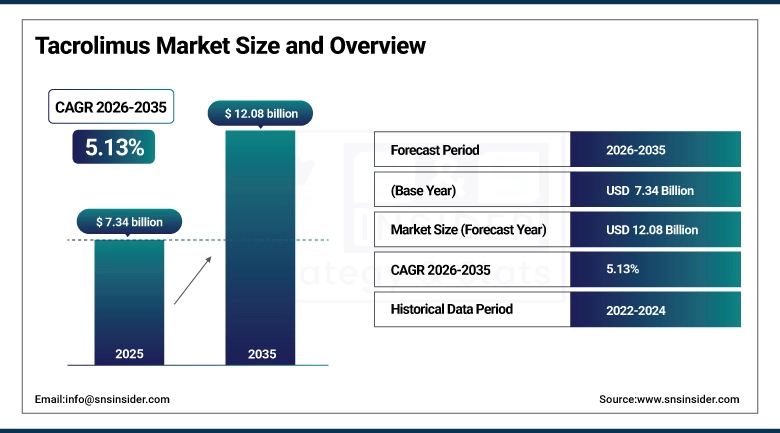
As per the SNS Insider Report titled, Tacrolimus Market By Drug Type, By Application/Indication, By Route of Administration, By End-User, By Region, And Global Forecast 2026–2035, “The global Tacrolimus Market size valued at USD 7.34 Billion in 2025, is anticipated to grow to USD 12.08 Billion by 2035, registering a CAGR of 5.13% over the 2026–2035 forecast period.”
Key Takeaways
- Tacrolimus capsules were the most preferred drug in 2025 as they captured 42.15% of the total global market share owing to their extensive application in immunosuppressant treatment after organ transplants.
- The most promising segment was the tacrolimus extended-release formulations that were expected to experience the fastest growth rate of 7.12% during the 2026-2035 timeframe because of increased patient compliance and decreased dose frequency.
- The application with the biggest share (50.28%) in the year 2025 was associated with organ transplantation due to an increase in kidney and liver transplants worldwide.
- The application segment expected to record the highest CAGR of 6.98% during the forecasted period was atopic dermatitis due to an increase in dermatological diseases and topical immunomodulators.
- The dominant mode of administration in 2025 had 45.77% share because of being effective, convenient, and widely recognized by patients and doctors.
- The fastest growing administration route with a CAGR of 7.05% between 2026-2035 belonged to the topical segment due to its usage in inflammatory conditions of the skin.
- The leading distribution channel, which had the biggest revenue share of 53.64%, was Hospitals & Clinics due to numerous transplantations and their monitoring occurring there.
- North America took the first position among all regional markets as it occupied 38.47% share in 2025; however, Asia-Pacific was expected to become the leader in terms of CAGR (6.64%).
Why Tacrolimus Market is Growing?
The Tacrolimus Market continues to grow consistently owing to the rise in the incidence rate of chronic organ failure, increasing instances of transplants and the increasing need for efficient immunosuppressant medications. Tacrolimus is among the most commonly used calcineurin inhibitors to prevent organ rejection after transplantation in kidneys, liver, hearts, and lungs.
Rising levels of knowledge about autoimmune and inflammatory diseases have contributed to the expansion in the market. The growing use of tacrolimus in topical treatments in dermatology for atopic dermatitis and eczema treatment has been instrumental in driving the adoption of these drugs outside hospitals.
There have been developments in the development of extended-release formulas that are increasing compliance and efficiency in treatment. Additionally, pharmaceutical organizations have been concentrating on launching generics products and enhancing the efficiency of drug delivery systems.
Besides, the fast development of transplant infrastructure, high expenditure on healthcare, and the availability of favorable reimbursement policies have provided opportunities for sustained growth in the market.
Tacrolimus Market Statistics:
- More than 150,000 organ transplants occur worldwide each year according to statistics provided by global registries, while most cases involve kidney transplantation.
- Millions of individuals globally suffer from chronic kidney disease, leading to a high need for immunosuppressive treatments for transplant patients.
- The number of atopic dermatitis cases is on the rise throughout the world and currently affects about 15–20% of children and around 10% of adults.
- There is an ongoing trend of personalized immunosuppressive therapy management in healthcare facilities to help manage tacrolimus doses safely.
- Immunosuppressive drugs administered orally belong to one of the most commonly used types of medications after organ transplantation.
- The rising rate of liver cirrhosis, cardiovascular diseases, and end-stage renal disease leads to growing lists of transplant patients.
- Dispensing transplant medications via hospital pharmacies is on the rise throughout the past decade.
- Tacrolimus generics continue receiving support from regulatory bodies in terms of their development and introduction into the market.
Emerging Trends:
Key trends influencing the market for Tacrolimus include the increased use of extended-release formulations intended for enhancing compliance and minimizing drug concentration variations in patients' bloodstreams.
There is also an escalating trend towards the use of advanced therapeutic drug monitoring techniques and precision medicine strategies. Topical forms of tacrolimus are increasingly popular in dermatology practices where they are prescribed as an alternative treatment to steroids for skin conditions characterized by chronic inflammation.
Other factors contributing to the growth opportunities in this industry include enhanced health facilities in Asian-Pacific countries along with transplant awareness programs that have become increasingly common.
Top 10 Companies:
- Astellas Pharma Inc.
- Viatris Inc.
- Sandoz International GmbH
- Dr. Reddy’s Laboratories Ltd.
- Accord Healthcare
- Glenmark Pharmaceuticals Ltd.
- Lupin Limited
- Hikma Pharmaceuticals PLC
- Strides Pharma Science Limited
- Veloxis Pharmaceuticals, Inc.
About the Author

Get in touch




