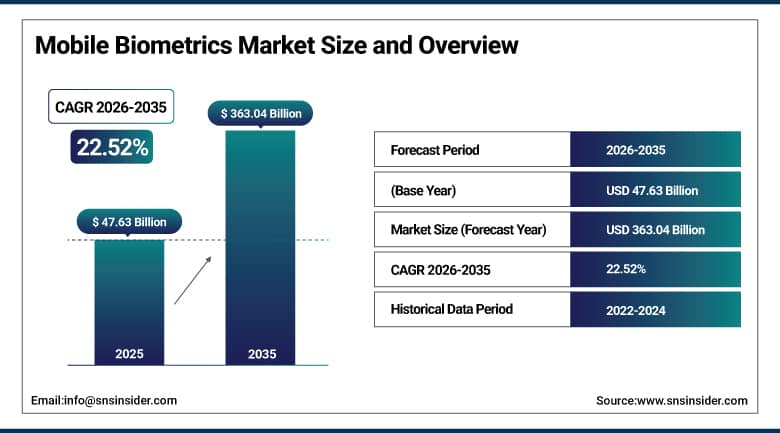
As per the SNS Insider Report titled, Mobile Biometrics Market by Component, by Technology, by Application, by End User, Region, And Global Forecast 2026-2035, “The global Mobile Biometrics Market size was valued at USD 47.63 billion in 2025, is anticipated to grow to USD 363.04 billion by 2035, registering a CAGR of 22.52% over the 2026–2035 forecast period.”
Key Takeaways:
-
Hardware emerged as the largest component accounting for about 42.8% market share in 2025 on the back of increased adoption of biometric sensors in smartphones, tablets, and wearable devices.
-
The software segment is estimated to witness the fastest rate of growth between 2026 and 2035, owing to rising use of biometric authentication software and cloud-based solutions powered by artificial intelligence (AI).
-
The fingerprint recognition sub-segment generated revenues of almost 45.3% in 2025 owing to its increasing usage in mobile banking and finance and smartphone applications.
-
The facial recognition segment is anticipated to generate the highest CAGR of 27.1% through 2035 due to increased demand for touchless biometric systems for various applications.
-
Mobile banking & payments emerged as the leading end-use industry accounting for a 40.6% share in 2025 driven by rising preference for mobile payments and security concerns.
-
The identity verification segment is expected to register the fastest CAGR of 28.1%, supported by increased use of biometric technologies for remote customer onboarding and online know your customer (KYC) processes.
-
The BFSI segment held about 44.2% share in 2025, attributable to high installation and usage rates of biometric authentication solutions in banking and financial platforms.
-
The government sector is expected to be the fastest-growing segment at a CAGR of 26.8% from 2026 to 2035, on account of digital identity initiatives.
-
The North America region captured about 36.50% of the total market revenue in 2025 whereas the Asia Pacific region is likely to exhibit the fastest CAGR of 24.37%.
Why Mobile Biometrics Market is Growing?
The Mobile Biometrics Market is witnessing tremendous growth on account of the increasing adoption of mobile-based secure authentication solutions around the globe. An increased usage of mobile phones, mobile banking applications, digital wallets, and digital commerce platforms is leading to a greater need for mobile-based biometric technologies.
Cybersecurity threats, cases of identity thefts, and data breaches are compelling companies to implement multi-factor biometric authentication solutions for improved digital security purposes. The increasing adoption of digital identity verifications and e-Know Your Customer Solutions is fueling market growth even further.
The latest technological developments in artificial intelligence, machine learning, and mobile sensors have been enhancing the performance of biometrics. Furthermore, the increased adoption of contactless biometric solutions owing to digital-first consumer behavior is increasing the demand for biometric facial and voice recognition technologies.
The rise in the adoption of smart government, digital healthcare, and secure mobile commerce is supporting market growth substantially.
Mobile Biometrics Market Statistics
-
Biometric technology like facial recognition and in-display fingerprints has found applications among smartphone manufacturers in high-end as well as mid-range smartphones.
-
The financial services industry is moving swiftly toward using biometric technology for better fraud prevention and customer verification processes.
-
Numerous governments around the world are developing their digital identification and e-government projects which use biometric authentication technology.
-
The demand for contactless biometrics is increasing as a result of increasing digitization and need for remote access.
-
Technological progress in the field of artificial intelligence has led to enhanced accuracy in biometric authentication technology.
-
Biometric payment and identity verification services are finding more applications in retail and e-commerce industries.
-
The health care industry is embracing biometric technology in mobile devices to ensure secure access to patient information.
Emerging Trends:
Some of the key transformative trends taking place in the Mobile Biometrics Market include the use of multimodal biometric authentication systems which involve the use of fingerprints, facial recognition, voice recognition, and iris recognition for increased security measures. Layered authentication systems are now becoming commonplace within enterprises as a measure for strengthening cybersecurity posture.
Artificial intelligence as well as deep learning techniques are being embedded in biometric systems in an attempt to enhance accuracy and real-time fraud prevention. The emerging popularity of behavioral biometrics such as typing patterns and user interactions can also be attributed to these developments.
Biometric authentication methods are becoming popular within mobile apps for digital banking, remote onboarding services, and mobile commerce operations. Other trends worth mentioning include those related to edge computing as well as biometric platforms delivered in the cloud.
Top 10 Companies
-
Apple Inc.
-
Samsung Electronics
-
NEC Corporation
-
Thales Group
-
HID Global
-
Synaptics Incorporated
-
Qualcomm Technologies
-
IDEMIA
-
Fujitsu Limited
-
Aware Inc.
About the Author

Get in touch