
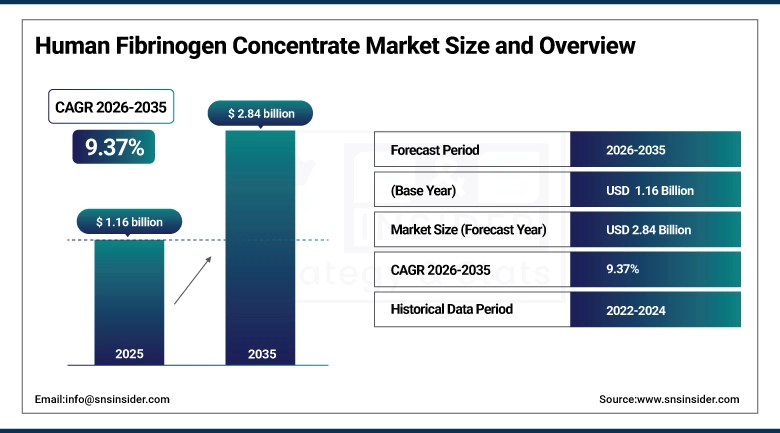
As per the SNS Insider Report titled, Human Fibrinogen Concentrate Market Size, Share & Segmentation, By Product Type, By Indication, By Application, By End User, By Region, And Global Forecast 2026–2035, “The global Human Fibrinogen Concentrate Market size valued at USD 1.16 billion in 2025, is anticipated to grow to USD 2.84 billion by 2035, registering a CAGR of 9.37% over the 2026–2035 forecast period.”
Key Takeaways
- Plasma-Derived Fibrinogen Concentrates accounted for the leading share of the market in 2025 owing to their established clinical use and broad availability.
- Recombinant Fibrinogen Concentrates are projected to be the fastest-growing product type segment through 2035 due to advancements in biotechnology and reduced dependence on plasma donations.
- Congenital Fibrinogen Deficiency represented the leading indication segment in 2025, supported by increasing diagnosis and lifelong treatment requirements.
- Trauma-Induced Hemorrhage is expected to witness the fastest growth during the forecast period due to rising adoption of rapid hemostatic therapies in emergency settings.
- Hemophilia Treatment remained the largest application segment in 2025 as fibrinogen replacement therapies continue to play an important role in bleeding disorder management.
- Emergency & Trauma Care is anticipated to register the fastest growth rate owing to increasing trauma cases and growing awareness of fibrinogen supplementation in acute bleeding control.
- Hospitals dominated the market among end users in 2025 due to high patient volumes, advanced transfusion facilities, and specialized hematology services.
- Ambulatory Surgical Centers are projected to be the fastest-growing end-user segment, reflecting the shift toward minimally invasive procedures and outpatient care.
- North America held the largest regional share, accounting for 42.00% of the global market in 2025.
- Asia Pacific is expected to record the fastest growth, expanding at a CAGR of approximately 11.81% between 2026 and 2035.
Why Human Fibrinogen Concentrate Market is Growing?
The Human Fibrinogen Concentrate Market is driven by the increasing prevalence of inherited and acquired bleeding disorders, rising number of surgical procedures, and increasing demand for targeted hemostatic therapies. Healthcare providers are using fibrinogen concentrates in place of traditional blood products because of standardized dosing, rapid administration and reduced risk of pathogen transmission.
The increasing worldwide burden of trauma-related injuries has further augmented the demand for fibrinogen replacement therapies in emergency medicine. In addition, improved diagnostics allow for earlier detection of congenital fibrinogen deficiencies, thus enabling greater treatment uptake. Moreover, increasing awareness among clinicians regarding the evidence-based bleeding management protocols and the expansion of healthcare infrastructure in developing economies are also contributing to the market growth.
In addition, ongoing research for recombinant fibrinogen products and improvements in plasma fractionation technologies are enhancing product availability and treatment outcomes. These developments are expected to increase the long-term use of human fibrinogen concentrates in hospitals, trauma centers, and specialized hematology clinics.
Human Fibrinogen Concentrate Market Statistics
- Health estimates suggest hundreds of thousands of patients around the world are affected by bleeding disorders, which continues to fuel the need for coagulation factor replacement therapies.
- Trauma remains the leading cause of death worldwide, and severe hemorrhage accounts for a significant percentage of trauma-related preventable deaths.
- The demand for effective solutions for managing perioperative bleeding is driven by the millions of major surgical procedures performed worldwide annually.
- Studies show that low fibrinogen is one of the earliest coagulation abnormalities that occurs in severe trauma and massive bleeding events.
- Health care systems are expanding the implementation of patient blood management programs to prevent unnecessary transfusions and optimize clinical outcomes.
- Advances in plasma fractionation technologies enable improved production efficiency and safety profile of plasma-derived therapeutic proteins.
- Increasing investments in diagnosis and treatment of rare diseases continue to support awareness and management of inherited coagulation disorders.
- Increased uptake of evidence-based transfusion protocols is prompting the use of targeted coagulation factor concentrates in critical care settings.
Emerging Trends
One of the key trends in the Human Fibrinogen Concentrate Market is the growing trend towards recombinant fibrinogen therapies, which offer greater supply reliability and less dependence on donor plasma. Manufacturers are spending tons of money on biotechnology platforms to create next generation products with better safety and efficacy profiles.
Another important trend is the inclusion of fibrinogen concentrates in trauma management protocols. Rapid point-of-care coagulation testing is allowing clinicians to more quickly identify fibrinogen deficiencies and offer targeted treatment earlier in the patient pathway.
Moreover, the rising number of outpatient surgical procedures is fueling the demand for ambulatory surgical centers, which in turn propels the market. At the same time, partnerships between pharma companies, research institutions and healthcare providers are fast-tracking clinical trials to expand indications and improve treatment guidelines.
The recent introduction of digital health technologies and advanced patient monitoring systems is also helping to facilitate personalized coagulation management strategies, which opens new avenues to optimize the use of fibrinogen replacement therapy.
Top 10 Companies
- CSL Behring
- Octapharma
- Takeda Pharmaceutical Company
- Grifols
- LFB Biomedicaments
- Kedrion Biopharma
- BPL
- Shanghai RAAS Blood Products
- Green Cross Corporation
- Japan Blood Products Organization
About the Author

Get in touch




