
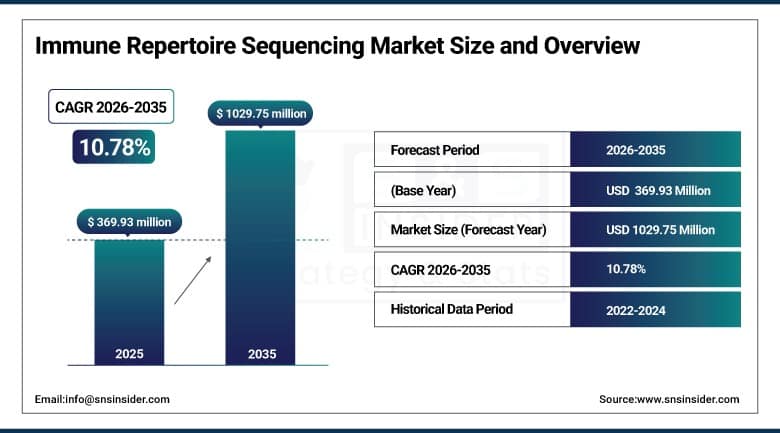
As per the SNS Insider Report titled, Immune Repertoire Sequencing Market by Technology, Application, Sequencing Type, End User, and Region, Global Forecast 2026–2035, “The global Immune Repertoire Sequencing Market size was estimated at USD 369.93 Million in 2025, is anticipated to grow to USD 1029.75 Million by 2035, registering a CAGR of 10.78% during the forecast period 2026–2035.”
Key Takeaways
-
Cancer Research dominated the application segment with a 46.81% market share in 2025, driven by growing utilization of immune profiling technologies in oncology research and precision medicine initiatives.
-
Vaccine Development is projected to expand at the fastest CAGR of 14.56% during the forecast period due to increasing investments in next-generation vaccine discovery and immunogenicity assessment.
-
Next-Generation Sequencing (NGS) held the largest technology segment share of 54.72% in 2025 owing to its high throughput, scalability, and ability to generate comprehensive immune repertoire data.
-
Single-Cell Sequencing is expected to register the fastest CAGR of 13.97% during 2026–2035 as researchers increasingly seek deeper insights into immune cell heterogeneity and functional responses.
-
T-Cell Receptor (TCR) sequencing accounted for the highest market share of 58.30% in 2025 due to its critical role in immuno-oncology, infectious disease research, and immune monitoring applications.
-
B-Cell Receptor (BCR) sequencing is anticipated to witness the fastest CAGR of 13.34% through 2035 as antibody discovery and vaccine development activities continue to accelerate globally.
-
Pharmaceutical & Biotechnology Companies held the largest end-user share of 41.56% in 2025, supported by increasing adoption of immune repertoire analysis in drug discovery and clinical development programs.
-
Hospitals & Clinics are expected to grow at the fastest CAGR of 13.89% during 2026–2035 owing to expanding implementation of precision diagnostics and personalized treatment strategies.
-
North America dominated the Immune Repertoire Sequencing Market with a 42.78% revenue share in 2025, while Asia-Pacific is projected to emerge as the fastest-growing region at a CAGR of 13.18% during the forecast period.
Why Immune Repertoire Sequencing Market is Growing?
Growth in the Immune Repertoire Sequencing Market can be attributed to the rising significance of studying the dynamic nature of immune systems in relation to cancer, infection, autoimmune diseases, and vaccination studies. Many researchers are now relying on the use of advanced immune repertoire sequencing technologies to acquire deep knowledge about the body's adaptive immunity and develop appropriate therapeutic interventions.
A rise in the number of precision medicine and immunotherapy programs is fueling demand for innovative sequencing methods. Immune repertoire sequencing allows experts to detect immune fingerprints associated with diseases, assess therapeutic efficacy, and devise better patient selection techniques.
In addition, increased investments in genomic technologies, bioinformatics, and translational medicine are propelling the adoption of immune repertoire sequencing platforms. The pharmaceutical and biotech sectors are adopting immune sequence analysis methods as part of their drug discovery programs to expedite drug development processes.
Moreover, technological advancements in sequencing technologies, falling sequencing prices, and improvements in computational infrastructure are further boosting the use of these tools across the globe.
Immune Repertoire Sequencing Market Statistics
-
The global cancer burden is on the rise, which means that more focus will be given to immunotherapy research.
-
The rising incidence of autoimmune diseases and infectious disease is fueling the need for detailed immune system responses studies.
-
Major pharmaceutical organizations are increasingly adopting immune repertoire sequencing within clinical studies.
-
Next generation sequencing technologies advancements are boosting sequencing capacity and improving accuracy.
-
Precision medicine is becoming increasingly popular, hence more immune response analysis is needed to develop individualized treatment approaches.
-
Vaccines have become one of the most promising treatments for diseases, and therefore research in this field has been increased, which requires immune sequencing technologies.
-
Investments in research by academic organizations around the world are still increasing to enhance immunology and genomics research.
Emerging Trends
There have been many innovations in the field of immune repertoire sequencing through technological advancements with increasing usage of single-cell sequencing instruments that provide comprehensive immune cell profiling with greater accuracy. These innovations help researchers understand intricate immune cell interactions and diversity within different conditions.
In recent years, the use of artificial intelligence and machine learning for immune repertoire analysis has increased significantly in order to provide advanced results, find new biomarkers, and speed up drug discovery process. There is a rising demand for bioinformatics tools in immune repertoire sequencing.
Another significant trend in the immune repertoire sequencing industry is the growing utilization of these solutions for vaccine development to evaluate immune reactions to a disease. Immune repertoire sequencing technology is increasingly used by scientists to develop future generation vaccines.
It is expected that precision oncology and cell therapy will offer ample opportunities for immune repertoire sequencing service providers in the coming years.
Top 10 Companies
-
Illumina, Inc.
-
Adaptive Biotechnologies Corporation
-
Thermo Fisher Scientific Inc.
-
Pacific Biosciences of California, Inc.
-
Oxford Nanopore Technologies plc
-
QIAGEN N.V.
-
Hoffmann-La Roche Ltd.
-
Takara Bio Inc.
-
BGI Genomics Co., Ltd.
-
Eurofins Scientific SE
About the Author

Get in touch




