
Immune Repertoire Sequencing Market Report Scope & Overview:
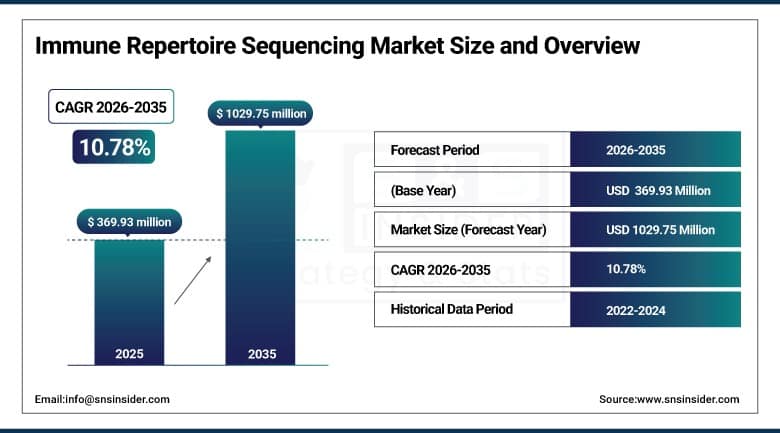
The Immune Repertoire Sequencing Market size was estimated at USD 369.93 Million in 2025 and is expected to reach USD 1029.75 million by 2035 and grow at a CAGR of 10.78% over the forecast period of 2026-2035.
The Immune Repertoire Sequencing Market analysis report provides details of market size, growth spectrum and the competitive scenario of Immune Repertoire Sequencing in the forecast timeline. Increasing adoption of next-generation sequencing in oncology, vaccine development and autoimmune studies, coupled with the growing superiority in bioinformatics capacities is projected to create significant market opportunities over the forecast period.
7.5 million immune repertoire sequencing tests were conducted in 2025, driven by rising oncology research and growing adoption of next-generation sequencing.
Market Size and Forecast:
-
Market Size in 2025: USD 369.93 Million
-
Market Size by 2035: USD 1029.75 Million
-
CAGR: 10.78% from 2026 to 2035
-
Base Year: 2025
-
Forecast Period: 2026–2035
-
Historical Data: 2022–2024
To Get More Information On Immune Repertoire Sequencing Market - Request Free Sample Report
Immune Repertoire Sequencing Market Trends:
-
Increase in precision medicine demand drives need to map immune profiles at the patient level for personalized treatment approaches.
-
Next-generation sequencing (NGS) platforms are being used more and more frequently, facilitating fast, low-cost high-throughput immune analysis.
-
AI and machine learning integration are also improving the interpretation of large immune datasets, thereby enhancing biomarker discovery and clinical decision-making.
-
Increasing clinical uptake in oncology is prompting the need for TCR/BCR sequencing to monitor evolution of tumours and responses immunotherapy.
-
Growth in the number of ongoing vaccine development programs is hastening immune repertoire analyses investigating pathogen response and vaccine performance.
-
BioPharma companies and sequencing service providers are joining forces to broaden awareness of more sophisticated applications immunology analytics within the emerging markets.
-
Single-cell-sequencing is taking off as a tool to help researchers develop broader insights into immune diversity at the cellular level.
U.S. Immune Repertoire Sequencing Market Outlook:
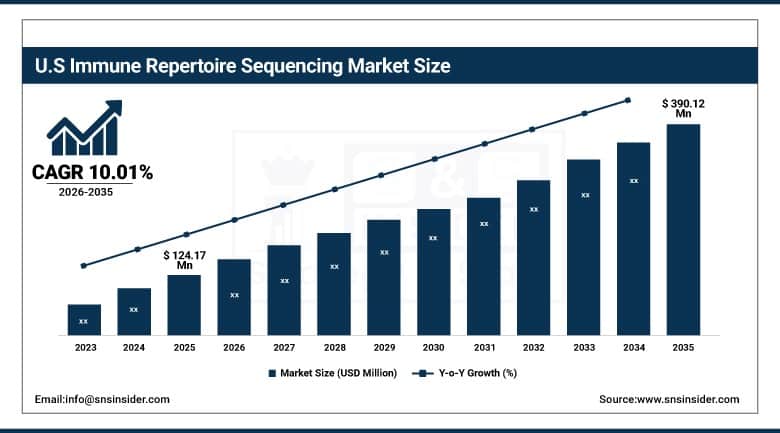
The U.S. Immune Repertoire Sequencing Market is projected to grow from USD 124.17 Million in 2025 to USD 390.12 Million by 2035, at a CAGR of 10.01%. The growth is driven by the growing immuno-oncology applications, adoption of NGS-based diagnostics and significant investment in precision medicine across leading healthcare and research organizations.
Immune Repertoire Sequencing Market Growth Drivers:
-
Growing reliance on immune repertoire profiling in cancer immunotherapy, enabling precise patient monitoring and personalized treatment optimization.
Growing reliance on immune repertoire profiling in cancer immunotherapy is a key driver of market growth. With adoption of precision oncology on the rise, there is growing need from clinicians for comprehensive BCR and TCR sequencing to monitor treatment response, follow tumour evolution, and make personalised therapeutic decisions. This trend is reinforced by large investments in immuno-oncology studies, broadening of clinical trials and consolidation of sequencing into standard cancer care practices which are driving the interest in high complexity immune repertoire sequencing instruments and analytics solutions.
Immune repertoire sequencing use in cancer care rose 14.2% in 2025, driven by immunotherapy trials and increasing adoption of NGS-based patient monitoring in oncology centers.
Immune Repertoire Sequencing Market Restraints:
-
High sequencing costs and complex data interpretation requirements are limiting widespread clinical adoption and routine use.
High sequencing costs and complex data interpretation requirements significantly restrict broader clinical adoption of immune repertoire sequencing. Operating costs of the new NGS platforms, the bioinformatics technologies and expertise constitute high-operating expenses that can be a barrier to access for modest-sized hospitals or research centers. Moreover, immune-OMICS data sets are large and very complex to be adequately analyzed, leading to long turnover times and poor scalability. These barriers hinder routine implementation in clinic, pennate diffusion beyond leading cancer units and well-funded research groups and limit the strive for an expanding market.
Immune Repertoire Sequencing Market Opportunities:
-
Expanding applications in vaccine development and infectious disease monitoring offer major opportunities for advanced immune sequencing platforms.
Expanding applications in vaccine development and infectious disease monitoring present a major growth opportunity for the Immune Repertoire Sequencing Market. With growing use of immune profiling in health programs to assess vaccine response, pathogen dynamics and long-term immunity, the need for high resolution sequencing systems is also increasing. Government funded research and pandemic preparedness programs in addition to increasing clinical partnerships are also driving adoption, allowing sequencing developers and analytics firms to extend their reach and innovation in immunology solutions.
Immune repertoire sequencing for vaccine research accounted for 31% of new projects in 2025, driven by rising infectious disease monitoring.
Immune Repertoire Sequencing Market Segmentation Analysis:
-
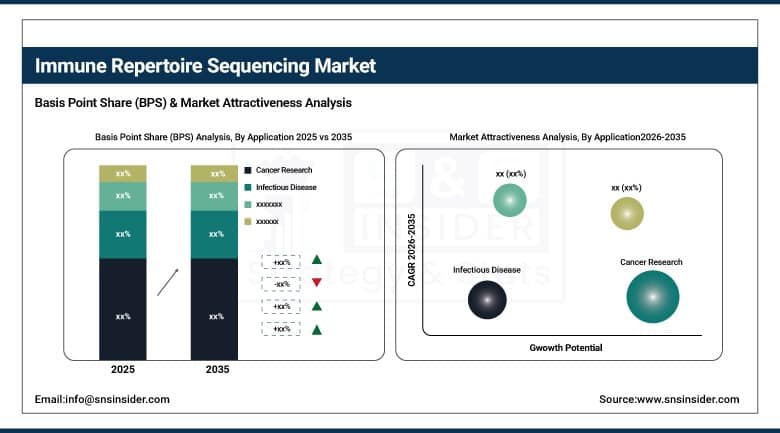
By Application, Cancer Research dominated with a 46.81% share in 2025, while Vaccine Development is projected to expand at the fastest CAGR of 14.56% during the forecast period.
-
By Technology, Next-Generation Sequencing (NGS) held the largest market share of 54.72% in 2025, while Single-Cell Sequencing is expected to grow at the fastest CAGR of 13.97% during 2026–2035.
-
By Sequencing Type, T-Cell Receptor (TCR) sequencing accounted for the highest market share of 58.30% in 2025, while B-Cell Receptor (BCR) sequencing is anticipated to record the fastest CAGR of 13.34% through 2026–2035.
-
By End User, Pharmaceutical & Biotechnology Companies held the largest share of 41.56% in 2025, while Hospitals & Clinics are expected to grow at the fastest CAGR of 13.89% during 2026–2035.
By Application, Cancer Research Dominates While Vaccine Development Expands Rapidly:
Cancer Research segment dominated the market on account of increasing dependency on immune repertoire sequencing to diagnose immunotherapy results, track tumor evolution, and comprehend patient-specific cellular responses. Its use has escalated to coincide with clinical trials of checkpoint inhibitors, CAR-T therapies and other novel biologics in oncology. Vaccine Development is the fastest-growing segment, driven by health readiness projects and mega-studies to chart new pathogen-specific immune responses; in 2025, 1,500 new vaccine-immunology sequencing studies were initiated across research institutions and pharmaceutical companies.
By Technology, Next-Generation Sequencing Dominates While Single-Cell Sequencing Expands Rapidly:
Next-Generation Sequencing (NGS) segment dominated the market with high-throughput, accuracy and broad-level clinical adoption across segments namely oncology, human leukocyte antigen typing and translational research. It’s powerful ability to process large sample volumes and provide deep insights into the immunogenomics has driven rapid adoption throughout leading oncology institutions, biopharma research pipelines and national genomic sequencing projects. Single-Cell Sequencing is the fastest-growing segment led by need for cell-level immune characterization and deeper repertoire mapping; in 2025, 3,400 large-scale immune single-cell sequencing projects were executed globally.
By Sequencing Type, T-Cell Receptor Sequencing Dominates While B-Cell Receptor Sequencing Expands Rapidly:
T-Cell Receptor (TCR) segment dominated the market having relevance in immuno-oncology which helps clinicians to monitor treatment response and administer precision therapies. The adoption is also particularly significant in cancer centers and research projects focusing on T-cell clonal expansion or tumor microenvironment dynamics. B-Cell Receptor (BCR) is the fastest growing segment, which has found applications in antibody discovery, vaccine optimization, infectious disease response evaluation and others; in 2025, 820 biotech R&D programs integrated BCR repertoire analysis into development workflows.
By End User, Pharmaceutical & Biotechnology Companies Dominate While Hospitals & Clinics Expand Rapidly:
Pharmaceuticals and Biotechnology Companies segment dominated the market driven by strongly investing in immuno-oncology, vaccine development and immune therapy pipelines which demand sequencing-based biological enablement. These entities receive most of the large-scale sequencing contracts, data analytics infrastructure spend and clinical research initiatives. Hospitals & Clinics is the fastest growing segment due to immune repertoire analysis is emerging in routine diagnostics and treatment monitoring; in 2025, 2,200 hospital oncology departments deployed immune sequencing to support personalized patient management.
Regional Insights:
North America Immune Repertoire Sequencing Market Insights:
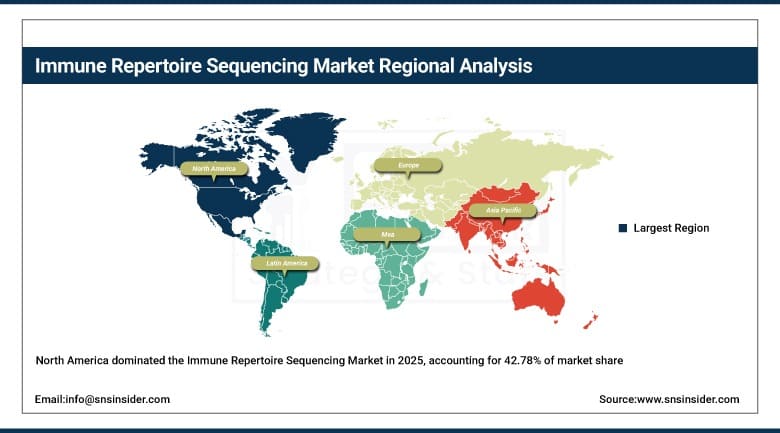
North America dominated the Immune Repertoire Sequencing Market with 42.78% of the market share, which was largely attributed to its robust adoption of precision medicine, advanced clinical research infrastructure and high investment in immuno-oncology. Top U.S. and Canadian hospitals and biopharmaceutical companies are adopting immune profiling for personalized therapy selection, monitoring, and research. Widespread adoption of AI-enabled bioinformatic tools, mounting sequencing data sets and increasing clinical trials continue to support North America’s dominance and the development of novel technology in this space.
Get Customized Report as Per Your Business Requirement - Enquiry Now
U.S. Immune Repertoire Sequencing Market Insights:
The U.S. Immune Repertoire Sequencing Market is booming due to high adoption of precision oncology, upgraded sequencing technologies and growing incorporation of immune profiling in treatment decision making. Growth in more clinical trials, AI-empowered bioinformatics platforms and hospital-biopharma company collaboration are driving innovation further, while broadening clinical recognition is cementing the country at the forefront of immunogenomics.
Asia-Pacific Immune Repertoire Sequencing Market Insights:
The Asia-Pacific Immune Repertoire Sequencing Market is the fastest-growing region, projected to expand at a CAGR of 13.18% during 2026–2035. Growth is driven by increasing g investment in genomic medicine, declining cost of sequencing procedure, and the rise in fully integrated single-cell analysis systems and technologies in China, Japan, South Korea, and India. Government-supported precision health initiatives, burgeoning biotech ecosystems and high implementation of digital bioinformatics platforms are driving adoption said while an expanding number of clinical trials and translational research collaborations underscore the region’s competitive edge.
China Immune Repertoire Sequencing Market Insights:
The China Immune Repertoire Sequencing Market is growing at an aggressive pace, fueled by the government funding toward precision medicine, implementation of next generation sequencing technology and increase in cancer demographic. With expanding biotech capacity, mega genome projects and robust national digital bioinformatics infrastructure in place, China represents one of the major growth engines for the APAC immunogenomics industry.
Europe Immune Repertoire Sequencing Market Insights:
The Europe Immune Repertoire Sequencing Market benefits from an increase in life science budgets in the developed countries of the region, favorable reimbursement landscape for NGS-based testing procedures; robust funding support and strong regulatory acceptance. Immunotherapy-Specialized countries such as Germany, the U.K. and France are breaking new ground within immuno-oncology, translational research and digital bioinformatics platforms. A large biopharma footprint, growing hospital, research center partnerships and broader adoption of immunotherapy programs are pushing the limits, cementing Europe’s place as a principal leader in immune sequencing.
Germany Immune Repertoire Sequencing Market Insights:
Germany is a large immune repertoire sequencing market, due to developed healthcare systems, well-established cancer research sector and high NGS implementation in clinical testing. The partnership between top hospitals, research institutions and biopharma companies is driving innovation forward, while increasing spending in immunotherapy and precision medicine accelerates growth of the market.
Latin America Immune Repertoire Sequencing Market Insights:
The Latin America Immune Repertoire Sequencing Market is expanding as healthcare modernization accelerates, supported by increasing adoption of NGS-based diagnostics and rising cancer prevalence. Rising investment in biotechnology, increasing clinical research capacities and deepening digital health investments in the likes of Brazil, Mexico and Argentina are driving adoption, while government supported precision medicine strategies are also propelling market momentum.
Middle East and Africa Immune Repertoire Sequencing Market Insights:
The Middle East & Africa Immune Repertoire Sequencing Market is growing at the increased healthcare infrastructure, investment in precision medicine and increasing oncology and immunological disorders. Increasing usage of NGS-based diagnostics, government initiatives to promote healthcare infrastructure and development along with the increasing research activities are helping the market in great extent across those regions.
Immune Repertoire Sequencing Market Competitive Landscape:
Illumina, headquartered in San Diego, USA, is the leader in sequencing and genomic analysis technologies, powering a majority of next-generation sequencing workflows used in research and clinical applications. It leads the market for immune repertoire sequencing, based on its high-throughput platforms, extensive IP and installed base of customers spanning oncology and immunology and the precision medicine sector. Relentless innovation, full realm of solutions across the genome, and partnerships with hospitals, pharma and research decouple Illumina balance sheet from competitors.
-
In July 2025, Illumina launched a new NGS-based proteomics solution enabling faster protein analysis from sample to reporting. The product enhances immune profiling, supports research scalability and strengthens Illumina’s leadership in high-throughput sequencing for oncology and immunology applications.
Thermo Fisher Scientific, based in Waltham, USA, is a life sciences giant providing sequencing systems, reagents, bioinformatics tools and laboratory infrastructure to researchers. It holds a solid position in the Immune Repertoire Sequencing Market due to its broad product offering, clinical-grade offerings and vast customer base across diagnostics, drug discovery and immune monitoring. The company is having strategic investment in automation, scalable sequencing workflows and key collaborations to facilitate faster, cost effective immune profiling studies; thus, cementing its leadership.
-
In May 2025, Thermo Fisher introduced the Oncomine TCR Beta-SR Assay, expanding its immuno-oncology sequencing portfolio. The assay enhances insights into T-cell receptor diversity, supporting cancer research laboratories adopting precise NGS tools for advanced immune monitoring and analysis.
Adaptive Biotechnologies, headquartered in Seattle, USA, is a pioneer in immune-driven diagnostics and deep immune profiling using next-generation sequencing. The company is the industry’s central hub for end-to-end Immune Repertoire Sequencing and has built its portfolio with ultra-high-throughput sequencing, cloud-based analytics, and industry-leading machine learning in a straightforward platform that users love. Its robust clinical partnerships, regulatory-embraced assays and expanding work in immunotherapy trial support have established Adaptive as a driving force that is turning immune response into clinically actionable personalized insights.
-
In March 2025, Adaptive Biotechnologies launched a next-generation distributable clonoSEQ and immunoSEQ IVD test kit, enabling decentralized MRD and immune profiling. The solution increases accessibility by allowing hospitals and labs to perform high-quality sequencing locally rather than relying solely on centralized testing.
Immune Repertoire Sequencing Market Key Players:
-
Illumina
-
Thermo Fisher Scientific
-
Adaptive Biotechnologies
-
BGI Genomics
-
10x Genomics
-
QIAGEN
-
F. Hoffmann-La Roche
-
Takara Bio
-
Oxford Nanopore Technologies
-
Agilent Technologies
-
Pacific Biosciences (PacBio)
-
Danaher Corporation
-
Azenta Life Sciences
-
Personalis
-
CD Genomics
-
iRepertoire
-
Creative Biolabs
-
Mission Bio
-
ENPICOM
-
Dolomite Bio
Immune Repertoire Sequencing Market Report Scope:
| Report Attributes | Details |
|---|---|
| Market Size in 2025 | USD 369.93 Million |
| Market Size by 2035 | USD 1029.75 Million |
| CAGR | CAGR of 10.78% From 2026 to 2035 |
| Base Year | 2025 |
| Forecast Period | 2026-2035 |
| Historical Data | 2022-2024 |
| Report Scope & Coverage | Market Size, Segments Analysis, Competitive Landscape, Regional Analysis, DROC & SWOT Analysis, Forecast Outlook |
| Key Segments | • By Technology (Next-Generation Sequencing (NGS), Single-Cell Sequencing, PCR-Based Sequencing, Others) • By Application (Cancer Research, Infectious Disease, Autoimmune Disorders, Vaccine Development, Others) • By Sequencing Type (T-Cell Receptor (TCR), B-Cell Receptor (BCR), Others) • By End User (Research Institutes, Hospitals & Clinics, Pharmaceutical & Biotechnology Companies, Others) |
| Regional Analysis/Coverage | North America (US, Canada, Mexico), Europe (Eastern Europe [Poland, Romania, Hungary, Turkey, Rest of Eastern Europe] Western Europe] Germany, France, UK, Italy, Spain, Netherlands, Switzerland, Austria, Rest of Western Europe]), Asia Pacific (China, India, Japan, South Korea, Vietnam, Singapore, Australia, Rest of Asia Pacific), Middle East & Africa (Middle East [UAE, Egypt, Saudi Arabia, Qatar, Rest of Middle East], Africa [Nigeria, South Africa, Rest of Africa], Latin America (Brazil, Argentina, Colombia, Rest of Latin America) |
| Company Profiles | Illumina, Thermo Fisher Scientific, Adaptive Biotechnologies, Qiagen, Mission Bio, 10x Genomics, F. Hoffmann-La Roche, BGI Genomics, NanoString Technologies, Pacific Biosciences, Agilent Technologies, PerkinElmer, Bio-Rad Laboratories, Takara Bio, Oxford Nanopore Technologies, Eurofins Scientific, Invitae, GenScript, CD Genomics, Nebula Genomics |

Frequently Asked Questions
The market is expected to reach USD 1029.75 Million by 2035.
The market size was estimated at USD 369.93 Million in 2025.
The market is projected to grow at a CAGR of 10.78% during the forecast period.
North America is expected to dominate due to strong healthcare infrastructure and research funding.
Increasing demand for precision medicine, cancer immunotherapy, and advanced sequencing technologies are driving market growth.
