
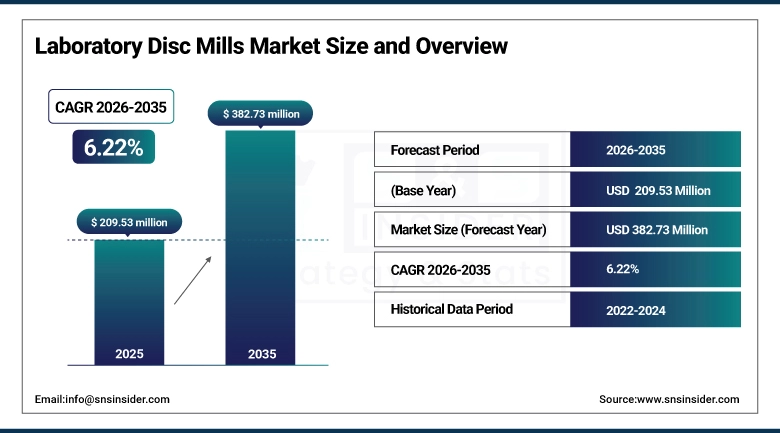
As per the SNS Insider Report titled, Laboratory Disc Mills Market by Product Type, by Operation Mode, by Application, by End User, by Region, And Global Forecast 2026–2035, “The global Laboratory Disc Mills Market size valued at USD 209.53 million in 2025, is anticipated to grow to USD 382.73 million by 2035, registering a CAGR of 6.22% over the 2026–2035 forecast period.”
Key Takeaways
-
Vibratory Disc Mills dominated the market by product type with a 63% share in 2025 owing to their superior grinding efficiency and widespread use in laboratory sample preparation.
-
Rotary Disc Mills are projected to be the fastest-growing product type segment during 2026–2035 due to increasing demand for high-throughput material processing applications.
-
Manual Laboratory Disc Mills accounted for the largest operation mode share of 48% in 2025, supported by their affordability and widespread adoption in small and medium-sized laboratories.
-
Fully Automatic Laboratory Disc Mills are expected to witness the fastest growth over the forecast period due to rising demand for automation and precision testing.
-
Mining & Metallurgy held the largest application share of 29% in 2025 owing to extensive mineral sample preparation and material characterization requirements.
-
Pharmaceuticals is anticipated to be the fastest-growing application segment during 2026–2035, driven by increasing research and quality control activities.
-
Industrial Laboratories led the market by end user with a 43% share in 2025 due to rising industrial testing and quality assurance requirements.
-
Europe dominated the Laboratory Disc Mills Market with approximately 37.5% of global revenue in 2025, while Asia-Pacific is projected to register the fastest CAGR of 8.99% during 2026–2035.
Why Laboratory Disc Mills Market is Growing?
The global Laboratory Disc Mills Market is poised for steady growth in the upcoming years, driven by a growing demand for high-precision sample preparation and material analysis across numerous industries including mining and metallurgy, pharmaceuticals, chemicals and environmental testing. The widespread adoption of innovative grinding and milling equipment against the backdrop of improving testing accuracy and operational efficiency is gaining traction globally.
The market is also being propelled by the technological advancements in laboratory milling systems. Producers have now begun to introduce automated designs for all that are outfitted with digital controls, better safety features, programable grinding parameters and more energy efficient. They allow laboratories to obtain more consistent particle sizes, require less manual interference and enhance productivity.
Some of the other factors supporting growth are the growing investments in research and development activities, expanding industrial quality control requirements coupled with the stringent regulatory standards regarding testing of materials. In addition, the growing mining exploration activities and proliferation of pharmaceutical research initiatives across the globe is also anticipated to promote sustained demand for laboratory disc mills during 2026-2035.
Laboratory Disc Mills Market Statistics
-
With the production of minerals all over the world surpassing 17 billion metric tons each year, there is a big need for laboratory sample preparation equipment.
-
There are over 300,000 analytical and industrial labs around the world spanning multiple sectors such as mining, pharmaceuticals, chemicals, environmental sciences.
-
Over the course of a year, global pharmaceutical companies spend upwards of USD 250 billion on research and development; thus driving demand for laboratory precision equipment.
-
Every year, industrial quality testing laboratories process millions of material samples for compliance with international standards and specifications.
-
The mining sector spends more than USD 1.8 trillion every year to the economies worldwide and involves testing and characterization of many types of minerals.
-
Over the past decade there has been a significant increase in the adoption of automation adopted within laboratory environments as organizations have adapted and improved efficiencies along with reproducibility.
-
Due to stricter regulations regarding pollution monitoring and sustainability, the environmental testing laboratories segment continues to expand globally.
-
Material science research has grown in importance, with increasing investment in advanced analytic equipment at universities and research institutes.
Emerging Trends
A strong trend in the Laboratory Disc Mills Market is higher acceptance of fully-automatic milling systems resulting in reduced human involvement and improved sample preparation reproducibility. Expanding of Smart Equipment in Laboratories for Efficient Workflow and Testing Accuracy
2.2 Digitalization and integration of lab equipment with LIMS as a major force reshaping the market Apart from strength, advanced disc mills with dashboard features recording and monitoring chamber parameters assist laboratories speed up tasks and stay aligned with compliance updates.
High Precision Grinding Technologies In Pharmaceutical, Biotechnology Sectors To Support Drug Development & Quality Control Applications This trend is predicted to fuel the demand for laboratory disc mills over the forecast period.
Moreover, manufacturers are designing energy-efficient products and developing compact footprints for the equipment along with improved safety features so that they can fulfill the future requirements of modern laboratories and research facilities.
Top 10 Companies
-
RETSCH GmbH
-
Fritsch GmbH
-
NETZSCH Group
-
Herzog Maschinenfabrik GmbH
-
Essa Australia (FLSmidth)
-
SIEBTECHNIK GmbH
-
Orto Alresa
-
Beijing Grinder Instrument Co., Ltd.
-
Torontech Group International
-
Laval Lab Inc.
About the Author

Get in touch




