
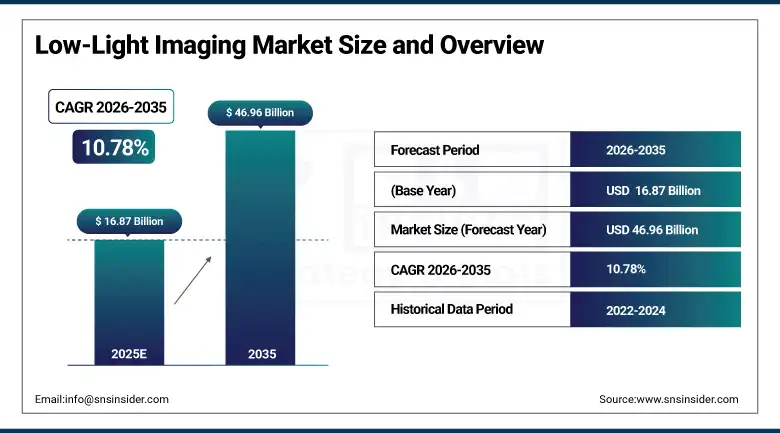
As per the SNS Insider Report titled, Low-Light Imaging Market by Sensor Type, by Device Type, by Technology, by End Use, and Region | Global Forecast 2026-2035, “The global Low-Light Imaging Market size valued at USD 16.87 billion in 2025, is anticipated to grow to USD 46.96 billion by 2035, registering a CAGR of 10.78% over the 2026–2035 forecast period.”
Key Takeaways
-
2D Sensors accounted for nearly 43.75% of the market share in 2025, driven by their extensive use in surveillance systems, consumer electronics, industrial imaging, and security applications.
-
3D Sensors are projected to witness the fastest growth during 2026–2035, registering a CAGR of 17.81%, owing to increasing demand for depth sensing, autonomous systems, advanced driver assistance systems (ADAS), and machine vision applications.
-
Camera Modules dominated the device type segment with a 44.25% revenue share in 2025 due to widespread integration into smartphones, surveillance cameras, automotive systems, and industrial imaging equipment.
-
Night Vision Devices are expected to register the fastest growth through 2035, supported by rising defense modernization programs, border surveillance requirements, and growing adoption in automotive safety systems.
-
CMOS technology held approximately 39.25% share in 2025, supported by its cost efficiency, low power consumption, high integration capabilities, and superior image quality in low-light conditions.
-
Scientific CMOS (sCMOS) is anticipated to emerge as the fastest-growing technology segment during the forecast period, registering a CAGR of 14.26%, driven by increasing adoption in scientific research, healthcare imaging, and high-performance industrial applications.
-
Surveillance & Security represented nearly 28.19% of the market revenue in 2025 owing to growing investments in public safety, critical infrastructure protection, and intelligent video analytics systems.
-
Automotive is projected to record the fastest growth from 2026 to 2035, registering a CAGR of 13.28%, driven by increasing deployment of low-light imaging technologies in ADAS, autonomous vehicles, and night driving assistance systems.
-
North America captured around 31.09% of total market revenue in 2025 and is expected to strengthen its market position further by 2035, supported by technological innovation, defense investments, and widespread adoption of advanced imaging solutions.
-
Europe accounted for approximately 24.56% of the global market share in 2025, driven by strong demand from automotive, industrial, and security sectors.
Why Low-Light Imaging Market is Growing?
The Low-Light Imaging Market is expected to grow at a rapid pace during the forecast period due to the increasing demand for advanced imaging technologies that can provide high-quality visual performance under challenging lighting conditions. These solutions are increasingly important for applications ranging from surveillance and defense to automotive, healthcare, industrial automation and consumer electronics.
Increasing concerns for public safety, critical infrastructure protection and border security are driving the demand for low light imaging systems. Organizations are investing heavily in sophisticated surveillance technologies that allow them to see better, detect threats and be more situationally aware at night and in low visibility conditions.
The rapid evolution of autonomous vehicles, advanced driver assistance systems and intelligent transportation technologies is further accelerating market expansion. Low-light imaging sensors help vehicles to detect obstacles, pedestrians and road conditions more efficiently in low light conditions, enhancing safety and operational reliability.
Technological advancements in CMOS, sCMOS, infrared imaging, artificial intelligence, and image processing algorithms also support the market growth. These innovations are improving image resolution, sensitivity, dynamic range and real-time analytics capabilities across a wide range of applications.
Low-Light Imaging Market Statistics
-
Surveillance and security applications continue to be the largest end-use segment owing to the growing investments in intelligent monitoring systems across the globe.
-
CMOS sensors continue to lead the technology pack due to their low cost, scalability and good low-light performance.
-
Automotive manufacturers are increasingly integrating low-light imaging technologies into ADAS and autonomous vehicle platforms.
-
Defense agencies are boosting deployment of night vision and low light imaging systems for tactical operations and border surveillance.
-
Scientific research and healthcare sectors drive the demand for advanced sCMOS imaging technologies with superior sensitivity and resolution.
-
Camera modules are still the most deployed device category across consumer, industrial and security.
-
North America continues to lead market adoption, driven by strong technology development and defense spending.
Emerging Trends
The Low-Light Imaging Market is observing several transformative trends including the growing adoption of artificial intelligence-powered image enhancement, machine vision technologies and advanced sensor architectures. Manufacturers are working to improve image quality, sensitivity and real-time processing capabilities to meet changing needs for applications.
3D sensing technologies are emerging as a major growth driver owing to the growing deployment in autonomous vehicles, robotics, industrial automation and augmented reality systems. These sensors offer improved depth perception and object recognition capabilities, leading to enhanced operational accuracy in low-light conditions.
There are also growing trends in the market of integrating infrared imaging, multispectral sensing, and AI-based analytics into advanced imaging platforms. Furthermore, the market is expected to be driven by advancements in sCMOS technology, edge computing and intelligent surveillance systems, opening up new avenues in automotive, defense, healthcare and industrial sectors.
Top 10 Companies
-
Sony Semiconductor Solutions Corporation
-
Teledyne Technologies Incorporated
-
FLIR Systems, Inc.
-
Hamamatsu Photonics K.K.
-
Canon Inc.
-
OmniVision Technologies, Inc.
-
STMicroelectronics N.V.
-
onsemi
-
Samsung Electronics Co., Ltd.
-
BAE Systems plc
About the Author

Get in touch




