
Low-Light Imaging Market Size & Trends:
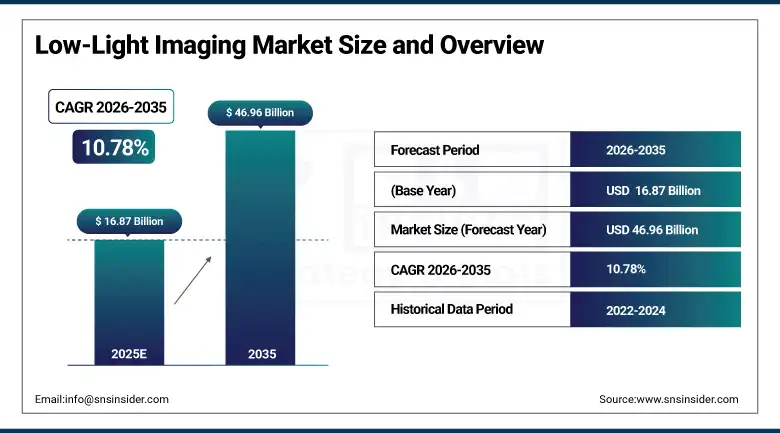
The Low-Light Imaging Market size was valued at USD 16.87 Billion in 2025 and is projected to reach USD 46.96 Billion by 2035, growing at a CAGR of 10.78% during 2026–2035.
The Low-Light Imaging market is experiencing significant growth due to increasing demand for high-sensitivity, high-resolution imaging across surveillance, automotive, industrial, medical, and research applications. Advanced technologies, including lens-free imaging, mid-infrared sensors, and innovative material-based sensors, are enhancing performance in extremely low-light conditions while offering wider depth of field, compact form factors, and energy-efficient operation. The market is further driven by adoption in smart infrastructure, machine vision, wearable devices, and autonomous systems. Continuous innovation in sensor design, miniaturization, and low-noise performance is creating opportunities for new applications and expanding the addressable market globally.
In September 2025 – Researchers in China developed a lens-free mid-infrared camera using a laser pinhole in a crystal, enabling sharp, low-light 3D imaging with wide depth of field and enhanced detection of heat and molecular signatures.
Market Size and Growth Projection:
-
Market Size in 2025: USD 16.87 Billion
-
Market Size by 2035: USD 46.96 Billion
-
CAGR: 10.78% from 2026 to 2035
-
Base Year: 2025
-
Forecast Period: 2026–2035
-
Historical Data: 2022–2024
To Get more information on Low-Light Imaging Market - Request Free Sample Report
Low-Light Imaging Market Trends Highlights:
-
U.S. SBIR funding supports low‑light imaging advancements for consumer, security, and medical applications, highlighting strong government interest in enhancing low‑light sensor capabilities.
-
sbir.gov
-
The U.S. National Institute of Standards and Technology developed high‑sensitivity superconducting imaging cameras for capturing extremely weak light signals, underscoring government support for advanced low‑light imaging research.
-
Official resources such as the U.S. Department of Homeland Security (DHS) recognize CMOS imaging sensors as key technology in video security systems used for public safety and low‑light environment monitoring.
-
U.S. federal science repositories index research on CMOS image sensor technology, reflecting official documentation on the importance of miniaturized, low‑cost low‑light imagers.
-
Government transport and infrastructure agencies note improved color cameras with low‑light performance help manage traffic and safety analysis, reflecting official adoption in public systems.
U.S. Low Light Imaging Market Size Outlook
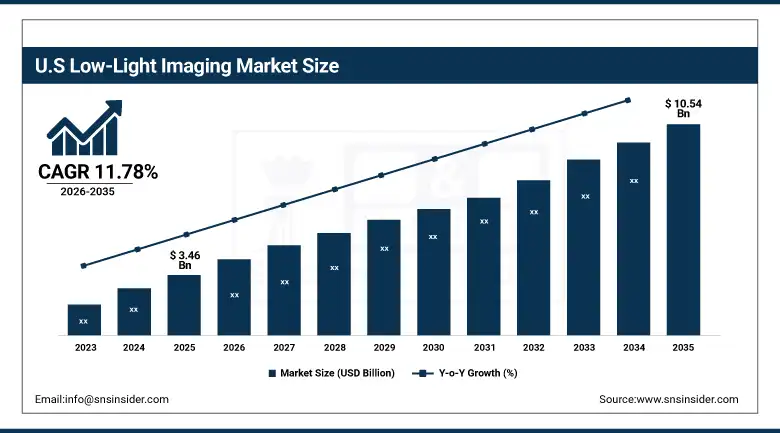
The U.S. Low Light Imaging Market size was valued at USD 3.46 Billion in 2025 and is projected to reach USD 10.54 Billion by 2035, growing at a CAGR of 11.78% during 2026–2035. Growth is driven by rising adoption in defense, surveillance, automotive night vision, and medical imaging, along with advancements in CMOS sensors, AI-based image enhancement, and increasing demand for high-performance imaging in low-visibility environments.
Market Drivers: Advances in sensors and miniaturization drive growth in the Low-Light Imaging market across surveillance, automotive, industrial, and consumer applications.
The low-light imaging industry is being driven by increasing demand for high-sensitivity, energy-efficient, and compact imaging solutions. Enhanced sensor technologies now provide superior light capture, improved color accuracy, and reduced image noise, enabling reliable performance in smartphones, cameras, automotive ADAS, industrial automation, surveillance, and wearable devices. Growing adoption of machine vision, smart infrastructure, and advanced security systems is further boosting market growth. Additionally, innovations in sensor materials and miniaturization are enabling higher performance in smaller form factors, creating opportunities for manufacturers to expand offerings across consumer, commercial, and industrial applications globally.
In June 2025 – Researchers at ETH Zurich and Empa developed a perovskite-based image sensor offering superior low-light performance, enhanced color reproduction, and fewer artifacts, making it ideal for smartphones, digital cameras, and machine vision applications.
Market Restraints: High costs, complex integration, and low-light limits restrict adoption in surveillance, automotive, and industrial sectors.
Despite growing demand for advanced imaging solutions, the low-light imaging market faces notable challenges. High sensor costs, particularly for CMOS, sCMOS, and NIR technologies, increase overall system expenses, limiting adoption among small and medium enterprises. Complex integration requirements, including precise optics alignment, compact form-factor design, and software-hardware calibration, add development time and technical hurdles. Additionally, performance limitations in extreme low-light environments, such as image noise, reduced sensitivity, and inconsistent HDR performance, hinder reliability. These factors collectively slow deployment across surveillance, automotive safety systems, industrial automation, and other critical applications worldwide.
Market Opportunities: Expanding Horizons in Low-Light Imaging Technologies
The growing demand for compact, energy-efficient imaging systems presents significant opportunities in the low-light and near-infrared camera market. Industries such as surveillance, smart access control, wearable technology, industrial automation, and retail analytics increasingly require high-performance sensors capable of HDR imaging, motion detection, and enhanced NIR sensitivity. Cameras with flexible optics integration and compact form factors enable seamless deployment across diverse applications, from always-on monitoring to event-driven operations. Manufacturers focusing on low-power, high-precision imaging solutions can capitalize on rising adoption in IoT devices, security infrastructure, and intelligent automation systems globally.
In January 2026 – Vadzo Imaging has launched the Falcon-544CRS, a 5MP USB 3.2 Gen1 UVC low-light camera powered by Onsemi’s AR0544 HyperLux™ LP sensor, offering HDR, NIR sensitivity up to 940 nm, and Wake-on-Motion for ultra-low-power, always-on applications. It supports flexible optics and compact form factors for industrial, surveillance, and wearable systems.
Low-Light Imaging Market Segment Highlights:
-
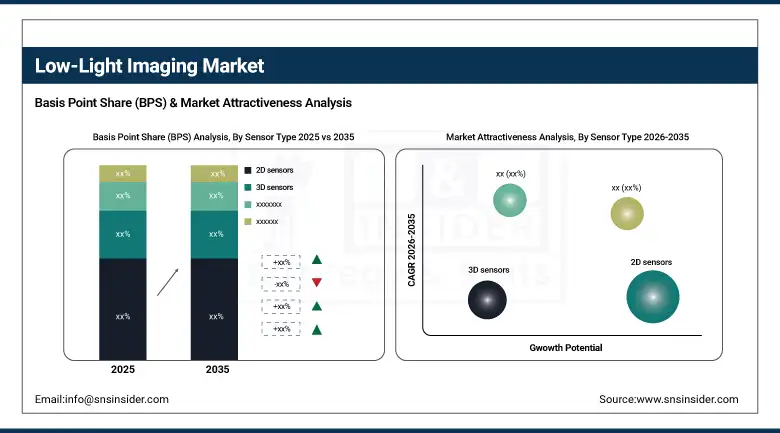
By Sensor Type: Dominant – 2D Sensors (43.75% in 2025 → 36.25% in 2035); Fastest-Growing – 3D Sensors (CAGR 17.81%)
-
By Device Type: Dominant – Camera Modules (44.25% in 2025 → 39.75% in 2035); Fastest-Growing – Night Vision Devices (CAGR 11.19%)
-
By Technology: Dominant – CMOS (39.25% in 2025 → 34.75% in 2035); Fastest-Growing – sCMOS (CAGR 14.26%)
-
By End Use: Dominant – Surveillance & Security (28.19% in 2025 → 26.27% in 2035); Fastest-Growing – Automotive (CAGR 13.28%)
By Sensor Type, 2D Sensors Dominating and 3D Sensors Fastest-Growing
2D Sensors remain the dominant segment in low-light imaging, widely used across consumer electronics, surveillance, and automotive applications due to their cost-effectiveness, compact design, and reliable performance. 3D Sensors, however, are the fastest-growing segment, driven by rising demand in advanced automotive systems, AR/VR devices, and industrial inspection, offering enhanced depth perception, accuracy, and innovative imaging capabilities for next-generation applications.
By Device Type, Camera Modules Dominating and Night Vision Devices Fastest-Growing
Camera Modules remain the dominant device type in low-light imaging, extensively deployed in smartphones, security cameras, and consumer electronics due to their compact design, cost-effectiveness, and reliable image quality. Night Vision Devices, however, are the fastest-growing segment, driven by increasing adoption in defense, surveillance, and automotive applications, offering enhanced visibility and performance in low-light and night-time conditions.
By Technology, CMOS Dominating and sCMOS Fastest-Growing
CMOS technology remains the dominant imaging technology, widely used for low-light applications due to its efficiency, low power consumption, and scalability in consumer and industrial devices. sCMOS (Scientific CMOS), however, is the fastest-growing segment, propelled by demand in research, medical imaging, and high-end scientific applications, providing high sensitivity, low noise, and advanced imaging performance.
By End Use, Surveillance & Security Dominating and Automotive Fastest-Growing
Surveillance & Security continues as the dominant end-use segment for low-light imaging, utilized extensively in public safety, building security, and monitoring systems due to its critical role in low-light detection and protection. Automotive, however, is the fastest-growing segment, driven by advanced driver-assistance systems (ADAS), autonomous driving technology, and in-vehicle monitoring, requiring high-performance low-light imaging for safety and operational efficiency.
Low-Light Imaging Market Regional Highlights:
-
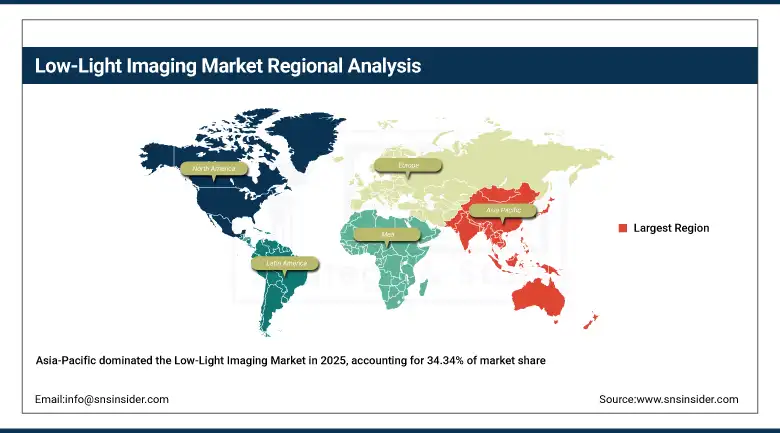
North America: In 2025E 31.09% → 33.91%, Dominating Region (CAGR 11.98%)
-
Europe: In 2025E 24.56% → 23.44%, Significant Market (CAGR 10.13%)
-
Asia-Pacific: In 2025E 34.34% → 32.66%, Fastest-Growing Region (CAGR 10.08%)
-
Latin America: In 2025E 5.22% → 5.78%, Steady Growth (CAGR 12.20%)
-
Middle East & Africa: In 2025E 4.78% → 4.22%, Stable Share (CAGR 9.05%)
Asia-Pacific Low-Light Imaging Market Insights:
Asia-Pacific leads the Low-Light Imaging Industry, driven by rapid adoption in consumer electronics, automotive, and surveillance sectors. Strong manufacturing infrastructure, government support for smart cities, and rising demand for advanced imaging technologies fuel growth. The region shows robust expansion potential, making it a key hub for innovation and market dominance.
Get Customized Report as per Your Business Requirement - Enquiry Now
China Low-Light Imaging Market Insights:
China dominates the Low-Light Imaging industry, driven by extensive electronics manufacturing, growing surveillance infrastructure, and rising demand for automotive and consumer imaging applications, positioning it as the largest regional market globally.
North America Low-Light Imaging Market Insights:
North America is the fastest-growing region in the Low-Light Imaging market, fueled by increasing adoption of advanced surveillance systems, automotive safety technologies, and research-driven imaging innovations. Strong investments in defense, smart infrastructure, and IoT applications are accelerating market expansion, making the region a key driver of global growth.
United States Low-Light Imaging Market Insights:
The United States dominates the Low-Light Imaging market, driven by advanced defense systems, widespread adoption of surveillance technologies, strong R&D investments, and leadership in automotive and consumer imaging innovations globally.
Europe Low-Light Imaging Market Insights:
The Europe Low-Light Imaging market is witnessing emerging trends, including increased adoption of smart surveillance systems, automotive ADAS integration, and industrial inspection applications. Government initiatives supporting security infrastructure and technological innovation are driving growth, while advancements in CMOS and sCMOS sensors enhance imaging performance across consumer, medical, and industrial sectors.
Germany Low-Light Imaging Market Insights:
Germany dominates the Europe Low-Light Imaging industry, led by strong automotive, industrial, and security sectors, advanced sensor manufacturing capabilities, and government support for research and technology-driven imaging solutions across multiple applications.
Latin America Low-Light Imaging Market Insights:
The Latin America Low-Light Imaging market is steadily expanding, driven by growing demand for security surveillance, automotive safety systems, and consumer electronics. Investments in smart infrastructure, urban monitoring projects, and gradual adoption of advanced imaging technologies are fueling consistent growth across the region, creating opportunities for both domestic and international market players.
Brazil Low-Light Imaging Market Insights:
Brazil is the dominant country in the Latin America Low-Light Imaging industry, driven by strong adoption of surveillance systems, automotive imaging technologies, and growing investments in smart infrastructure and security applications.
Middle East & Africa Low-Light Imaging Market Insights:
The Middle East and Africa Low-Light Imaging industry is witnessing moderate growth, fueled by increasing adoption of security and surveillance systems, government investments in smart city initiatives, and gradual integration of advanced imaging technologies in industrial, automotive, and defense sectors, supporting steady market expansion across the region.
Saudi Arabia Low-Light Imaging Market Insights:
Saudi Arabia is the dominating country, driven by strong investments in smart city projects, advanced surveillance infrastructure, and defense & security applications across the region.
Low-Light Imaging Market Competitive Landscape:
Sony Semiconductor Solutions Corporation is a global leader Established in 2015 in CMOS image sensors, delivering advanced solutions for low-light imaging, automotive vision, industrial, and consumer electronics, with strengths in HDR, stacked sensor architecture, and near-infrared sensitivity, supporting next-generation imaging and sensing applications worldwide.
-
In Oct 2025 – Sony Semiconductor Solutions announced the IMX828 automotive CMOS image sensor with a built-in MIPI A-PHY interface, delivering industry-leading HDR (up to 150 dB), reduced power consumption, and compact camera design.
OmniVision Technologies, founded in 1995, is a global semiconductor company specializing in CMOS image sensors and advanced imaging solutions for smartphones, automotive systems, security cameras, medical devices and IoT applications, delivering high performance, low‑power, compact sensors that enable exceptional image quality and innovative visual experiences worldwide across diverse industries globally.
-
In Jan 2025, OMNIVISION introduced the OX03J10, the industry’s first 3MP automotive SoC image sensor combining 140 dB HDR and LED flicker mitigation, delivering superior low-light and high-contrast imaging for surround-view and rear-view camera systems.
Low-Light Imaging Companies are:
-
Sony Corporation
-
Samsung Electronics Co., Ltd.
-
ON Semiconductor Corporation
-
STMicroelectronics N.V.
-
Panasonic Holdings Corporation
-
Canon Inc.
-
Hamamatsu Photonics K.K.
-
ams OSRAM AG
-
Tower Semiconductor Ltd.
-
SK hynix Inc.
-
GalaxyCore Inc.
-
Himax Technologies, Inc.
-
Sharp Corporation
-
Toshiba Corporation
-
Infineon Technologies AG
-
Rohm Semiconductor
-
iC-Haus GmbH
-
Teledyne e2v
| Report Attributes | Details |
|---|---|
| Market Size in 2025 | USD 16.87 Billion |
| Market Size by 2035 | USD 46.96 Billion |
| CAGR | CAGR of 10.78% From 2026 to 2035 |
| Base Year | 2025E |
| Forecast Period | 2026-2035 |
| Historical Data | 2022-2024 |
| Report Scope & Coverage | Market Size, Segments Analysis, Competitive Landscape, Regional Analysis, DROC & SWOT Analysis, Forecast Outlook |
| Key Segments | • By Sensor Type(2D sensors, 3D sensors, Multispectral sensors, Near-Infrared (NIR) sensors) • By Device Type(Camera modules, Night vision devices, Thermal imagers and Image intensifiers) • By Technology(CMOS (Complementary Metal-Oxide-Semiconductor), CCD (Charge-Coupled Device), sCMOS (Scientific CMOS), EMCCD (Electron Multiplying CCD), Infrared imaging and Thermal imaging) • By End Use(Surveillance & security, Automotive, Consumer electronics, Medical imaging, Industrial, Military & defense and Others) |
| Regional Analysis/Coverage | North America (US, Canada), Europe (Germany, UK, France, Italy, Spain, Russia, Poland, Rest of Europe), Asia Pacific (China, India, Japan, South Korea, Australia, ASEAN Countries, Rest of Asia Pacific), Middle East & Africa (UAE, Saudi Arabia, Qatar, South Africa, Rest of Middle East & Africa), Latin America (Brazil, Argentina, Mexico, Colombia, Rest of Latin America). |
| Company Profiles | Sony Corporation; Samsung Electronics Co., Ltd.; OmniVision Technologies, Inc.; ON Semiconductor Corporation; STMicroelectronics N.V.; Panasonic Holdings Corporation; Canon Inc.; PixArt Imaging Inc.; Hamamatsu Photonics K.K.; ams OSRAM AG; Tower Semiconductor Ltd.; SK hynix Inc.; GalaxyCore Inc.; Himax Technologies, Inc.; Sharp Corporation; Toshiba Corporation; Infineon Technologies AG; Rohm Semiconductor; iC-Haus GmbH; Teledyne e2v. |

Frequently Asked Questions
Asia-Pacific dominated the Low-Light Imaging Market in 2025.
The “2D sensors” segment dominated during the projected period.
Advancements in high-sensitivity sensors, miniaturization, HDR and NIR capabilities, and growing demand in surveillance, automotive, industrial, and consumer applications are driving the Low-Light Imaging market.
The Market was valued at USD 16.87 Billion in 2025E and is projected to reach USD 46.96 Billion by 2035.
The Low-Light Imaging Market is expected to grow at a CAGR of 10.78% during 2026–2035.
