
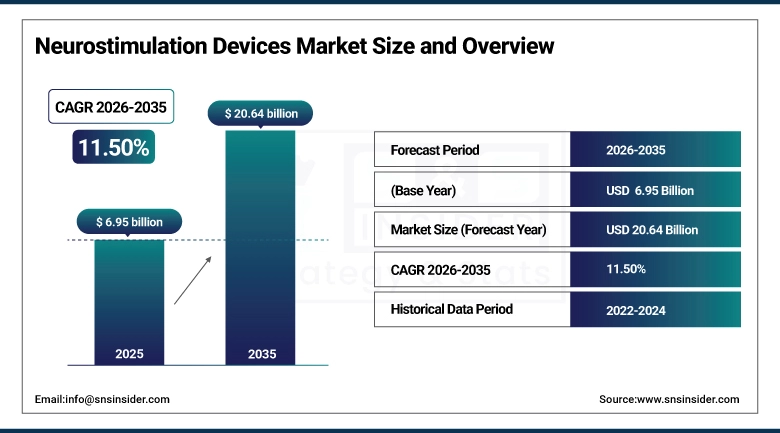
As per the SNS Insider Report titled, Neurostimulation Devices Market Size, Share & Segmentation, By Device Type, By Technology, By Application, By End-Use, By Region, And Global Forecast 2026–2035, “The global Neurostimulation Devices Market size valued at USD 6.95 billion in 2025, is anticipated to grow to USD 20.64 billion by 2035, registering a CAGR of 11.50% over the 2026–2035 forecast period.”
Key Takeaways
- Spinal Cord Stimulators accounted for the largest revenue share of 39.6% in 2025 due to increasing adoption in chronic pain management procedures.
- Deep Brain Stimulators are projected to witness the fastest growth, expanding at a CAGR of 15.8% during the forecast period.
- Implantable Neurostimulation Devices dominated the technology segment with a 63.2% market share in 2025.
- Wearable Neurostimulation Devices are expected to register the fastest CAGR of 16.4% owing to rising preference for non-invasive therapies.
- Chronic Pain Management held the leading application share of 44.9% in 2025 as neurological pain disorders continue to increase globally.
- The Depression segment is forecast to grow at the highest CAGR of 17.1% driven by expanding adoption of neuromodulation therapies in mental health treatment.
- Hospitals represented the largest end-user segment with a 52.7% share in 2025 due to higher procedural volumes and advanced surgical infrastructure.
- North America dominated the global Neurostimulation Devices Market with a 42.0% share in 2025, while Asia Pacific is anticipated to record the fastest CAGR of 14.04% through 2035.
Why Neurostimulation Devices Market is Growing?
The neurostimulation devices market is witnessing substantial growth owing to an increasing incidence of neurological disorders, chronic pain syndromes, epilepsy, Parkinson's disease, and resistant depression across the globe. The escalating trend of preference towards minimally-invasive therapy options is motivating health care organizations to opt for modern neuromodulation technologies for better symptom control without causing systemic side effects.
Advancements in the development of implantable pulse generators, wireless neurostimulators, rechargeable battery systems, and artificial intelligence-based programming platforms are enhancing the effectiveness and patient-friendly nature of neurostimulation therapies. Another factor responsible for rising demands for neurostimulation devices is the increasing population of the geriatric segment globally, which is highly prone to neurodegenerative diseases.
Moreover, positive reimbursement policies and clinical validation of the neurostimulation devices technology in advanced countries is adding momentum to the growth of the market.
Neurostimulation Devices Market Statistics
- World Health Organization estimates that more than one billion people suffer from neurological diseases per year.
- The number of people suffering from Parkinson’s disease has doubled since the last 25 years, and there are now more than 8.5 million patients with the disease globally.
- The number of people suffering from chronic pain conditions is about 20% of adults throughout the world.
- As reported by the U.S. Centers for Disease Control and Prevention (CDC), there are about 51.6 million patients with chronic pain conditions per year in the U.S. alone.
- About 280 million people are affected by depression globally.
- Healthcare companies are adopting neuromodulation therapies for various ailments including epilepsy, migraine, and psychological conditions.
- The use of wearable health care devices has been growing very fast due to rising consumer awareness about non-invasive treatments.
- The amount of research being done on brain computer interfaces is growing tremendously throughout North America, Europe, and Asia Pacific regions.
Emerging Trends
One of the main rising trends observed in the neurostimulation devices industry is the rise in the acceptance of wearable as well as non-invasive neurostimulation techniques. The rising prevalence of neurostimulators that can be used by individuals at home for managing neurological symptoms is being observed.
Moreover, the advent of artificial intelligence and machine learning is impacting the field of neuromodulation therapy optimization. Adaptive stimulation that can adapt itself according to patient inputs has become one of the latest trends that have been making waves within the industry.
Closed loop neuromodulation systems represent another rising trend within the market. This technology has found use in the management of epilepsy and other movement disorders. The miniaturization of neurostimulation devices, wireless communication features, rechargeable implants, and MRI compatibility are some of the emerging trends that have been witnessed recently.
Collaborations between device manufacturers, neuroscience research centers, and firms engaged in digital health products is contributing to innovation in the market.
Top 10 Companies
- Medtronic plc
- Abbott Laboratories
- Boston Scientific Corporation
- LivaNova PLC
- Nevro Corp.
- Integer Holdings Corporation
- Synapse Biomedical Inc.
- NeuroSigma Inc.
- electroCore Inc.
- Biotronik SE & Co. KG
About the Author

Get in touch




