
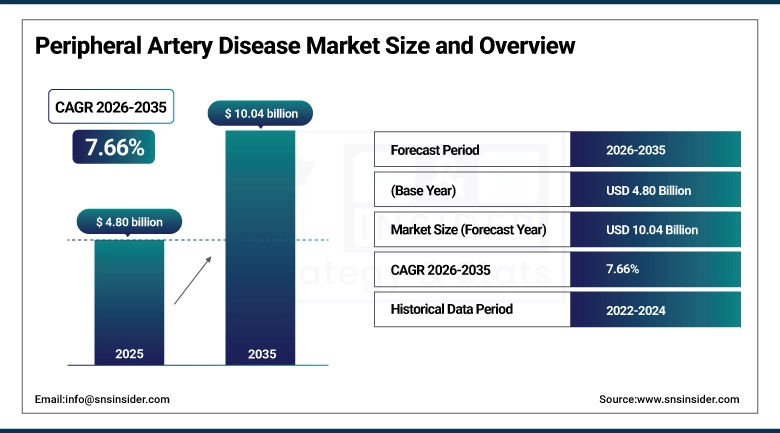
As per the SNS Insider Report titled, Peripheral Artery Disease Market Size, Share & Segmentation, By Type, By End-user, By Region, And Global Forecast 2026–2035, “The global Peripheral Artery Disease Market size valued at USD 4.80 billion in 2025, is anticipated to grow to USD 10.04 billion by 2035, registering a CAGR of 7.66% over the 2026–2035 forecast period.”
Key Takeaways
- The Peripheral Artery Disease (PAD) Market was valued at USD 4.80 billion in 2025 and is projected to reach USD 10.04 billion by 2035.
- The market is expected to expand at a CAGR of 7.66% during the forecast period from 2026 to 2035.
- By Type, the Devices segment dominated the market with a 65.06% share in 2025.
- The Devices segment is also projected to witness the fastest growth, registering a CAGR of 7.90% through 2035.
- By End-user, Hospitals accounted for 72.80% of total revenue in 2025, maintaining their leadership position.
- The Specialty Clinics segment is expected to grow at the fastest CAGR of 7.94% during the forecast period.
- North America held the largest regional share of 40.60% in 2025, supported by advanced vascular care infrastructure.
- Asia Pacific is projected to be the fastest-growing regional market, expanding at a CAGR of 8.16% between 2026 and 2035.
Why Peripheral Artery Disease Market is Growing?
The Peripheral Artery Disease Market is witnessing strong growth owing to the rising incidence rate of atherosclerosis, diabetes, obesity, high blood pressure, and other cardiovascular ailments that increase the risk of peripheral artery disease. There is an improvement in patient outcomes along with increased awareness about early diagnosis and adoption of minimally-invasive treatment methods, which is driving the need for innovative therapies and diagnostics for PAD.
There have been many innovations in technologies, such as drug-coated balloons, atherectomy devices, stents, and other medical technologies used for the purpose of peripheral artery interventions. The rise in geriatric populations is another factor responsible for growth, because they have a higher risk of suffering from arterial obstruction and other cardiovascular conditions. There are other growth drivers in the market, such as governmental programs and spending on preventive care for cardiovascular diseases in emerging nations.
Peripheral Artery Disease Market Statistics
- PAD is one of the most common disorders of blood vessels, with more than 230 million people having this disease globally.
- Heart problems account for up to 17.9 million deaths per year, and vascular complications make up an important factor of morbidity among cardiovascular disorders.
- Numerous studies suggest that up to 20% of people older than 60 can suffer from different forms of peripheral artery disease.
- Around four times increased risk is seen among diabetics who are at high risk of suffering from peripheral artery disease.
- According to various studies, about half of patients suffering from PAD have no symptoms at all, which creates an urgent need for further research and treatment.
- The habit of smoking makes up an important risk factor with smokers having three times increased chance of having PAD compared with people who do not smoke.
- There are more hospitalizations among people with heart problems due to obesity.
Emerging Trends
There are several innovative developments in the PAD industry intended to optimize the results of clinical interventions and decrease the likelihood of complications. For instance, the usage of drug-eluting and drug-coated devices can contribute to the reduction of stenosis cases after vascular intervention. At the same time, there is an increasing focus on the development of highly flexible and durable next-generation stents.
The use of sophisticated imaging techniques, such as IVUS, OCT, as well as AI technologies that allow for diagnosing arterial occlusions, is becoming a common practice. The prevalence of minimally invasive endovascular techniques is growing because of the desire to achieve better results in terms of recovery speed and decreased costs of hospitalization.
Furthermore, there are several promising innovations associated with the use of digital health products, including remote monitoring systems designed to manage chronic conditions and monitor patients' adherence to treatment plans. Finally, the continued development of research in the area of regenerative medicine and personalized medicine is likely to become a potential growth factor.
Top 10 Companies
- Medtronic
- Abbott
- Boston Scientific Corporation
- Becton, Dickinson and Company
- Terumo Corporation
- Cook Medical
- Cardinal Health
- B. Braun SE
- Philips
- Merit Medical Systems
About the Author

Get in touch




