
Peripheral Artery Disease Market Report Scope & Overview:
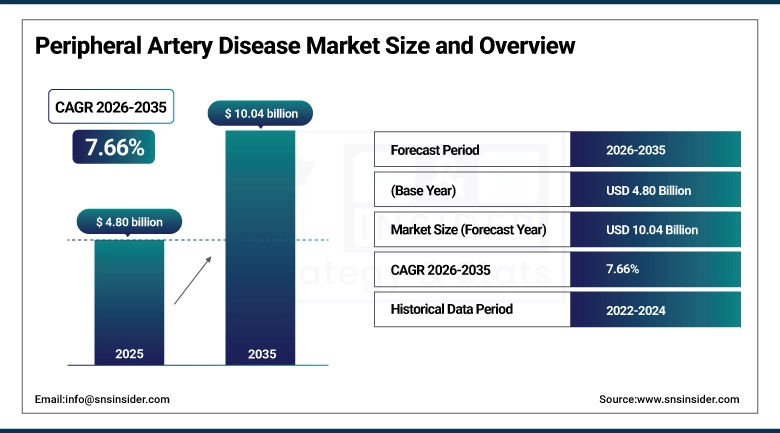
The Peripheral Artery Disease Market size was valued at USD 4.80 Billion in 2025 and is expected to reach USD 10.04 Billion by 2035, growing at a CAGR of 7.66% over the forecast period of 2026-2035.
The rapidly aging population is the prime driver in the global peripheral artery disease market surge. PAD is rare below the age of 60 but can affect up to 20% of individuals older than 80. Age-related changes, including the build-up of arterial plaque, are associated with a greatly increased risk of PAD. Additionally, older patients frequently have comorbidities, including diabetes or hypertension, which hasten the course of illness.
Market Size and Forecast:
-
Market Size in 2025 USD 4.80 Billion
-
Market Size by 2035 USD 10.04 Billion
-
CAGR of 7.66% From 2026 to 2035
-
Base Year 2025
-
Forecast Period 2026-2035
-
Historical Data 2022-2024
To Get more information on Peripheral Artery Disease Market - Request Free Sample Report
Peripheral Artery Disease Market Trends:
-
Rising prevalence of diabetes significantly increases the risk and incidence of peripheral artery disease (PAD).
-
Diabetic PAD cases often lead to complications such as critical limb ischemia and amputations, driving demand for advanced interventions.
-
Growing use of stents and atherectomy procedures to manage severe PAD is expanding treatment options.
-
Increasing awareness and early screening programs in regions like Asia-Pacific support timely diagnosis and intervention.
-
Global rise in cardiovascular disorders and aging populations continues to boost the overall PAD market demand.
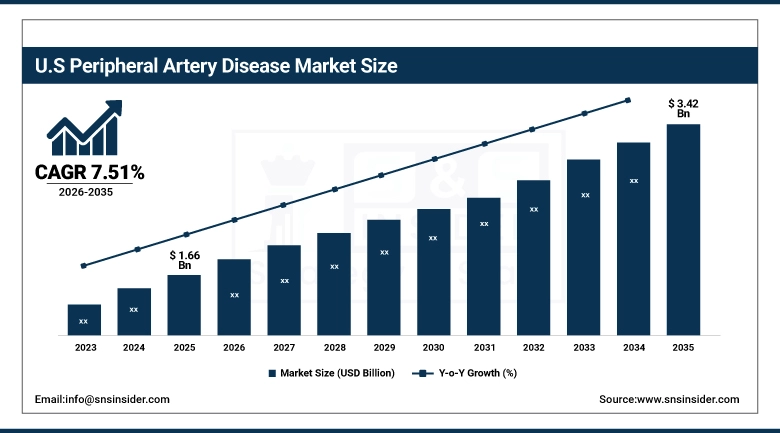
The U.S. Peripheral Artery Disease Market was valued at USD 1.66 billion in 2025 and is expected to reach USD 3.42 billion by 2035, growing at a CAGR of 7.51% from 2026 to 2035. The US has the dominating peripheral artery disease market share in the world due to the speedy uptake of minimally invasive devices, including drug-eluting stents, atherectomy devices, and bioresorbable scaffolds.
For instance, in March 2025, IN 2025, the FDA approved over 12 PAD devices, reinforcing the U.S. leadership in vascular innovation through rapid regulatory support for advanced technologies.Top of Form
Peripheral Artery Disease Market Growth Drivers:
-
Increasing Incidence of Diabetes, Driving the Peripheral Artery Disease Market Growth
The increasing incidence of diabetes is also a key factor in the peripheral artery disease market, as diabetics are two to four times more prone to PAD, suffering from accelerated atherosclerosis and damage to the vessels. Cases of PAD induced by diabetes mellitus tend to become more complicated, including critical limb ischemia and amputation, which have led to a higher requirement for advanced interventions, including stents and atherectomy. Due to the increasing prevalence of diabetes across the globe, majorly in the Asia-Pacific early screening and intervention continue to witness an exponential growth, boosting the peripheral artery disease market share globally.
For instance, in February 2025, Global diabetes cases exceeded 540 million in 2025, with over 30% at risk for PAD, especially in Asia-Pacific due to aging and urbanization trends.
Peripheral Artery Disease Market Restraints:
-
Supply Chain Disruptions, Restraining the Peripheral Artery Disease Market
Interruptions to the supply chain limit the peripheral artery disease market due to delayed manufacturing operations, increased forensic costs, and a lack of devices, including stents and catheters. Material, semiconductor, and transportation supply shortages result in treatment delays and compromised patient care. These issues impede hospital purchasing and patient acquisition, as well as market growth, and slow technology adoption, having a direct effect on the worldwide peripheral artery disease market share.
For instance, in October 2025, over 6,000 PAD balloon catheters were recalled due to component failures linked to supply chain quality issues, disrupting availability and treatment continuity across U.S. hospitals.
Peripheral Artery Disease Market Segment Analysis:
-
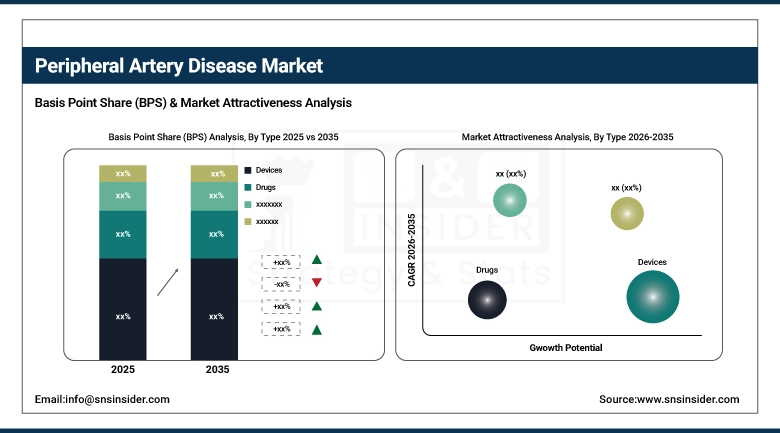
By Type, Devices dominated with 65.06% in 2025, and it is expected to grow at the fastest CAGR of 7.90% from 2026 to 2035.
-
By End-user, Hospitals dominated with 72.80% in 2025, and Specialty Clinics is expected to grow at the fastest CAGR of 7.94% from 2026 to 2035.
By Type, Devices Segment Dominates Peripheral Artery Disease Market While Minimally Invasive Technologies Drive Fastest Growth
Devices were the dominant segment in the peripheral artery disease market analysis, with a market share of 65.06% share in 2025. It is also the fastest growing segment with a CAGR of 7.90%, owing to the increasing preference for minimally invasive procedures including DCBs, DES, and atherectomy systems. These newer technologies provide for quicker recovery, fewer complications, and better long-term results than traditional surgery. Adoption is also driven by continued innovation, aging populations, and the prevalence of PAD globally. Therefore, devices dominate the overall peripheral artery disease market share and will continue to lead growth in the next few years.
By End-user, Hospitals Lead Peripheral Artery Disease Market While Specialty Clinics Drive Fastest Growth 2026 to 2035
In 2025, the Hospitals segment controlled the global peripheral artery disease market share, as they have well-built-in infrastructures and access to skilled practitioners and the ability to perform technologically-advanced, minimally invasive procedures, like angioplasty and stenting. They act as major places of referral for the diagnosis of PAD, offering emergency assistance and post-operative care, in particular for the high-risk and older age patients. Advanced inpatient services led to high patient volume and the resulting dominance of hospitals as the highest revenue-generating contributing factor in the global peripheral artery disease market share. The Specialty Clinics are the fastest-growing segment in the peripheral artery disease market because of the increasing demand for outpatient minimally invasive procedures with fast recovery and low-cost treatment procedures.
Regional Insights:
North America Peripheral Artery Disease Market Insights
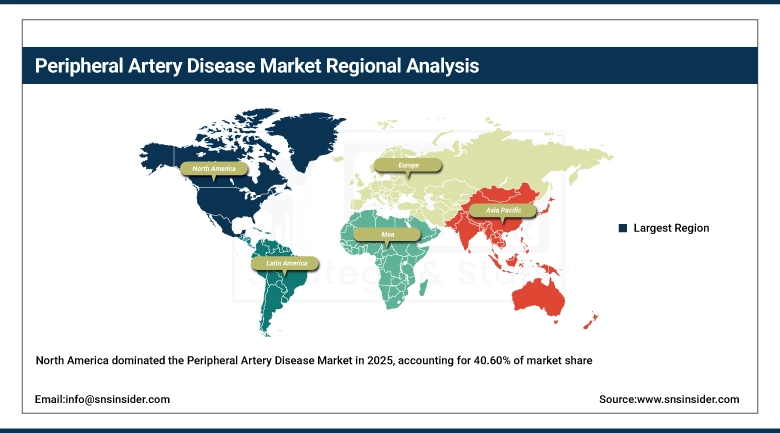
In 2025, the North American region dominated the peripheral artery disease industry and accounted for 40.60% of the overall revenue share, owing to its mature healthcare system, high sick awareness, and rich resources of high-tech diagnostics and therapeutics. The region has a big aging population and a high prevalence of major risk factors, including diabetes mellitus, obesity, and smoking, all leading to the high PAD incidence. The US, in particular, is at the forefront of the adoption of minimally invasive procedures, including drug-coated balloons, stents, and atherectomy devices with the help of favorable reimbursement policies and ongoing product innovation. Moreover, significant R&D investment and a sound regulatory framework expedite the market entry of next-generation PAD treatments.
Get Customized Report as per Your Business Requirement - Enquiry Now
Europe Peripheral Artery Disease Market Insights
Europe accounts for the second-largest market share for the peripheral artery disease industry, as it has an aging population, high rates of cardiovascular disease and diabetes, and well-resourced healthcare systems. The notion in the region is that increased awareness, early diagnosis, and availability of advanced PAD technologies, including drug-eluting stents and image-guided intervention techniques, will have an impact. The increasing government programs for vascular health and rising acceptance of minimally invasive processes across countries, including Germany, France, Norway, and the UK are the factors driving the peripheral artery disease market growth in that region. The peripheral artery disease market size in Europe holds a noteworthy share as well.
Asia Pacific Peripheral Artery Disease Market Insights
The Asia Pacific region is projected to grow with the fastest CAGR of 8.16% over the forecast period, owing to a rapidly aging population, rising prevalence of diabetes and hypertension, and increasing adoption of sedentary lifestyles. Countries like China, India, and Japan are experiencing significant growth in PAD cases, driven by urbanization and lifestyle changes. Improved healthcare infrastructure, expanding access to advanced medical technologies, and increasing government focus on non-communicable disease management are boosting PAD diagnosis and treatment rates. Furthermore, growing awareness campaigns, rising healthcare spending, and the emergence of minimally invasive vascular procedures are accelerating demand for PAD devices and therapies.
Latin America (LATAM) and Middle East & Africa (MEA) Peripheral Artery Disease Market Insights
The Middle East & Africa have a smaller share in the peripheral artery disease market, which is growing gradually due to rising healthcare infrastructure and awareness, coupled with growing diabetes and cardiovascular disease burden. Urbanization, changes in lifestyle, and government initiatives to improve vascular care have promoted the expansion of the peripheral artery disease market in the region. The peripheral artery disease market is a developing market in Latin America with an increase in prevalence of diabetes, smoking, and obesity, which are the risk factors that lead to PAD.
Competitive Landscape:
Abbott Laboratories is a leading global healthcare company offering advanced cardiovascular and peripheral artery disease solutions. In the PAD market, Abbott provides innovative devices such as stents, catheters, and atherectomy systems, enabling minimally invasive interventions, improved patient outcomes, and enhanced management of complications associated with diabetes and peripheral vascular disorders.
-
In February 2025, Abbott received FDA approval to expand the use of its Supera Stent for complex PAD cases, including below-the-knee lesions, enhancing treatment options for challenging vascular conditions.
Philips Healthcare is a global leader in medical technologies and solutions, providing advanced imaging, diagnostic, and interventional systems for peripheral artery disease. Their portfolio supports early detection, minimally invasive procedures, and patient monitoring, improving treatment outcomes, workflow efficiency, and management of complications associated with PAD and cardiovascular conditions worldwide.
-
In March 2025, Philips launched AI-powered software integrated with Volcano IVUS to enhance intravascular imaging precision in PAD procedures, enabling better lesion assessment and treatment planning across interventional vascular centers.
Peripheral Artery Disease Market Key Players:
-
Medtronic plc
-
Abbott Laboratories
-
Boston Scientific Corporation
-
Becton, Dickinson and Company (BD)
-
Cook Medical
-
Cardinal Health, Inc.
-
Terumo Corporation
-
Philips Healthcare
-
BIOTRONIK SE & Co. KG
-
iVascular S.L.U.
| Report Attributes | Details |
|---|---|
| Market Size in 2025 | USD 4.80 Billion |
| Market Size by 2035 | USD 10.04 Billion |
| CAGR | CAGR of 7.66% From 2026 to 2035 |
| Base Year | 2025 |
| Forecast Period | 2026-2035 |
| Historical Data | 2022-2024 |
| Report Scope & Coverage | Market Size, Segments Analysis, Competitive Landscape, Regional Analysis, DROC & SWOT Analysis, Forecast Outlook |
| Key Segments | • By Type (Devices, Drugs) • By End-user(Hospitals, Specialty Clinics) |
| Regional Analysis/Coverage | North America (US, Canada), Europe (Germany, UK, France, Italy, Spain, Russia, Poland, Rest of Europe), Asia Pacific (China, India, Japan, South Korea, Australia, ASEAN Countries, Rest of Asia Pacific), Middle East & Africa (UAE, Saudi Arabia, Qatar, South Africa, Rest of Middle East & Africa), Latin America (Brazil, Argentina, Mexico, Colombia, Rest of Latin America). |
| Company Profiles | Medtronic plc, Abbott Laboratories, Boston Scientific Corporation, Becton, Dickinson and Company (BD), Cook Medical, Cardinal Health, Inc., Terumo Corporation, Philips Healthcare , BIOTRONIK SE & Co. KG, iVascular S.L.U., and other players |
Frequently Asked Questions
The Peripheral Artery Disease Market size was valued at USD 4.80 Billion in 2025.
The market is expected to reach USD 10.04 Billion by 2035.
The market is projected to grow at a CAGR of 7.66% from 2026 to 2035.
The growth is primarily driven by the rising aging population, increasing prevalence of diabetes and hypertension, and growing awareness of vascular disorders.
Older adults are at a significantly higher risk of developing peripheral artery disease, which increases demand for diagnostic tools, treatment options, and vascular interventions.
