
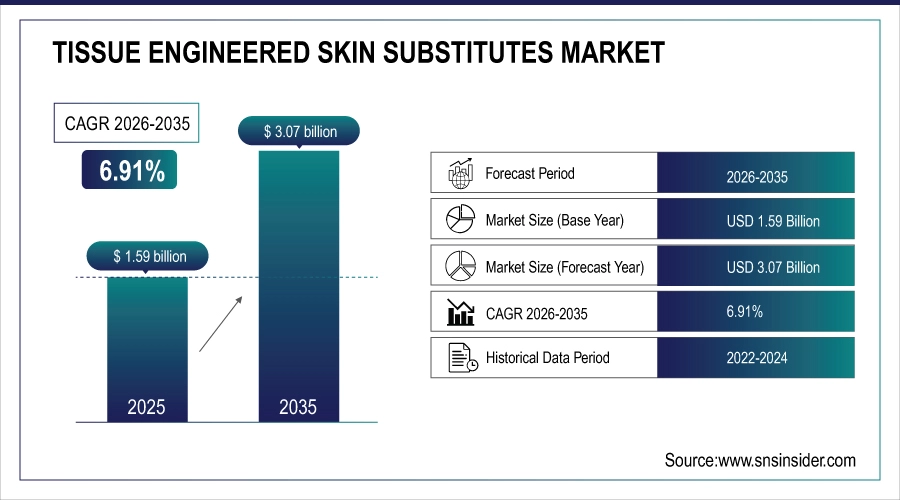
As per the SNS Insider Report titled, Tissue Engineered Skin Substitutes Market Size, Share & Segmentation, By Application, By Product, By End-Use, By Region, And Global Forecast 2026–2035, “The global Tissue Engineered Skin Substitutes Market size valued at USD 1.59 billion in 2025, is anticipated to grow to USD 3.07 billion by 2035, registering a CAGR of 6.91% over the 2026–2035 forecast period.”
Key Takeaways
- The Tissue Engineered Skin Substitutes Market was valued at USD 1.59 billion in 2025 and is projected to reach USD 3.07 billion by 2035.
- The market is expected to expand at a CAGR of 6.91% during the forecast period from 2026 to 2035.
- By Application, the Acute Wounds segment dominated the market and accounted for 61% of total revenue in 2025.
- The Chronic Wounds segment is anticipated to witness the fastest growth throughout the forecast period.
- By Product, Biological skin substitutes held the largest market share of 38% in 2025.
- Biosynthetic skin substitutes are expected to emerge as the fastest-growing product category over the next decade.
- By End-Use, Hospitals represented the leading segment with a 51% market share in 2025.
- Wound Care Centers are projected to register the fastest growth rate between 2026 and 2035.
- North America accounted for the largest regional revenue share of approximately 41% in 2025.
- Asia Pacific is forecast to record the fastest regional growth, with a CAGR of about 8.50% during the study period.
Why Tissue Engineered Skin Substitutes Market is Growing?
The Tissue Engineered Skin Substitutes Market is experiencing steady growth due to the increasing prevalence of chronic wounds, burns, diabetic foot ulcers, pressure ulcers, and traumatic injuries requiring advanced wound management solutions. The global rise in diabetes and the aging population has led to a great demand for efficient skin regeneration technologies. Tissue-engineered skin substitutes are increasingly being used by healthcare providers, due to faster healing, reduced risk of infection, improved patient outcomes and reduced duration of hospitalization.
Technological advances in regenerative medicine, biomaterials engineering, stem cell research and 3D tissue manufacturing are also driving product innovation. Furthermore, reimbursement policies in developed healthcare systems and growing investments in wound care infrastructure are conducive to wider adoption across hospitals and specialized wound care centers. Growing awareness for advanced wound management approaches continues to drive market expansion globally.
Tissue Engineered Skin Substitutes Market Statistics
- According to International Diabetes estimates, there are over 500 million adults living with diabetes worldwide, which greatly increases the risk of diabetic foot ulcers and chronic wound complications.
- Each year millions of people worldwide suffer from burn injuries, and there is a huge demand for advanced technologies for skin replacement and wound healing.
- Research indicates that chronic wounds can take months or years to heal, resulting in increased healthcare costs and prolonged patient care.
- Use of advanced wound care interventions has been shown to improve healing outcomes in many complex wound cases versus conventional dressings.
- The rising prevalence of age-related skin disorders and impaired wound healing will be higher with increase in the global elderly population in the coming decades.
- Global healthcare systems are investing in regenerative medicine research, including tissue engineering and bioengineered skin technologies.
- Hospital admissions for serious burns, trauma injuries and surgical wounds continue to be major drivers of demand for skin regeneration products.
- The rising incidence of obesity and vascular diseases has led to an increase in the incidence of hard-to-heal wounds requiring advanced treatment options.
Emerging Trends
The hospitals and clinics present opportunities for the Tissue Engineered Skin Substitutes Market and the future looks bright. Manufacturers are increasingly developing next-generation biosynthetic and hybrid skin substitutes that combine biological performance with improved durability and scalability. The potential of stem cell-based regenerative therapies to promote tissue regeneration is leading to significant research interest.
Another interesting trend is the increasing application of 3D bioprinting technologies for the fabrication of personalized skin constructs, customized to patients’ needs. Companies are also trying to develop off-the-shelf skin substitute products that have a longer shelf life and easier storage requirements. In addition, greater collaboration between biotech companies, academia and healthcare providers is providing a boost to the innovation and commercialization activities across the regenerative medicine landscape.
Advanced wound care workflows are also incorporating digital wound assessment technologies and AI-supported treatment planning, which helps clinicians optimize treatment outcomes and improve patient monitoring.
Top 10 Companies
- Organogenesis Holdings Inc.
- Integra LifeSciences Holdings Corporation
- Smith+Nephew plc
- MiMedx Group, Inc.
- Vericel Corporation
- AVITA Medical, Inc.
- Mallinckrodt plc
- Mölnlycke Health Care AB
- AlloSource
- B. Braun SE
About the Author

Get in touch




