
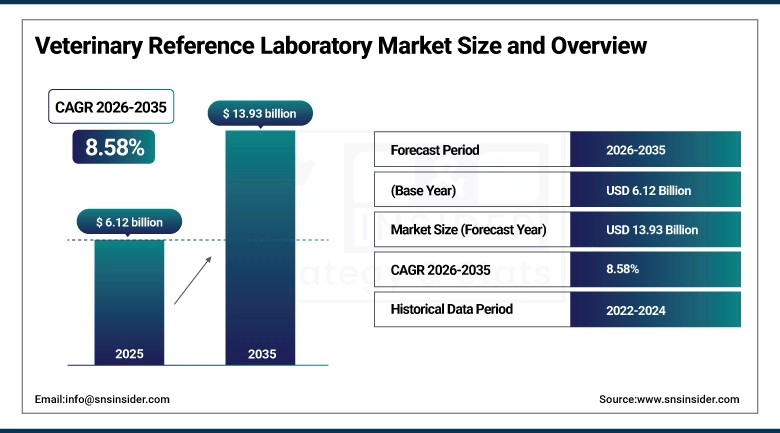
As per the SNS Insider Report titled, Veterinary Reference Laboratory Market Size, Share & Segmentation, By Animal Type, By Service Type, By Technology, By End User, By Region, And Global Forecast 2026–2035, “The global Veterinary Reference Laboratory Market size valued at USD 6.12 billion in 2025, is anticipated to grow to USD 13.93 billion by 2035, registering a CAGR of 8.58% over the 2026–2035 forecast period.”
Key Takeaways
- The Veterinary Reference Laboratory Market was valued at USD 6.12 billion in 2025 and is projected to reach USD 13.93 billion by 2035.
- Companion animals (Pets & Equines) dominated the animal type segment in 2025, accounting for 63% of the market.
- Livestock animals (Food-Producing) are expected to witness the fastest growth during the forecast period.
- Clinical biochemistry led the service type segment with a 35% revenue share in 2025.
- Molecular diagnostics is anticipated to emerge as the fastest-growing service category through 2035.
- Clinical Chemistry Analyzers and Immunoassays accounted for 42% of the technology segment in 2025.
- Veterinary clinics & hospitals dominated the end-user segment with a 70% market share and are expected to maintain strong growth.
- North America held the largest regional share at 43.20% in 2025, while Asia-Pacific is forecast to expand at a CAGR of approximately 13.91% through 2035.
Why Veterinary Reference Laboratory Market is Growing?
The veterinary reference laboratory market is expected to grow at a steady rate owing to factors such as increasing pet ownership, rising expenditure on animal healthcare and increasing awareness regarding preventive veterinary diagnostics. With companion animals increasingly becoming integral family members, demand for advanced laboratory testing services has grown in developed and emerging economies. Veterinary practitioners are increasingly relying on external reference laboratories for specialized diagnostic capabilities, which enables accurate disease detection and treatment planning.
The livestock industry is also a major contribution to the market growth as governments and producers focus on disease surveillance, food safety and productivity improvement. Increased attention to zoonotic diseases and animal-borne infections has led to increased investments in laboratory infrastructure and molecular testing technologies. Moreover, the convergence of automation, artificial intelligence-supported diagnostics, and next-generation sequencing technologies is enhancing the laboratory efficiency and diagnostic accuracy, thus creating positive conditions for long-term market growth.
Veterinary Reference Laboratory Market Statistics:
- It is estimated that over 1 billion companion animals live in households around the world, driving significant demand for veterinary healthcare services.
- Spending growth in the global pet care industry remains healthy with veterinary services among the fastest growing categories of expenditure.
- Animal diseases cause significant economic losses each year across livestock industries, leading to increased investment in disease monitoring and laboratory testing.
- The increasing use of molecular diagnostic techniques for rapid identification of infectious diseases, genetic disorders and emerging pathogens in animals.
- Rising rates of chronic conditions such as cancer, diabetes, endocrine disorders and kidney diseases in pets are driving demand for advanced diagnostic testing.
- Veterinary laboratories are expanding their test menus to include genomics, pathology, microbiology, toxicology and infectious disease screening.
- The regulatory emphasis on animal welfare and food safety is driving routine laboratory screening of livestock populations.
- Digital pathology, laboratory automation and cloud-based data management systems are improving operational efficiency across veterinary diagnostic networks.
Emerging Trends
One of the major trends driving the veterinary reference laboratory market is the fast adoption of molecular diagnostics and PCR-based testing platforms. These technologies allow for quicker and more precise detection of infectious diseases, assisting veterinarians in initiating timely treatment interventions.
A further important trend is the increasing use of genetic and genomic testing in companion animals. In addition, breed-specific disease screening, hereditary disorder detection and personalized veterinary care is becoming more common. Veterinary laboratories are also utilizing artificial intelligence and machine learning tools to enhance diagnostic workflows, image analysis, and result interpretation.
Further, telemedicine integration is supporting laboratory growth by enabling remote consultations and driving diagnostic testing referrals. Moreover, the growth of centralized laboratory networks and strategic partnerships between veterinary hospitals and diagnostic providers are enhancing accessibility to advanced testing services. Sustainability initiatives, including digital reporting systems and optimized laboratory operations.
Top 10 Companies
- IDEXX Laboratories
- Zoetis
- Antech Diagnostics
- Mars Veterinary Health
- Heska Corporation
- Virbac
- Neogen Corporation
- Thermo Fisher Scientific
- Bio-Rad Laboratories
- Randox Laboratories
About the Author

Get in touch




