
4K Technology Market Report Scope & Overview:
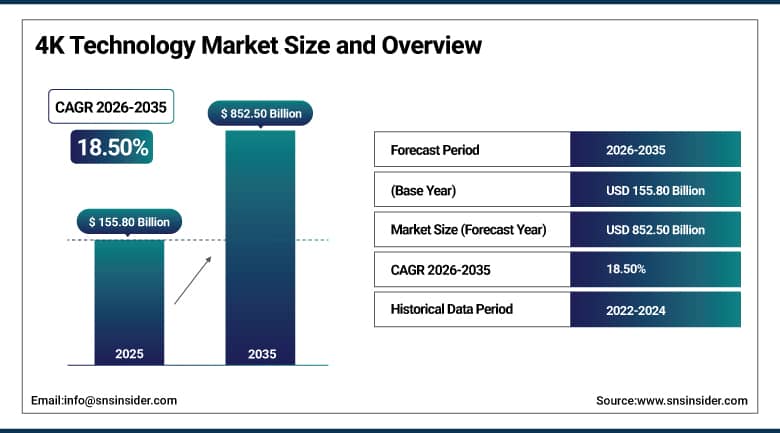
The 4K Technology Market size was valued at USD 155.80 Billion in 2025 and is expected to reach USD 852.50 Billion by 2035, growing at a CAGR of 18.50% from 2026 to 2035.
The 4K Technology Market is experiencing rapid growth due to declining costs in manufacturing panels, increasing native 4K content available on streaming and broadcast, and increasing consumer demand for higher image resolution. 4K technology, providing four times the amount of pixels as that of full high definition technology, is becoming the minimum standard in the realm of consumer electronics, professional display technologies, gaming industry, and content creation industry. Moreover, the growth of the market is being facilitated by the increasing use of 4K compatible gaming consoles, commercial usage in digital signage, and health care and industrial visualization.
Samsung and LG both expanded their Mini-LED and OLED 4K panel production lines in 2026 to meet surging demand from premium television and gaming monitor segments, as streaming platforms and cloud gaming services continue to standardize native 4K content delivery across their libraries.
To Get More Information On 4K Technology Market - Request Free Sample Report
4K Technology Market Trends
-
Rising adoption of Mini-LED and OLED panel technologies is improving contrast, brightness, and color accuracy across premium 4K television and monitor segments.
-
Growing availability of native 4K content across streaming platforms, live sports broadcasting, and cloud gaming services is accelerating consumer upgrade cycles from Full HD to 4K devices.
-
Increasing adoption of 4K displays in gaming, supported by next-generation consoles and high-refresh-rate gaming monitors, is expanding demand among esports and content creator communities.
-
Expanding commercial deployment of 4K digital signage and retail displays is being driven by falling panel costs and growing demand for high-impact visual advertising.
-
Strategic partnerships among panel manufacturers, streaming platforms, and device OEMs are supporting development of AI-based upscaling technologies that enhance lower-resolution content on 4K displays.
U.S. 4K Technology Market Size Outlook
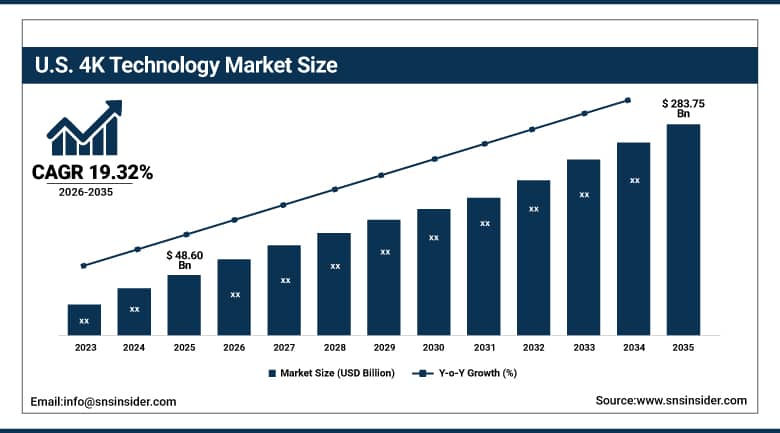
The U.S. 4K Technology Market was valued at USD 48.60 Billion in 2025 and is projected to reach USD 283.75 Billion by 2035, growing at a CAGR of 19.32% during 2026–2035.
U.S. 4K Technology Market growth will be driven by substantial investments made by consumers in home entertainment equipment; quick replacement of old and outdated Full HD televisions; rising popularity of 4K gaming screens in the country’s active gaming and esport community; and the development of native libraries of 4K content on the most popular streaming services and sports broadcasting channels in the United States. Moreover, 4K displays are increasingly being used in commercial environments.
In 2026, Samsung Electronics expanded U.S. retail availability of its Neo QLED 4K television lineup featuring AI-enhanced upscaling processors, while Sony extended its Bravia 9 Mini-LED series to additional screen sizes, reflecting intensifying competition among premium 4K television brands for U.S. consumer market share.
4K Technology Market Segment Analysis
-
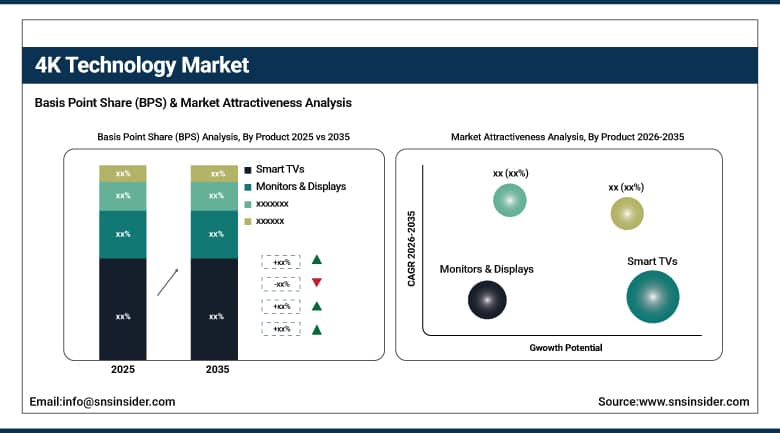
By Product, Smart TVs dominated the 4K Technology Market with a 48.60% share in 2025, while Monitors & Displays is the fastest-growing product segment with a CAGR of 20.80% from 2026–2035.
-
By Panel Technology, LED/LCD dominated the 4K Technology Market with a 58.30% share in 2025, while OLED is the fastest-growing panel technology segment with a CAGR of 22.40% from 2026–2035.
-
By Application, Home Entertainment dominated the 4K Technology Market with a 44.70% share in 2025, while Gaming & Esports is the fastest-growing application segment with a CAGR of 23.60% from 2026–2035.
-
By Distribution Channel, Offline Retail dominated the 4K Technology Market with a 56.80% share in 2025, while Online is the fastest-growing distribution channel segment with a CAGR of 21.90% from 2026–2035.
-
By End User, Residential dominated the 4K Technology Market with a 63.40% share in 2025, while Commercial is the fastest-growing end user segment with a CAGR of 19.80% from 2026–2035.
By Product, Smart TVs Lead, Monitors Grow Fastest
The Smart TVs segment dominated the 4K Technology Market with a revenue share of 48.60% in 2025. Smart televisions remain the largest product category owing to the sheer scale of global television replacement cycles, falling 4K panel manufacturing costs, and the widespread integration of streaming applications directly into television operating systems, which continues to drive consumer preference for 4K-capable smart TVs over conventional Full HD models across both mature and emerging markets.
The Monitors & Displays segment is anticipated to register the fastest CAGR of 20.80% during the forecast period 2026-2035. Growing adoption of 4K monitors among gamers, content creators, and remote professionals seeking higher pixel density for design, video editing, and competitive gaming applications is driving rapid segment growth. Falling prices of high-refresh-rate 4K gaming monitors, combined with expanding hybrid work arrangements requiring higher-resolution displays, are expected to further accelerate adoption throughout the forecast period.
By Panel Technology, LED/LCD Leads, OLED Grows Fastest
The LED/LCD category was the largest revenue generator and had a market share of 58.30% in the year 2025 within the 4K Technology Market. The technology remains prevalent due to its economical manufacturing process, availability at affordable prices and advancements in the backlighting technology like the use of Mini-LED to bridge the performance difference with other premium display technologies.
The OLED category has been estimated to exhibit the highest CAGR of 22.40% between 2026 and 2035. The rising preference of consumers towards higher contrast ratio, true black screens, and wide viewing angles are fueling the quick acceptance of OLED screens in the 4K technology display. The decreasing cost of OLED panel manufacturing along with improvements in the lifetime and burn-in resistance of OLED panels is set to boost the growth of this category over traditional LED/LCD technology.
By Application, Home Entertainment Leads, Gaming Surges
The Home Entertainment segment dominated the 4K Technology Market with a revenue share of 44.70% in 2025. Home entertainment remains the largest application owing to the widespread replacement of aging televisions with 4K-capable smart TVs, expanding availability of native 4K streaming content, and rising consumer preference for immersive home viewing experiences across both mature and emerging consumer electronics markets.
The Gaming & Esports segment is expected to register the fastest CAGR of 23.60% during the forecast period 2026-2035. Rising adoption of 4K-capable gaming consoles, growing popularity of competitive esports requiring high-refresh-rate 4K displays, and expanding cloud gaming services delivering native 4K streaming are driving rapid segment growth. Increasing investment by game publishers in native 4K asset development is further reinforcing this application's rapid expansion.
By Distribution, Offline Retail Leads, Online Grows Fastest
The Offline Retail accounted for a revenue share of 56.80% of the 4K Technology Market in 2025. In-store shopping remains the most favored means of acquiring 4K TV and display technology by customers who enjoy the option of physically comparing products in terms of picture clarity, having demonstrations and access to products at electronics retail chain stores and specialty stores.
The Online segment is anticipated to have the highest CAGR of 21.90% over the forecast period 2026-2035. This is attributed to increasing consumer confidence when making online transactions especially for electronic gadgets; development of virtual product demo options on e-commerce websites, and cheaper prices of the products on the online market channels.
By End User, Residential Leads, Commercial Grows Fastest
The Residential segment dominated the 4K Technology Market with a revenue share of 63.40% in 2025. Households remain the largest end-user category owing to the sheer scale of global consumer electronics ownership and the widespread replacement of aging Full HD televisions and monitors with 4K-capable alternatives across both developed and emerging economies.
The Commercial segment is expected to register the fastest CAGR of 19.80% during the forecast period 2026-2035. Rising deployment of 4K displays in retail digital signage, corporate conference rooms, healthcare imaging suites, and hospitality venues is driving rapid commercial segment growth, as businesses increasingly prioritize high-resolution visual communication to enhance customer engagement and operational clarity.
Regional Analysis
|
Region |
Major Country |
Share within Region, 2025 (%) |
|---|---|---|
|
North America |
United States |
71.50% |
|
Europe |
Germany |
24.30% |
|
Asia Pacific |
China |
46.80% |
|
Middle East & Africa |
UAE |
25.60% |
|
Latin America |
Brazil |
38.20% |
North America 4K Technology Market Insights
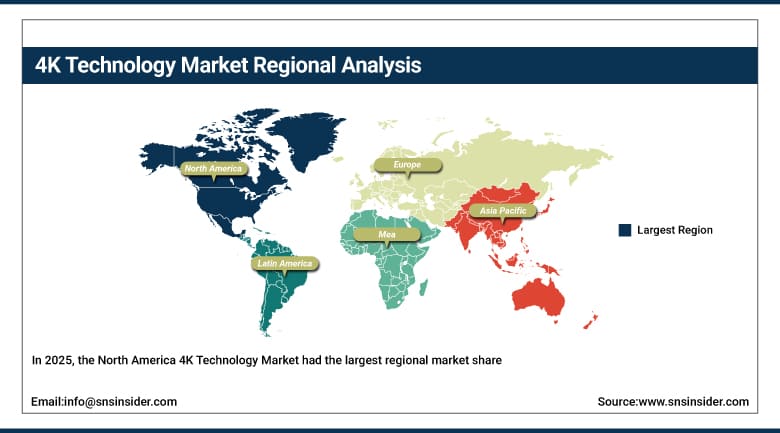
In 2025, the North America 4K Technology Market had the largest regional market share on account of the high spending ability of consumers in the region, the presence of premium electronics in retail, and the early adoption of 4K technology by the leading broadcasting and streaming companies in the region. The mature home entertainment environment and a large community of gamers in the region is also expected to ensure continued demand for 4K displays in homes and offices.
The United States of America had the highest country market share among the countries comprising the North America 4K Technology Market at 71.50%. This market share was achieved on the back of strong consumer electronics retail infrastructure in the region, adoption of the streaming platforms, and commercial deployment of 4K display screens in retail and business organizations. The Canadian market is contributing to regional growth through e-commerce electronics retail and the adoption of 4K technology in healthcare imaging.
Get Customized Report as Per Your Business Requirement - Enquiry Now
Europe 4K Technology Market Insights
The Europe region was a major contributor to the 4K Technology Market in 2025. This is attributed to strong consumer purchasing power, growing adoption of 4K broadcasting by major European sports leagues and public broadcasters, and rising commercial demand for high-resolution digital signage across retail and hospitality sectors.
Germany is one of the major markets in Europe owing to its strong consumer electronics retail sector, high household penetration of premium televisions, and growing commercial adoption of 4K displays in corporate and industrial applications. Other countries such as the United Kingdom, France, and Italy are also contributing to market growth through expanding streaming platform adoption and growing esports and gaming culture.
Asia Pacific 4K Technology Market Insights
The Asia Pacific 4K Technology Market is expected to witness the fastest growth rate during the forecast period 2026-2035. The market growth is driven by the region's massive electronics manufacturing base, rapidly rising disposable incomes, growing middle-class consumer electronics spending, and the presence of leading panel manufacturers that continue to lower production costs and expand global 4K panel supply.
China is one of the main growth drivers in the Asia Pacific 4K Technology Market, owing to its dominant position in global panel manufacturing, rapidly growing domestic consumer electronics market, and expanding 4K broadcast infrastructure. Japan, South Korea, and India are also contributing to market growth through advanced panel technology development, strong consumer electronics brand presence, and rapidly expanding middle-class electronics spending.
Middle East & Africa and Latin America 4K Technology Market Insights
The Middle East & Africa and Latin America are rapidly embracing 4K technology due to increasing disposable incomes, growth in the e-commerce electronics retailing business, and investments from the commercial industry such as hospitality and retail in high-resolution digital signage. Increased investment in regional sports broadcasting and increased streaming platform access are also contributing factors to adoption within these regions.
The coming up market in Latin America will be Brazil owing to rising consumer electronics expenditure among the middle class and growth in subscriptions for streaming platforms. In the Middle East & Africa region, UAE and Saudi Arabia have been investing in premium hospitality, retail, and smart-city digital signage which is becoming increasingly dependent on 4K technology.
Market Dynamics
Growth Drivers: Falling panel costs and expanding 4K content availability driving market growth
The falling cost of 4K panel manufacturing, rapid expansion of native 4K content across streaming platforms and broadcast networks, and rising consumer preference for immersive visual experiences are among the primary drivers of the 4K Technology Market. As 4K resolution becomes the baseline standard across consumer electronics, content creators and broadcasters continue to expand native 4K production, reinforcing the replacement cycle from Full HD to 4K-capable devices across global markets.
Technological advancements in Mini-LED, OLED, and AI-based upscaling technologies have significantly improved the visual performance and affordability of 4K displays across price tiers. Rising adoption of 4K-capable gaming consoles, growing esports and content creation communities, and expanding commercial deployment of 4K digital signage and retail displays are further supporting demand for 4K technology across residential and commercial applications alike.
Restraints: Content bandwidth requirements and premium pricing of top-tier panels limiting market expansion
One of the key issues that restricts growth in the market is the high amount of bandwidth and storage necessary for native 4K content distribution and storage, which can cause problems for internet infrastructure in developing countries due to lack of broad bandwidth access and increased costs for streaming services and broadcasting companies. Lack of consistent internet connections in some developing countries further restricts the usefulness of 4K-compatible products for some customers.
Moreover, premium panels based on OLED and MicroLED technologies are still quite expensive compared to traditional LED/LCD panels, which restricts wider adoption of top-level display technologies by average consumers. Also, competition from emerging 8K display technology poses some questions for technology roadmaps of panel producers who invest in next-generation facilities.
Opportunities: Expansion of gaming, healthcare imaging, and commercial signage applications creating new growth avenues
The rapid development of the 4K-compatible ecosystem of gaming and esports as well as the adoption of 4K image technology in health diagnostics and surgery visualization as well as increased use of commercial digital signage should offer significant market opportunities for the 4K Technology Market. Increasing demand for high-resolution displays in medical imaging and industrial visualizations is expected to drive the demand for the technology in the future as well.
The significant growth opportunity lies in emerging markets in Asia Pacific, Latin America, and the Middle East & Africa regions due to rapidly increasing disposable income and development of e-commerce electronics retail channels in those regions. Adoption of AI-driven technology that upgrades lower resolution content on 4K displays as well as decreasing costs of manufacturing premium panels will increase market opportunities in the forecast period.
Recent Developments:
-
2025: Samsung Electronics launched its Neo QLED 8K and 4K television lineup featuring the NQ4 AI Gen3 upscaling processor, delivering improved contrast and real-time content enhancement across its 2025 premium television range.
-
2025: LG Electronics introduced its G5 OLED evo television series with a four-stack RGB tandem panel design, improving peak brightness and color volume compared to its prior-generation 4K OLED lineup.
-
2026: Sony Corporation expanded its Bravia 9 Mini-LED television series to additional screen sizes, integrating its Cognitive Processor XR for enhanced 4K upscaling and gaming performance with reduced input lag.
-
2026: TCL Technology launched its X11H Mini-LED 4K television series in North America, featuring over 5,000 local dimming zones aimed at competing directly with premium OLED offerings at a lower price point.
4K Technology Companies are:
-
Samsung Electronics Co., Ltd.
-
Sony Corporation
-
Panasonic Corporation
-
TCL Technology Group Corporation
-
Hisense Group Co., Ltd.
-
Toshiba Corporation
-
Skyworth Group Co., Ltd.
-
TP Vision (Philips)
-
Vizio Holding Corp.
-
Konka Group Co., Ltd.
-
Sichuan Changhong Electric Co., Ltd.
-
AU Optronics Corp. (AUO)
-
BOE Technology Group Co., Ltd.
-
Innolux Corporation
-
Canon Inc.
-
JVC Kenwood Corporation
-
Blackmagic Design Pty. Ltd.
-
Seiko Epson Corporation
4K Technology Market Report Scope:
| Report Attributes | Details |
|---|---|
| Market Size in 2025 | USD 155.80 Billion |
| Market Size by 2035 | USD 852.50 Billion |
| CAGR | CAGR of 18.50% From 2026 to 2035 |
| Base Year | 2025 |
| Forecast Period | 2026-2035 |
| Historical Data | 2022-2024 |
| Report Scope & Coverage | Market Size, Segments Analysis, Competitive Landscape, Regional Analysis, DROC & SWOT Analysis, Forecast Outlook |
| Key Segments | • by Product (Smart TVs, Monitors & Displays, Projectors, Smartphones & Tablets, Digital Cameras & Camcorders) • by Panel Technology (LED/LCD, OLED, QLED/Mini-LED, MicroLED) • by Application (Home Entertainment, Media & Broadcasting, Gaming & Esports, Healthcare Imaging, Retail & Digital Signage) • by Distribution Channel (Online, Offline Retail) • End User (Residential, Commercial) |
| Regional Analysis/Coverage | North America (US, Canada, Mexico), Europe (Eastern Europe [Poland, Romania, Hungary, Turkey, Rest of Eastern Europe] Western Europe] Germany, France, UK, Italy, Spain, Netherlands, Switzerland, Austria, Rest of Western Europe]), Asia Pacific (China, India, Japan, South Korea, Vietnam, Singapore, Australia, Rest of Asia Pacific), Middle East & Africa (Middle East [UAE, Egypt, Saudi Arabia, Qatar, Rest of Middle East], Africa [Nigeria, South Africa, Rest of Africa], Latin America (Brazil, Argentina, Colombia, Rest of Latin America) |
| Company Profiles | Samsung Electronics Co., Ltd., LG Electronics Inc., Sony Corporation, Panasonic Corporation, TCL Technology Group Corporation, Hisense Group Co., Ltd., Sharp Corporation, Toshiba Corporation, Skyworth Group Co., Ltd., TP Vision (Philips), Vizio Holding Corp., Konka Group Co., Ltd., Sichuan Changhong Electric Co., Ltd., AU Optronics Corp. (AUO), BOE Technology Group Co., Ltd., Innolux Corporation, Canon Inc., JVC Kenwood Corporation, Blackmagic Design Pty. Ltd., Seiko Epson Corporation |
Frequently Asked Questions
The 4K Technology Market is expected to grow at a CAGR of 18.50% from 2026 to 2035.
The 4K Technology Market was valued at USD 155.80 Billion in 2025.
The market is driven by falling panel manufacturing costs, expanding availability of native 4K streaming and broadcast content, rising demand for 4K gaming displays, and growing commercial adoption of 4K digital signage.
The Smart TVs segment dominated the 4K Technology Market in 2025, accounting for approximately 48.60% market share.
The North America region dominated the 4K Technology Market in 2025, led by the United States' strong consumer electronics retail infrastructure and streaming platform adoption.
