
Display Technology Market Report Scope and Overview:
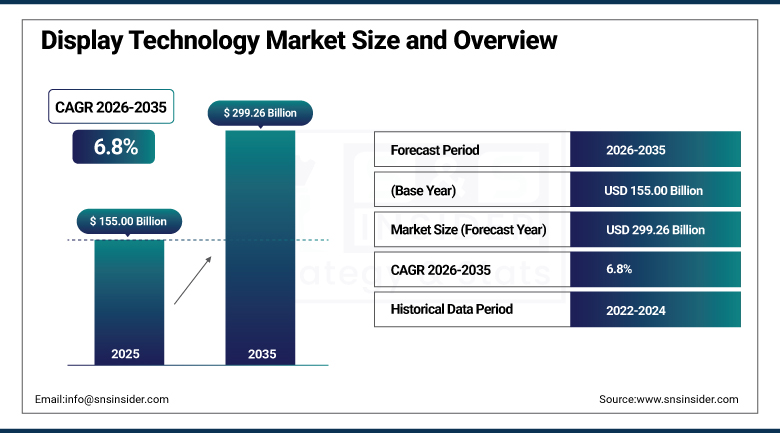
The Display Technology Market size was valued at USD 155.00 Billion in 2025 and is projected to reach USD 299.26 Billion by 2035, registering a CAGR of 6.8% from 2026 to 2035.
Display Technology Market is comprised of panel components, driver circuitry, and production techniques behind each screen present in smartphones, televisions, computer displays, car cockpits, and signages that include technologies from liquid crystal display structures that are well developed to the innovative micro LED and transparent screens. More than 2.5 billion display devices are being shipped globally annually, while the automotive industry has been rapidly adopting the latest display technologies such as digital dashboards, heads up displays, and rear seat entertainment systems, as manufacturers of electric vehicles seek differentiation by using large and curved OLED and mini-LED screens to differentiate themselves from other competitors in the cockpit experience. With more than 1.2 billion phones being shipped annually, consumer electronics industry plays an important role in defining the direction of display technology and mass adoption of each generation of display.
In August 2025, Lava released the Blaze AMOLED 2 smartphone that features 6.67 inches of Full HD Plus AMOLED display with 120 Hz refresh rate.
To Get more information On Display Technology Market - Request Free Sample Report
Display Technology Market Trends
-
Ultra-thin OLED panels approaching 0.6 millimeters continue reducing device weight and power draw considerably, with mass production of these thinner formats continuing to scale.
-
Yield-management advances, including hybrid organic-inorganic encapsulation, continue delivering meaningfully longer flex-cycle durability for foldable and flexible panel formats.
-
Automotive cockpit integration continues expanding, with digital dashboards, head-up displays, and rear-seat entertainment systems becoming standard rather than premium-only features.
-
Government incentive programs supporting mass-transfer laser breakthroughs continue accelerating micro-LED manufacturing scale-up across leading panel makers.
-
Quantum-dot display variants continue facing genuine rare-earth material price volatility, even as the broader technology gains ground in premium television and monitor segments.
US Display Technology Market Size Outlook
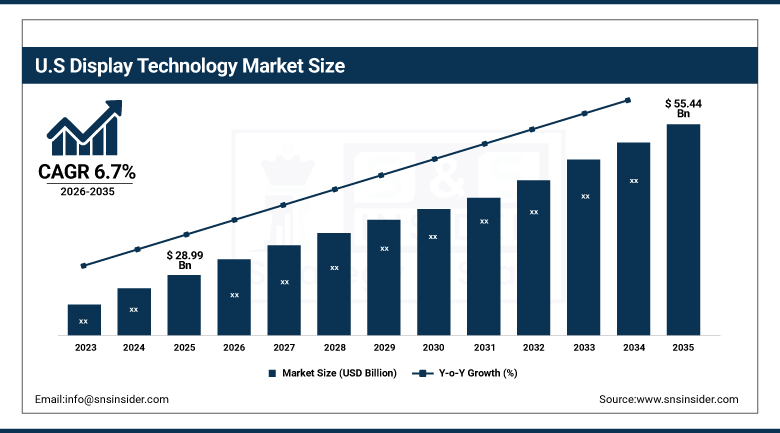
The US Display Technology Market was valued at approximately USD 28.99 Billion in 2025 and is projected to reach approximately USD 55.44 Billion by 2035, registering a CAGR of approximately 6.7% from 2026 to 2035.
Demand across the United States continued to be shaped by strong automotive cockpit display adoption, growing enterprise and consumer demand for high-resolution monitors and televisions, and a deep concentration of display technology research institutions and materials suppliers. Electric vehicle makers building domestic assembly capacity continued driving fresh demand for advanced cockpit display integration, while enterprise IT refresh cycles kept sustaining steady demand for high-resolution monitors across corporate and educational settings. Growing consumer appetite for premium home entertainment displays, alongside expanding retail and hospitality signage deployment, continued broadening the domestic addressable market well beyond the smartphone and television categories that first established the industry.
Universal Display Corporation continued expanding its OLED materials and technology licensing business throughout 2025, supplying phosphorescent OLED emitter materials to major panel manufacturers supporting the continued transition from LCD toward OLED across premium smartphone, television, and automotive display segments.
Display Technology Market Segment Analysis
-
By Display Type, Flat Panel Display led the market with an estimated 68.7% share in 2025, while Flexible and Transparent Panel formats were the fastest-growing display types.
-
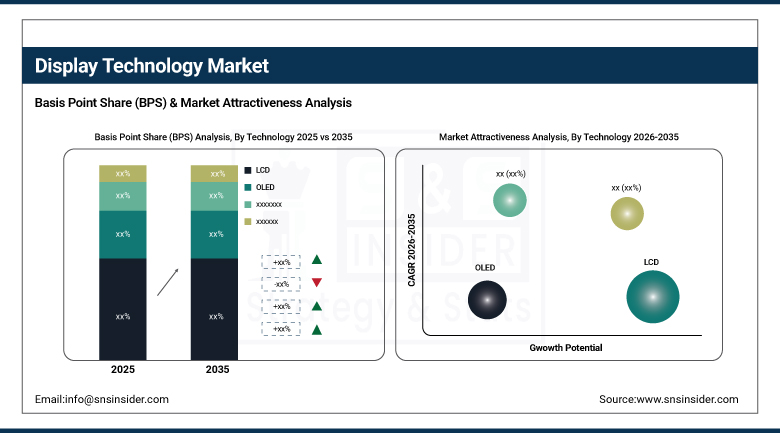
By Technology, LCD led the market with an estimated 49.5% share in 2025, while Micro-LED was the fastest-growing technology, tracking a projected 9.7% CAGR.
-
By Panel Size, Large Panels led the market with an estimated 44.1% share in 2025, while Small and Medium Panels were the fastest-growing panel-size category.
-
By Application, Consumer Electronics led the market with the largest share in 2025, while Automotive was the fastest-growing application, tracking a projected 14.3% CAGR.
By Display Type, Flat Panel Display led the market, Flexible and Transparent Panels grew fastest
The Flat Panel Display segment held the largest display-type share in 2025, at approximately 68.7%. Maturated television and monitor production lines, built on decades of manufacturing refinement and optimized yields, continued reinforcing this leadership position across the broadest range of consumer and commercial applications this market serves.
Flexible and Transparent Panel formats are projected to grow at the fastest CAGR during the forecast period. Rising demand for foldable smartphones, curved automotive cockpit displays, and next-generation retail and hospitality signage continues to drive this growth, as hybrid organic-inorganic encapsulation techniques now deliver flex-cycle durability that would have been commercially impractical only a few years earlier, unlocking genuinely new product categories that flat panels alone could never address.
By Technology, LCD led the market, Micro-LED grew fastest
The LCD segment held the largest technology share in 2025, at approximately 49.5%, owing to its advantages in cost-effectiveness compared to premium alternatives like OLED and micro-LED. This affordability makes it the preferred choice for mid-range televisions, computer monitors, and budget smartphones, where price sensitivity remains genuinely high, and the technology's decades of manufacturing maturity, optimized production processes, and vast global supply chain continued ensuring steady component availability.
The Micro-LED segment is projected to grow at the fastest CAGR during the forecast period. Superior brightness, longer lifespan, and meaningfully better energy efficiency compared to traditional technologies continue driving this growth, as micro-LEDs consume considerably less energy than OLEDs, an efficiency advantage that keeps appealing to both environmentally conscious buyers and manufacturers racing to differentiate premium product tiers with genuinely next-generation display performance.
By Panel Size, Large Panels led the market, Small and Medium Panels grew fastest
The Large Panels segment held the largest panel-size share in 2025, at approximately 44.1%, buoyed by television replacement cycles and expanding digital signage deployment across retail and commercial settings. That combination of consumer upgrade demand and commercial display expansion continued reinforcing this leadership position across the panel-size spectrum.
Small and Medium Panels are projected to grow at the fastest CAGR during the forecast period. Rising demand for wearables, foldable devices, automotive infotainment systems, and professional-grade compact monitors continues to drive this growth, as component miniaturization keeps expanding the practical use cases for smaller-format displays well beyond their traditional smartphone and tablet stronghold into automotive clusters and portable medical devices.
By Application, Consumer Electronics led the market, Automotive grew fastest
Consumer Electronics accounted for the largest application share in 2025, supported by the sheer scale of global smartphone, television, and computing device shipments that continue anchoring baseline display demand. That massive, recurring replacement-cycle volume across billions of devices annually continued keeping consumer electronics the market's largest single application category by a considerable margin.
The Automotive segment is projected to grow at the fastest CAGR during the forecast period. Rapid integration of digital dashboards, head-up displays, and rear-seat entertainment systems continues to drive this growth, as electric vehicle makers aiming to differentiate their cockpit experience increasingly adopt large, curved OLED and mini-LED panels, turning what used to be a single small instrument cluster into a genuinely expansive in-cabin display surface.
Regional Analysis
|
Region |
Major Country |
Share within Region, 2025 (%) |
|---|---|---|
|
Asia Pacific |
China |
36.85% |
|
North America |
United States |
80.75% |
|
Europe |
Germany |
24.15% |
|
Middle East and Africa |
UAE |
26.30% |
|
Latin America |
Brazil |
34.65% |
Asia Pacific Display Technology Market Insights
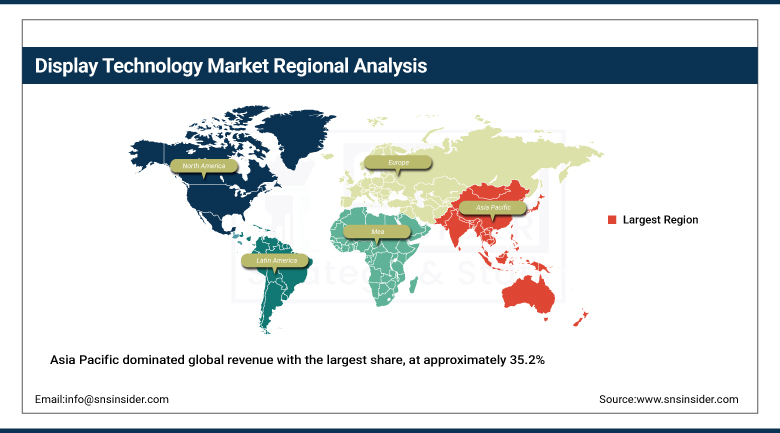
Asia Pacific dominated global revenue with the largest share, at approximately 35.2%, supported by a dense concentration of panel manufacturers spanning China, South Korea, Japan, and Taiwan alongside continued heavy capital investment in next-generation manufacturing capacity. Japan in particular continued showing rapid growth momentum within the broader region, reflecting the country's ongoing strength in materials science and precision manufacturing supporting the wider Asian display supply chain.
China led the pack, supported by its massive domestic panel manufacturing base and continued government-backed investment in advanced display technology development. South Korea and Japan contributed meaningful additional demand, with South Korea's leadership in OLED technology and Japan's precision materials expertise both reinforcing Asia Pacific's structural dominance in both production capacity and downstream innovation.
Get Customized Report as per Your Business Requirement - Enquiry Now
North America Display Technology Market Insights
North America held a substantial share of global revenue, supported by strong automotive cockpit display adoption, deep concentration of display research institutions, and robust enterprise and consumer demand for premium display technology. Growing electric vehicle production commitments from automakers building assembly capacity domestically continued reinforcing regional demand for advanced cockpit display integration specifically.
The United States accounted for roughly 80.75% of regional revenue, anchored by deep materials science research infrastructure and a concentration of leading display technology licensing and component suppliers headquartered domestically. Canada added further regional demand through its own growing automotive and technology sector participation, and that combined strength kept the continent a genuinely significant contributor to global display technology revenue.
Europe Display Technology Market Insights
Europe held a meaningful share of global revenue, with the region's automotive sector rapidly integrating advanced display technologies including digital dashboards and head-up displays across premium and mainstream vehicle segments alike. Specialized European display technology developers, including next-generation micro-LED and 3D display research ventures, continued extending the continent's stake in emerging display technology innovation.
Germany led demand at roughly 24.15% of European revenue, supported by its substantial automotive manufacturing base and deep concentration of premium vehicle cockpit display integration. The UK and France contributed substantial additional demand, and continued European investment in next-generation display research should keep regional demand climbing steadily through the forecast period.
MEA and Latin America Display Technology Market Insights
The Middle East and Africa and Latin America both showed steady growth, driven by expanding retail and hospitality signage deployment, growing consumer electronics penetration, and rising government focus on digital infrastructure modernization across both areas. As these markets continued building out modern commercial and residential display infrastructure, demand grew correspondingly from a considerably smaller base than in more mature display technology markets.
The UAE led Middle East and Africa demand, supported by substantial retail and hospitality signage investment tied to the region's tourism-driven economy. Saudi Arabia contributed further demand through its own commercial infrastructure development programs. In Latin America, Brazil accounted for the largest share of regional revenue, with growing consumer electronics penetration continuing to anchor demand for display technology across the region.
Growth Drivers: Automotive Cockpit Integration and Consumer Electronics Replacement Cycles
The automotive sector rapidly integrating advanced display technologies, including digital dashboards, head-up displays, and rear-seat entertainment systems, continues serving as a genuinely significant driver of this market. Electric vehicle makers aiming to stand out increasingly adopt large, curved OLED and mini-LED panels to differentiate their cockpit experience, and that competitive pressure among automakers keeps translating directly into fresh display technology demand well beyond the category's traditional automotive stronghold.
Sustained consumer electronics replacement cycles continue reinforcing this driver, with over 1.2 billion smartphones shipping annually and continued innovation in OLED, micro-LED, and 8K resolution technology keeping consumers upgrading devices at a steady pace. LCD production costs have decreased meaningfully over recent years, making display technology accessible for mass-market applications even as premium technologies keep pushing the upper end of the market toward genuinely differentiated visual performance.
Restraints: High Production Costs for Advanced Technologies and Intense Price Competition
High production costs of advanced display technologies, including micro-LED and flexible OLED formats, continue posing a genuine restraint on faster mainstream adoption, as specialized mass-transfer manufacturing processes remain considerably more expensive than mature LCD production. That cost premium keeps advanced technologies concentrated in premium product tiers rather than achieving the broad market penetration LCD has enjoyed for decades.
Intense competition leading to price wars continues pressuring margins across the industry, as panel manufacturers, particularly across an increasingly competitive Chinese supplier base, keep driving down average selling prices even as production costs for advanced formats remain elevated. That combination of margin pressure and high capital intensity continues challenging smaller manufacturers without the scale to compete effectively against the largest, most vertically integrated panel makers.
Opportunities: Automotive Display Expansion and Micro-LED Commercialization
Continued automotive display expansion represents a genuinely significant opportunity, as this application's fastest-growing status among all categories tracked in this market reflects automakers' genuine appetite for differentiated in-cabin experiences. Vendors offering genuinely durable, automotive-qualified display technology capable of surviving demanding temperature and vibration conditions stand to capture meaningful share of this rapidly expanding, high-value application category.
Accelerating micro-LED commercialization offers a second substantial opportunity, as government incentive programs and breakthroughs in mass-transfer laser technology continue lowering the manufacturing barriers that have historically kept micro-LED confined to ultra-premium applications. Vendors positioned early in scalable micro-LED production stand to capture meaningful share as the technology's superior brightness, lifespan, and energy efficiency continue winning over both premium consumer and commercial signage buyers.
Recent Developments:
-
2025: Samsung Display continued advancing its 4K micro-OLED technology for virtual reality applications, targeting the growing demand for ultra-high-density displays in next-generation headset platforms.
-
2025: LG Display continued scaling production of its 4,000-nit brightness display platform, targeting premium television and monitor customers seeking genuinely differentiated peak brightness performance.
-
2025: Aledia continued expanding its 3D gallium-nitride-on-silicon micro-LED production line in France, extending Europe's manufacturing stake in next-generation micro-LED display technology.
Display Technology Companies are:
-
Samsung Display Co., Ltd.
-
BOE Technology Group Co., Ltd.
-
AU Optronics Corp.
-
Japan Display Inc.
-
Sharp Corporation
-
Tianma Microelectronics Co., Ltd.
-
Visionox Technology Inc.
-
Royole Corporation
-
eMagin Corporation
-
Kopin Corporation
-
Universal Display Corporation
-
Jade Bird Display (Beijing) Limited
-
Aledia SAS
-
Q-Pixel, Inc.
-
China Star Optoelectronics Technology Co., Ltd.
-
HannStar Display Corporation
-
E Ink Holdings Inc.
-
Applied Materials, Inc.
Display Technology Market Report Scope:
| Report Attributes | Details |
|---|---|
| Market Size in 2025 | USD 155.00 Billion |
| Market Size by 2035 | USD 299.26 Billion |
| CAGR | CAGR of 6.8% From 2026 to 2035 |
| Base Year | 2025 |
| Forecast Period | 2026-2035 |
| Historical Data | 2022-2024 |
| Report Scope & Coverage | Market Size, Segments Analysis, Competitive Landscape, Regional Analysis, DROC & SWOT Analysis, Forecast Outlook |
| Key Segments | • by Display Type (Flat Panel Display, Flexible Panel, and Transparent Panel) • by Technology (LCD, OLED, Micro-LED, and Direct-View LED) • by Panel Size (Small and Medium Panels and Large Panels) • by Application (Smartphones, Televisions, PC Monitors and Laptops, Automotive, and Others) |
| Regional Analysis/Coverage | North America (US, Canada, Mexico), Europe (Eastern Europe [Poland, Romania, Hungary, Turkey, Rest of Eastern Europe] Western Europe] Germany, France, UK, Italy, Spain, Netherlands, Switzerland, Austria, Rest of Western Europe]), Asia Pacific (China, India, Japan, South Korea, Vietnam, Singapore, Australia, Rest of Asia Pacific), Middle East & Africa (Middle East [UAE, Egypt, Saudi Arabia, Qatar, Rest of Middle East], Africa [Nigeria, South Africa, Rest of Africa], Latin America (Brazil, Argentina, Colombia, Rest of Latin America) |
| Company Profiles | Samsung Display Co., Ltd., LG Display Co., Ltd., BOE Technology Group Co., Ltd., AU Optronics Corp., Japan Display Inc., Sharp Corporation, Innolux Corporation, Tianma Microelectronics Co., Ltd., Visionox Technology Inc., Royole Corporation, eMagin Corporation, Kopin Corporation, Universal Display Corporation, Jade Bird Display (Beijing) Limited, Aledia SAS, Q-Pixel, Inc., China Star Optoelectronics Technology Co., Ltd., HannStar Display Corporation, E Ink Holdings Inc., Applied Materials, Inc. |

Frequently Asked Questions
The Display Technology Market is expected to grow at a CAGR of approximately 6.8% from 2026 to 2035, based on triangulated secondary research estimates.
The Display Technology Market was valued at approximately USD 155.00 Billion in 2025, based on triangulation across multiple independent research sources.
The major growth factor is rapid automotive cockpit display integration combined with sustained consumer electronics replacement cycles across smartphones, televisions, and computing devices.
The LCD segment dominated the Display Technology Market by technology, representing an estimated 49.5% of revenue in 2025.
Asia Pacific dominated the Display Technology Market in 2025, holding an estimated 35.2% share of total global market revenue.
